Cardiocondyla
Cardiocondyla mauritanica
Nuptial Flight Calendar
Flight months: May, Jun, Jul, Aug, Sep
Care Guide
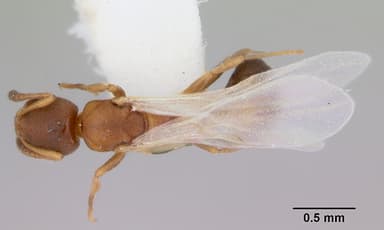
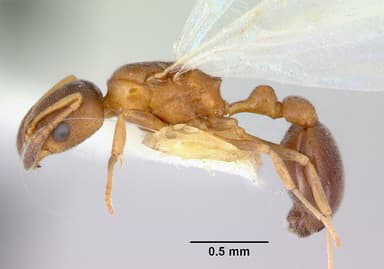
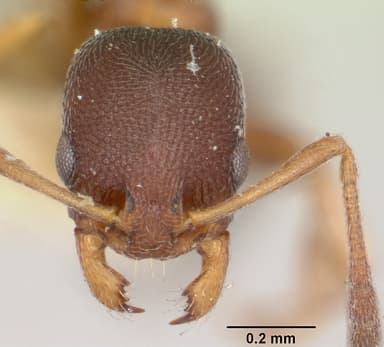
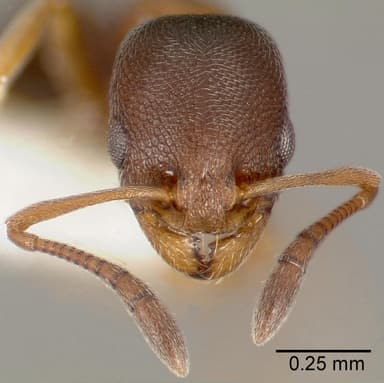
Cardiocondyla mauritanica is a minute yet endlessly intriguing ant that punches far above its weight in terms of biological curiosity. The queens measure a modest 2.5 to 3 millimeters, while the monomorphic workers range from 2 to 2.5 millimeters—both cloaked in a pale yellow-brown to dark brown hue, often with a darker gaster. Colonies are small by ant standards, peaking at around 3,000 individuals, but what they lack in numerical heft they compensate for with a remarkable reproductive strategy. Unlike most ants, this species dispenses entirely with the familiar aerial nuptial flight. Instead, colonies produce a bizarre caste of wingless, worker-like “ergatoid” males, which never leave the nest. These males engage in ferocious, often lethal combat with one another using sickle-shaped mandibles to monopolise mating rights over virgin queens, all within the dark confines of the natal tunnel network (Heinze et al. 2006). Mated queens then disperse on foot with a retinue of workers to establish new nests by budding, resulting in colonies that frequently house multiple fertile queens. This inbreeding, intra-nest conflict, and budding dispersal are part of a life-history package that has allowed C. mauritanica to become a successful tramp species, now recorded across Mediterranean and North African regions and far beyond, from the Americas to Asia (Seifert 2003). For the ant keeper, these behaviours turn a modest colony into a living laboratory of social evolution.
The care difficulty for C. mauritanica is best described as intermediate, making it a compelling project for a hobbyist who has already mastered a few easier species and is ready to manage the quirks of a micro-ant. The primary challenge lies not in sensitive environmental requirements but in the ants’ diminutive stature and an impressive ability to exploit the tiniest escape routes. A colony can vanish overnight through a gap you swore was too small. Therefore, this species suits keepers who are meticulous about enclosure security and comfortable working with very small inhabitants. The reward for that diligence is a front-row seat to the ergatoid male battles and the constant, low-level activity of foragers that are only somewhat shy and often visible in the outworld. Because they are not explosive growers and remain a manageable size, they are also a sensible choice for those with limited space, provided you have a taste for the bizarre.
Housing must be tailored to their thermal preferences and their need for a relatively dry nest environment. A temperature range of 22 to 30°C is ideal, with the warmer end promoting faster brood development; many keepers achieve this with a small heat mat placed against one side of the nest to create a gentle gradient. Humidity should be maintained between 40% and 60%, placing this ant firmly in the “dry-loving” category. The nest itself should offer a moisture source—a small plaster, ytong, or sand-clay module is excellent, as it can be lightly moistened on one side while leaving the rest dry. The outworld can be furnished with a fine layer of sand or a sandy-loam substrate, which not only mimics their natural habitat but also provides a surface they can navigate with sure-footedness. Escape prevention is paramount: use a tight-fitting lid with ultrafine mesh or a well-applied PTFE barrier, and keep all ventilation holes minuscule. These ants are accomplished climbers, so vertical glass surfaces are no obstacle. A small founding formicarium or test-tube nest with a connected foraging area is all that’s needed for years; they do not demand expansive real estate.
Feeding these tiny ants is straightforward but requires appropriately scaled offerings. Protein should come from the smallest of prey: Drosophila fruit flies (both flightless and wild-type), pinhead crickets, chopped mealworm segments, or fresh springtail cultures. Because a colony has limited ability to process large items, pre-cutting food into minuscule pieces is beneficial and reduces waste. Carbohydrates can be supplied as a thin streak of sugar water, a droplet of diluted honey, or a purpose-made ant nectar placed on a small piece of waxed paper or foil to simplify cleanup. Fresh water is essential and can be provided via a test tube with a cotton plug or a tiny water tower; these ants drink readily, and a dry colony will quickly perish. Prompt removal of any uneaten food is vital, as the warm, moderately humid nest can otherwise encourage mould that overwhelms a small brood chamber.
Hibernation is not required for C. mauritanica. In their native range and introduced habitats, they experience mild winters at most, and they have no physiological need for a cold diapause. Maintaining a steady temperature within the 22–30°C band year-round will keep the colony active and brood production continuous. If ambient temperatures drop during the cooler months, the ants may slow their foraging and retreat to the warmest part of the nest, but they should not be deliberately chilled. An uninterrupted warm season is all they need to thrive.
When your new colony arrives, it will most likely be a small budding nucleus comprising one or several queens and a handful of workers. The initial hours after unpacking are critical: place the transport tube directly into the prepared outworld, open it, and allow the ants to explore at their own pace while the setup remains dark and undisturbed. Offer a minute drop of sugar water near the tube entrance to replenish their energy. After twenty-four hours of settling, introduce a tiny amount of protein—a single freshly killed fruit fly or a sliver of mealworm is plenty. Over the first week, watch for the construction of small refuse piles or the workers moving brood to a preferred humidity zone, both signs that they are accepting the nest. Avoid the temptation to check on them frequently during this delicate establishment phase. Once you observe steady foraging a few days in, you can gradually increase feeding to meet the demands of a growing brood, but always feed in quantities that can be consumed within a day. With patience and stable conditions, your colony will soon begin to exhibit the cycles of ergatoid male emergence and budding that make this species a perennial favourite among those who study ant social behaviour.