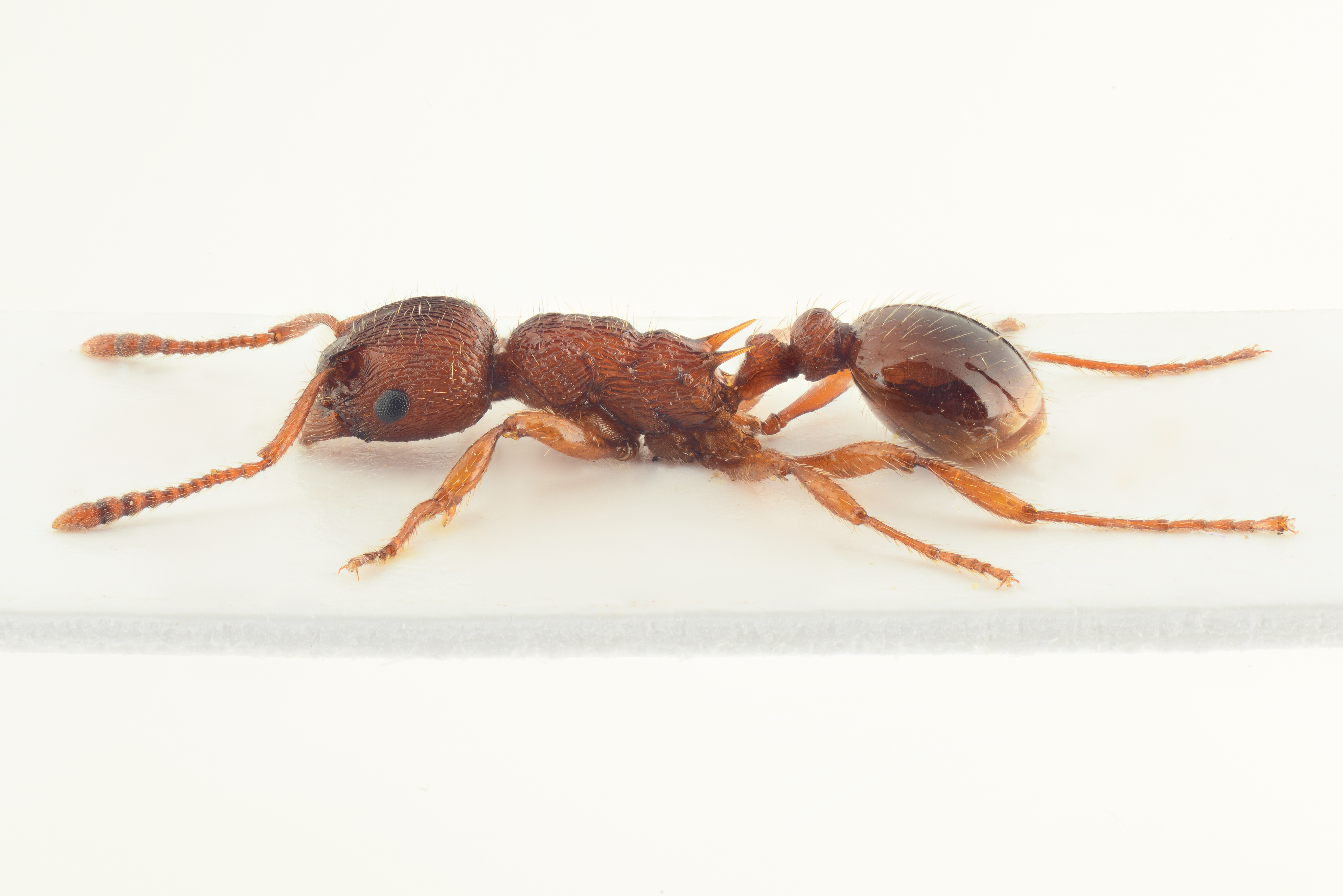
Myrmica
Myrmica gallienii
Nuptial Flight Calendar
Care Guide
Myrmica gallienii is a charming, medium-sized ant species that offers an engaging challenge for keepers who have moved beyond the very basics. Unlike the massive, polymorphic seed-eaters, this species forms colonies of 500 to 3,000 workers with a more uniform worker size of 4 to 5.5 mm, while the queen reaches a modest 5.5 to 7 mm. One of the most distinctive traits of Myrmica is their ability to deliver a sharp sting, which they use readily when disturbed – a fascinating but important consideration when handling or maintaining their setup. These are semi-claustral founders, meaning the queen must leave the nest regularly to hunt and feed during the founding stage, relying entirely on external protein sources rather than her own metabolic reserves.
The diet of Myrmica gallienii is straightforward but demands consistency. They are active hunters and scavengers, and their menu should include a regular supply of small insects such as fruit flies, crickets, or mealworms, alongside sugar water or honey water for carbohydrates. Protein is especially critical for brood development, and a colony will quickly decline if left without insect prey. Unlike granivorous species, there is no need for seed storage; instead, the ants will process and share their insect prey directly within the nest.
Care difficulty
Keeping Myrmica gallienii is rated as intermediate, largely because of their semi-claustral founding and hibernation requirements. Beginners often struggle with the queen’s need for food during colony establishment, and the species’ sensitivity to dry conditions can be a challenge. However, with proper attention to humidity and a quiet environment, they reward their keeper with lively foraging and rapid growth.
Housing
A formicarium with a well-hydrated nest area is essential. Maintain humidity between 60 and 80 percent, as the larvae are particularly vulnerable to desiccation. The temperature range of 18 to 24°C suits them well, though slightly warmer areas can boost brood development. Myrmica gallienii appreciates a connection to an open foraging arena where they can hunt and find water. They are not as vibration-sensitive as some species, but sudden disturbances or strong light should be avoided to prevent stress. A key point: these ants will hibernate. As autumn approaches, gradually reduce temperature and food, then provide a cool, dark period at around 5°C for two to three months. Without this dormancy, the colony may fail to thrive in the following season.
First days after purchase
Upon receiving your colony, transfer the ants into their new formicarium with minimal fuss. Place the setup in a quiet, dimly lit location and allow them at least 48 hours to settle. During this time, keep disturbances to a minimum and ensure a constant supply of sugar water and small insects. Observe the queen’s activity – if she is semi-claustral, she will need to hunt, so provide live prey in the foraging area. Avoid handling the ants or opening the nest needlessly, as stressed queens may eat their eggs. With patience, you will soon see the first workers hardening, and your Myrmica gallienii colony will begin its steady, rewarding journey.