Myrmecia
Myrmecia piliventris
Nuptial Flight Calendar
Care Guide
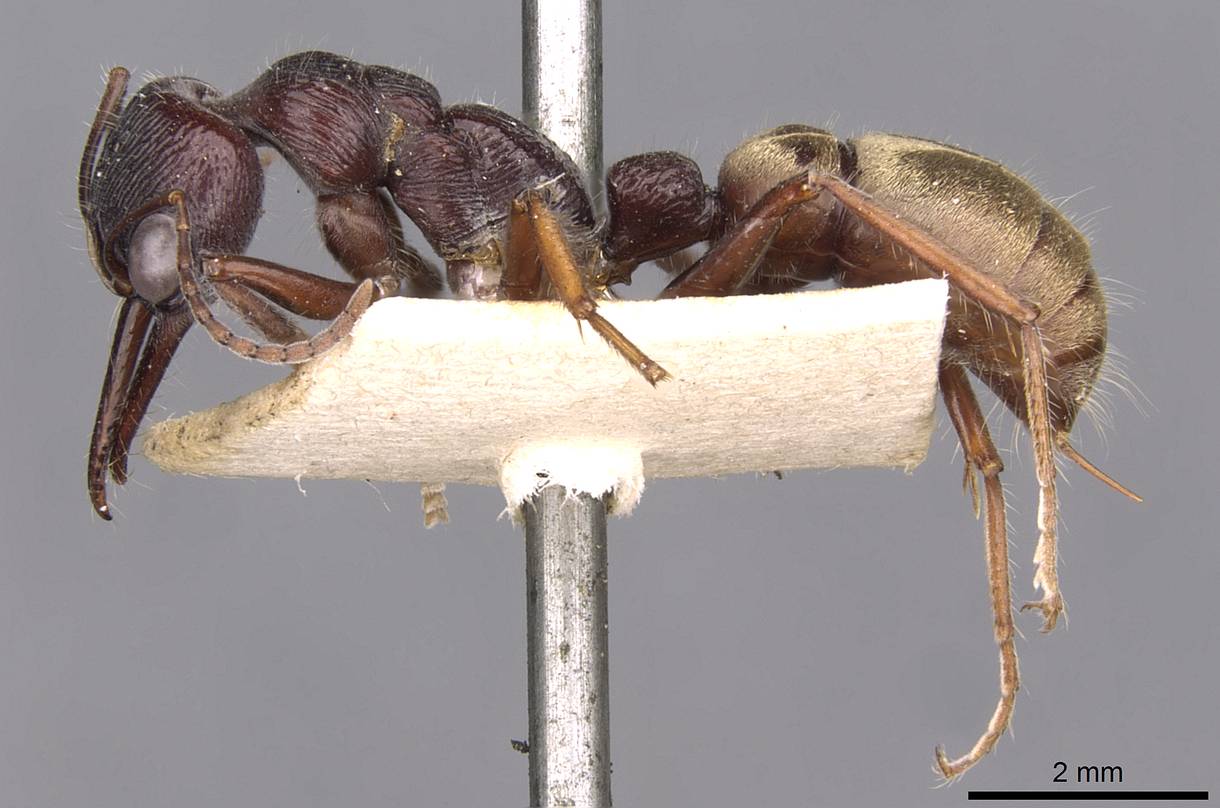
Myrmecia piliventris, commonly known as the green-headed bull ant, is a striking and charismatic species native to Australia. These ants are renowned for their large size, powerful mandibles, and painful sting, making them one of the most thrilling species for experienced keepers. The queen, measuring 18 to 22 mm, is a formidable insect, while the workers range from 12 to 18 mm. Unlike the polymorphic seed harvesters, Myrmecia piliventris is monomorphic — all workers are similar in size, but each one is an agile, visually guided predator with enormous compound eyes. They are among the most primitive living ants, retaining many ancestral traits such as solitary hunting and the ability to leap.
One of the most unique aspects of this species is their semi-claustral founding strategy. The queen must leave the nest regularly to forage for food during the early stages of colony establishment. This means that unlike fully claustral species, she cannot be sealed away and left alone; she requires a steady supply of live insects and sugar water. This behavior continues even after the first workers emerge, making the founding period particularly demanding. The colony grows slowly but steadily, eventually reaching up to 1,500 workers. Their diet is almost exclusively insectivorous — crickets, flies, mealworms, and roaches are eagerly hunted. Protein is essential, but they also accept sugar water as an energy supplement for adults.
Care difficulty
Keeping Myrmecia piliventris is rated as advanced. Their strong venom, speed, and tendency to jump when disturbed demand constant caution. Escape-proofing the setup is critical — a single gap and these ants will exploit it. They are also highly sensitive to vibrations and disturbances, especially during the founding phase. The keeper must be patient and observant, as any stress can cause the queen to abandon brood or even cannibalize eggs. Their semi-claustral nature means the keeper must actively feed the colony from day one, which adds a layer of complexity not found in fully claustral species.
Housing
A secure formicarium with a connected outworld is essential. The nest should offer chambers with moderate humidity (50–70%) and a temperature gradient between 20 and 26°C. Myrmecia piliventris does not tolerate excessive moisture — good ventilation is key. Because they are visual hunters, the outworld should be well-lit but the nest kept dark. Provide a deep substrate of sand or soil for digging, as they prefer naturalistic burrows. Hibernation is mandatory for healthy colony development; during winter, lower the temperature to a steady 14°C for several months, with reduced but not absent food.
First days after purchase
Upon receiving your Myrmecia piliventris colony, transfer them into the prepared setup immediately, but do so with extreme care. Place the formicarium in a quiet, vibration-free room. In the first few days, offer small, pre-killed insects directly near the entrance and a drop of sugar water. Minimize disturbance — do not shine bright lights or tap the glass. Observe from a distance. The queen will need to forage, so ensure the outworld is accessible but escape-proof. Allow her to acclimate at her own pace; patience now will reward you with a thriving colony later.