Eciton
Eciton hamatum
Nuptial Flight Calendar
Flight months: Jan, Feb, Mar, Apr, Dec
Care Guide
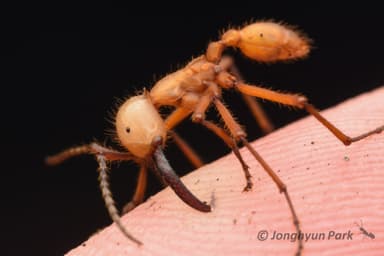
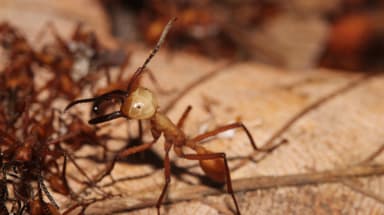
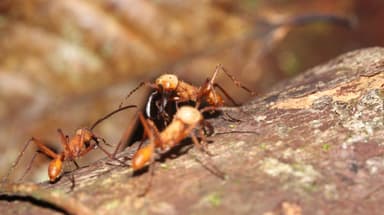
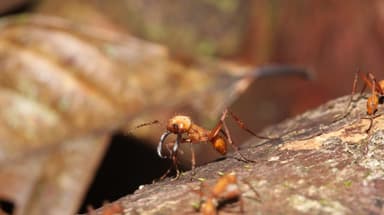
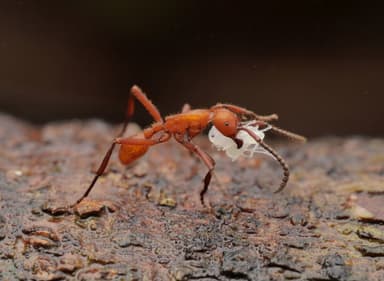
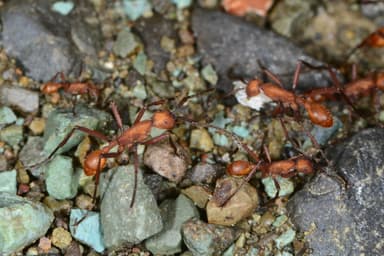
Among the most dramatic and behaviourally complex ants in the Neotropics, Eciton hamatum is a true army ant, famed for its colossal nomadic colonies, relentless swarm raids, and extraordinary reproductive strategy. A mature colony can number up to a quarter of a million individuals, with a single enormous dichthadiiform queen measuring 20 to 25 mm, surrounded by a highly polymorphic worker force that spans a striking size range of 4 to 13 mm. Workers are divided into at least three distinct physical castes — minors, medias, and majors (or soldiers), the latter bearing long, hook-shaped mandibles adapted for defence and prey transport. Their entire life revolves around the cyclical alternation between a statary phase, during which the queen lays a massive batch of eggs and larvae develop, and a nomadic phase, during which the colony bivouacs in a new location every night and the wingless queen moves with the swarm. This spectacle of coordinated movement, pheromone-organised raiding columns, and the myriads of associated arthropod guests that live within the bivouac has inspired classic studies by Schneirla (1971) and Rettenmeyer (1963), and it continues to fascinate myrmecologists today.
Unsurprisingly, Eciton hamatum is assigned the highest care difficulty rating — expert only. This ant is completely unsuited to beginners or even intermediate keepers, and should be contemplated solely by highly experienced enthusiasts with dedicated facilities and a deep understanding of army ant biology. The fundamental challenge lies in their obligate nomadic lifestyle: a colony cannot be confined to a conventional formicarium. In nature, they form living bivouac clusters of their own bodies, clinging to a log or root mass while the queen and brood are protected within. In captivity, replicating this requires a specially designed system of multiple connected, easily interchangeable nest chambers that must be moved daily during the nomadic phase to simulate the relocation urge, while also providing secure, escape-proof foraging arenas of considerable size. The colony will consume vast quantities of live arthropod prey and produce enormous amounts of waste, demanding elaborate cleaning protocols. Furthermore, workers are extremely aggressive and have a powerful sting; escape of even a small portion of the colony can be a serious hazard. One must also factor in that these ants reproduce by colony fission — budding — with the wingless queen and a portion of the workforce splitting off, a process that is nearly impossible to support in artificial settings. As Kronauer (2009) notes, army ant colonies are fundamentally nomadic predator communities that defy standard ant-keeping paradigms.
Housing Eciton hamatum requires a departure from typical stocked formicariums. The best approach mimics a laboratory setup used by researchers: a temperature- and humidity-controlled room or large cabinet maintained at 22–30 °C and 70–95% relative humidity, with a deep, slightly moist substrate such as coconut coir or a bark-and-soil mix that facilitates bivouac formation. Daily provision of a new darkened nest box — a large plastic tub with a rough interior surface and a single entrance — encourages the colony to move each night. These boxes must be connected to a spacious foraging arena via tubing that allows the ants to form their signature raiding columns. The arena floor should be lined with removable paper or a thin substrate layer for easy cleaning. Secure ventilation is critical, as these ants readily climb smooth surfaces and can squeeze through minuscule gaps; the entire system must be sealed with a fine mesh and PTFE-based liquid barriers. Continuous air movement and exactly regulated moisture are non-negotiable, as workers desiccate quickly when humidity drops below 70%. Monitoring with digital sensors inside both nest and arena is essential.
The diet of Eciton hamatum is almost exclusively proteinaceous, consisting of live insect prey and other arthropods. In the wild, their swarms flush out and overwhelm a huge variety of invertebrates; Rettenmeyer (1963) documented columns retrieving grasshoppers, roaches, spiders, scorpions, and other soft-bodied arthropods. In captivity, a steady supply of crickets, locusts, mealworms, and roaches — ideally gut-loaded and free of pesticides — must be offered daily, with quantities reaching hundreds of individuals for a large colony. Carbohydrate sources are taken only minimally and opportunistically; a shallow dish of sugar water or diluted honey may be accepted by workers, but it should never be the staple. Fresh water must be available at all times, either via a wick system or moist sections of substrate, as these ants maintain a high metabolic rate and risk dehydration rapidly. Feeding is best done in the evening, when foraging activity naturally peaks, and leftover prey should be removed within hours to prevent mould and mite infestations.
*Eciton hamatum* does not undergo hibernation; the colony remains active year-round. There is no cool-down period required, and temperatures must stay within the tropical range perpetually. Any drop below 22 °C for more than a few hours can be fatal to brood and slow the queen’s egg-laying dramatically. Keepers must maintain constant conditions with no seasonal shift, which has significant implications for energy usage and equipment reliability. The ants’ native range, as suggested by GBIF occurrence data, extends from roughly 23.5°N to 25°S across the Neotropics, where temperatures are consistently warm and humid.
Obtaining a colony of Eciton hamatum is exceptionally rare and fraught with ethical and practical concerns. They are almost never sold through commercial channels; any specimen would likely come from a research institution or a specialised import. The first days after acquiring them are a critical blur of immediate action, not a settling-in period. The colony will probably arrive in a transport container that must be attached at once to a pre-heated, pre-humidified nest box and foraging arena. Workers will stream out, seeking a bivouac site; if the new nest box meets their requirements, they will move the queen and brood into it within hours. Offer a large number of live prey immediately, as the colony is likely starved from transport. Watch for signs of stress: workers carrying brood in circles, reluctance to bivouac, or the queen laying unfertilised eggs. It is vital to have the full system running flawlessly from moment one, because any disruption — low humidity, a gap in the escape barrier — can trigger a catastrophic chain reaction. This species punishes any lapse, and even with meticulous care, long-term survival beyond a few nomadic cycles remains an unresolved husbandry challenge, cementing Eciton hamatum as a holy grail for only the most advanced and well-resourced ant keepers.