Crematogaster
Crematogaster mimosae
Nuptial Flight Calendar
Flight months: Mar, Apr, May, Nov
Care Guide
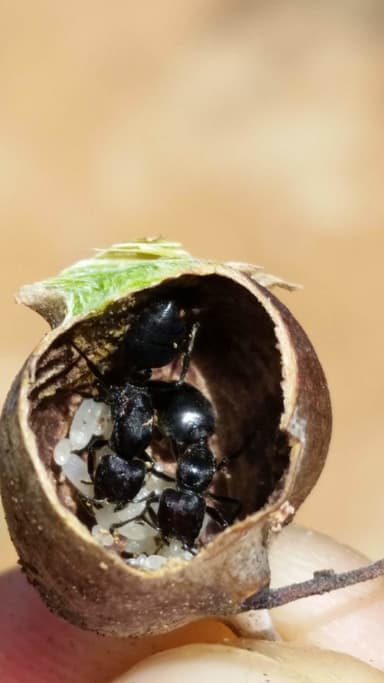
The acacia‑ant Crematogaster mimosae is one of the most charismatic and rewarding species for a seasoned myrmecophile, instantly recognizable by its alert, heart‑shaped gaster that workers can cock over their bodies like a tiny scorpion’s sting. Queens measure a robust 8 to 10 mm, while the colony presents a continuous polymorphism between diminutive 2.5 mm minors and broad‑headed 5 mm majors, a two‑caste system that allows for exceptional division of labor. Mature colonies in the wild can swell to 100,000 individuals, fully occupying the swollen‑thorn acacias (Vachellia spp.) of the East African savannah. In this iconic mutualism, meticulously documented by Palmer and colleagues in Laikipia, Kenya (Palmer et al. 2000–2010; Young et al. 1997), the ants nest inside the hollow thorns, feed on carbohydrate‑rich extrafloral nectar and lipid‑rich Beltian bodies, and in return aggressively defend their host tree from herbivores and even competing vegetation (Stanton & Palmer 2011). Keeping C. mimosae is therefore an invitation to observe one of evolution’s most dramatic partnerships on your own shelves.
This is unequivocally an expert‑level species, and it belongs only in the hands of keepers with a proven track record of managing large, fast‑growing tropical ants. The challenges are legion: the colony must be confined within an absolute prison, as the same slim, flexible workers that squeeze into acacia domatia are masterful escape artists capable of exploiting the thread‑thin gap beneath a poorly seated lid. Their natural aggression, while fascinating, means they will pour out at the slightest disturbance and can deliver a sharp bite while daubing defensive secretions. Furthermore, a mature colony requires substantial space and a voracious, constant supply of food, making it a serious long‑term commitment. Novices should never consider this ant as a first or even third project; even experienced keepers must be prepared for a steep learning curve and the logistical demands of a fully grown supercolony.
To house C. mimosae successfully, you must engineer a stable patch of their tropical lowland habitat. Maintain a temperature gradient from 22 °C at the coolest edge to a warm 32 °C near a basking zone, and keep relative humidity between 50% and 75% – too dry and the brood desiccates, too wet and you invite fatal fungal blooms. A large arboreal‑style terrarium with plenty of vertical space works best, containing a plaster or ytong nest block with multiple chambers and a deep foraging area. Scatter branches, bark, and dried leaf litter to allow the ants to exercise their innate carton‑building behavior; they will pulp wood fibers into paste to expand tunnels and seal gaps, a trait that can turn a sterile plastic setup into a living, organic sculpture. The setup must be sealed with a tight‑fitting, weighted lid and a generous PTFE barrier around the rim. Given their natural tendency toward polydomy – spreading across multiple thorn domatia on a single tree – the colony may readily expand into satellite nests if you provide them, which can simplify management of a booming population.
Diet in captivity mirrors the two‑fold fare supplied by the acacia: carbohydrates and protein. Offer a permanent liquid sugar source, such as diluted honey, maple syrup, or artificial nectar, in a small feeder that cannot drown the ants; they will station guards around it and drink greedily. For protein, supply freshly killed or thawed small insects – fruit flies, pinhead crickets, diced mealworms, or minced dubia roaches – cut to a size the minor workers can easily carry. Major workers, with their heavier mandibles, can tackle larger prey items, but it is safest to offer bite‑sized portions that are quickly processed. A test tube waterer or a cotton‑plugged dish of fresh water is indispensable, as the warm nest accelerates dehydration. Remove all uneaten protein after 24 hours to prevent mold, and be prepared to scale up feeding drastically as the colony grows; a mature nest of 50,000 ants will consume an astonishing amount.
This equatorial species does not hibernate, nor does it require any winter cooling period. Keep ambient temperatures steady year‑round, never allowing the core nest to drop below 22 °C for long. When you first receive a queen or small founding colony, place the test tube or small container directly into the prepared setup and leave them completely undisturbed for 24 to 48 hours. A claustral queen needs no food until her first nanitic workers emerge; if you have a queen with a few workers, offer a microscopic dab of sugar water and a pre‑killed fruit fly after two days, placing the offering just outside their nest entrance before retreating. Watch for frantic, repetitive pacing or workers desperately gnawing at the ventilation mesh – these are signs of humidity stress or an insecure nesting site. Open the enclosure only in a safe, contained space and with extreme caution, as these ants erupt into motion and can ascend smooth surfaces with startling speed. With patient, minimal interference in those critical early weeks, you will soon see the first foraging trails being laid and the colony’s rhythm take hold, setting the stage for a spectacular, lifelong display of mutualistic ambition.