Gnamptogenys
Gnamptogenys menadensis
Care Guide
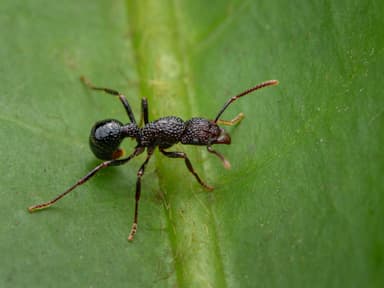
Gnamptogenys menadensis is a striking and somewhat uncommon species in the ant keeping hobby, known for its elegant, slender build and active, predatory nature. The queen measures between 6 and 7 mm, while workers range from 4 to 5.5 mm. Unlike many common species, this ant does not exhibit clear polymorphism — workers are all roughly the same size, but what they lack in size variation they make up for in agility and hunting skill. Their body is dark, with a subtle metallic sheen, and they move with a purposeful, almost deliberate pace that makes them fascinating to observe.
One of the most distinctive features of Gnamptogenys menadensis is their semi-claustral founding strategy. The queen must forage for food during the early stages of colony establishment, meaning she cannot seal herself off in a dark chamber and rely solely on her fat reserves. Instead, she requires a steady supply of insects and sugar water from the very beginning. This makes the founding phase more hands-on than with fully claustral species. Once the colony grows, it remains relatively small by ant standards — between 50 and 300 workers — which is perfect for keepers who prefer a manageable colony size without overwhelming space requirements.
Care difficulty
Keeping Gnamptogenys menadensis is rated as intermediate. The main challenge lies in the semi-claustral founding and the need for high humidity levels. These ants are sensitive to dry conditions and require a consistently humid environment, with humidity levels ranging from 70 to 90 percent. Temperature should be maintained between 24 and 28°C year-round, as these ants do not undergo hibernation. Their diet consists primarily of protein-rich insects, such as fruit flies, crickets, or roaches, supplemented with sugar water. They are enthusiastic hunters and will chase down live prey, making feeding time an engaging spectacle.
Housing
A formicarium for Gnamptogenys menadensis should prioritize moisture retention. A nest with a substrate that can hold humidity — such as clay, sand-soil mixes, or acrylic chambers with a water-absorbent material — works well. The outworld should provide a foraging area where live prey can be offered. Because the colony stays below 300 workers, a medium-sized formicarium is sufficient for the colony’s lifetime. Ensure a reliable water source is always available, either through a test tube or a hydration system, as these ants are prone to desiccation. They are not particularly sensitive to light or vibrations once established, but during the founding stage, a quiet, dark spot is important to reduce stress on the queen.
First days after purchase
Upon receiving your colony, transfer the ants into a pre-humidified nest and place it in a calm, dimly lit area. For a semi-claustral queen, provide small pieces of insect (like a crushed fruit fly or a tiny cricket leg) and a drop of sugar water near the entrance. Do not disturb her for the first few days; instead, observe from a distance to confirm she is feeding. If the colony already has workers, they will quickly take over foraging duties. Avoid opening the nest unnecessarily — maintain humidity by moistening the substrate as needed. With patience and consistent care, you will soon see the colony grow steadily, revealing the unique hunting behavior that makes this species a true gem for intermediate keepers.