Liometopum
Liometopum luctuosum
Nuptial Flight Calendar
Flight months: Mar, Jun, Jul, Aug
Care Guide
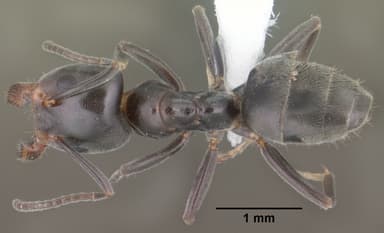
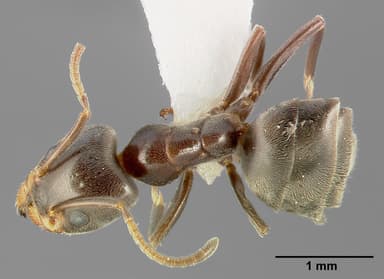
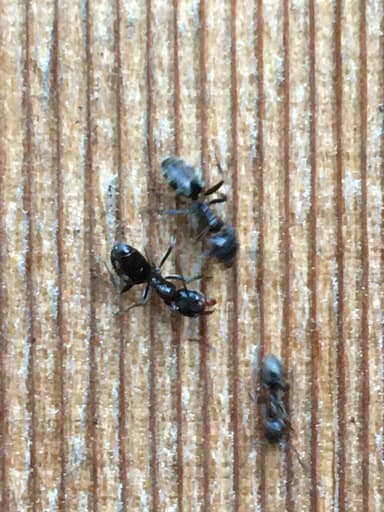
A member of the velvet ant subfamily Dolichoderinae, Liometopum luctuosum is a robust and highly active species native to the western Nearctic, ranging from the mountains of southern British Columbia down to Mexico’s Sierra Madre. Workers are a uniform dark brown to black, covered in a fine silver pubescence that lends them a velvety sheen under a lens; they are monomorphic, measuring a modest 3 to 5 mm, while the single queen reaches 8 to 10 mm. Colonies are both populous and long‑lived, often exceeding 100,000 individuals in the wild (Mackay & Mackay 2002). What makes this ant particularly captivating is its lifestyle: a true carpenter that nests primarily in the dead wood of pines and oaks, L. luctuosum forms immense foraging trails to exploit honeydew‑producing Hemiptera, and the colony emits a characteristic acrid, coconut‑like odour when disturbed. This combination of large colony size, wood‑nesting habits, and quick, assertive workers makes it a dramatic centrepiece for an intermediate‑level ant keeper, providing a window into the ecology of one of the continent’s most charismatic woodland ants.
With a care difficulty rated intermediate, Liometopum luctuosum is best suited to a hobbyist who has successfully overwintered a temperate species and is comfortable managing an escape‑prone, fast‑growing colony. Beginners may find their demands frustrating: a queen founding alone in claustral secrecy, a growing need for a secure formicarium, and an absolute requirement for a true hibernation period. That said, for the keeper ready to invest in a well‑sealed setup and a dedicated cooling strategy, the species rewards with year‑round activity and a tremendous appetite for both insect protein and sugary liquids. Observing a mature colony deploy thousands of workers along foraging lanes to a drop of honey is nothing short of mesmerising.
Housing for L. luctuosum must simultaneously provide a humid nest chamber, a dry foraging arena, and impeccable escapology. In the wild, nests are excavated in rotting logs and stumps high in the canopy (Del Toro et al. 2009), so a vertical wood‑nest setup or a plaster/y tong‑stone formicarium with a generous digging medium such as a sandy‑loam mix works beautifully. The nest portion should be kept relatively humid, but the species tolerates a wide range — 40 to 60% ambient humidity is adequate if a water source is always available. Temperature is equally broad; the colony thrives between 18°C and 28°C, with the warmer end promoting faster brood development. Because they are superb climbers and can squeeze through tiny gaps, a substantial PTFE or oil‑based escape barrier on the arena walls is non‑negotiable. Provide plenty of climbing surfaces (untreated twigs, bark slabs) to mimic their arboreal tendencies, and expect the ants to arrange brood, seeds, and refuse in distinct piles according to an internal logic only they understand.
Feeding Liometopum luctuosum is straightforward and satisfying. As trophobiont‑tending ants, they rely heavily on carbohydrates; dilute honey, maple syrup, and sugar‑water are all seized with enthusiasm, and the workers will quickly form dense aggregations at feeding stations. Protein is equally crucial for larval development, and the colony will accept a wide array of soft‑bodied insects — fruit flies, small crickets, mealworm segments, and diced feeder roaches. Because the colony can reach six figures, daily feeding will eventually become necessary; a large colony can drain a teaspoon of honey water and consume several large crickets in a single night. Always provide fresh water in a test tube or by saturating a cotton ball within the arena, and remove uneaten protein after 24 hours to prevent mould. In the wild, these ants also scavenge nectar and pollen, so a tiny drop of agave nectar or a pinch of bee pollen can be offered as an occasional dietary supplement.
A genuine winter dormancy is non‑negotiable. Across their extensive range, winter temperatures regularly dip, and colonies need a sustained cold period to reset their biological clocks, stimulate spring brood production, and maintain queen longevity. Hibernation should be maintained at approximately 10°C for three to four months, typically from November to early March. The colony can be gradually cooled over two weeks by moving the formicarium to an unheated garage, a cool basement, or a wine fridge. During this time, activity essentially ceases; the ants cluster tightly, drawing on internal reserves. Check monthly that water is still available (a condensation‑free test tube setup inside the nest is ideal) and that the substrate has not dried out completely. As spring arrives, warm the colony slowly back to room temperature, and within days the queen will resume laying, greeted by the first hungry workers ready to be fed.
The first days after acquiring a new colony — whether a founding queen or a small incipient unit — call for minimal interference. A newly captured claustral queen should be housed in a standard test‑tube setup with a water reservoir, wrapped in a dark cover, and left utterly undisturbed for at least a week. She will have stored enough energy for the entire founding period and typically raises her first nanitic workers without any outside protein. If you have purchased a young colony with a few workers, connect the test‑tube nest to a small foraging arena, offer a minute droplet of honey water and a pre‑killed fruit fly, then retreat. The colony may take a day or two to find the food, so patience is essential. Watch for signs of stress such as persistent antenna‑cleaning or the queen running in circles; if these appear, ensure darkness and reduce vibrations. Once the first scouts discover the offerings, you will witness the colony’s characteristic confident foraging — and you can begin to enjoy the quiet hum of one of the West’s most industrious little architects.