Meranoplus
Meranoplus peringueyi
Care Guide
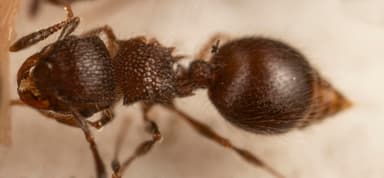
Meranoplus peringueyi is a fascinating ant species that hails from southern Africa, where it has evolved a remarkable suite of adaptations for life in arid and semi-arid environments. The workers are compact and sturdy, measuring 3 to 4.5 mm, with a broad, shield-like head and a flattened body that allows them to press themselves tightly against surfaces—a clever defense against predators and desiccation. The queen, slightly larger at 5 to 7 mm, is similarly robust and begins her colony in typical claustral fashion, sealing herself away and raising her first brood without needing to forage. Colonies of Meranoplus peringueyi remain modest in size, typically reaching between 100 and 800 workers, which makes them well-suited for keepers who enjoy observing a manageable yet active colony.
Diet is where this species shows its versatility. While many seed-harvesting ants rely almost exclusively on grains, Meranoplus peringueyi is more of an omnivore with a preference for variety. In the wild, they collect seeds, hunt small insects, and readily take sugar-rich liquids. In captivity, a balanced menu of high-quality seeds, feeder insects such as fruit flies or small crickets, and diluted sugar water will keep the colony thriving. The seeds are often stored in specialized chambers, but unlike some Messor species, these ants do not produce “ant bread” in large quantities—they simply consume the seeds whole or crack them open with their strong mandibles. Protein in the form of insects is especially important during brood rearing.
Care difficulty
Keeping Meranoplus peringueyi is best suited for intermediate ant keepers. The main challenges lie in providing consistent warmth and humidity without crossing into overly wet conditions. They do not hibernate, so year-round activity can be maintained as long as temperatures stay within the recommended range of 22 to 28 °C. Humidity should be kept moderate, around 40 to 60 percent—too much moisture can lead to mold or stress, while too little may hinder brood development. Another reason for the intermediate rating is their somewhat shy nature; colonies can be sensitive to excessive light and vibration, especially when small.
Housing
A formicarium with a dry outworld and a humidified nest zone works best for these ants. The nest should offer tight, flat crevices or chambers that mimic the natural rock crevices and soil cracks they favor in the wild. Regular, gentle moistening of one part of the nest ensures the proper humidity gradient. Because they are not heavy excavators, pre-made chambers or a substrate that holds shape (like a sand-clay mix) are ideal. Provide a clean water source in the outworld (test tubes with cotton plugs are sufficient) and scatter seeds in a feeding area away from the nest entrance.
First days after purchase
When your Meranoplus peringueyi colony arrives, transfer them into their new formicarium as calmly as possible and place it in a dim, quiet location. The first few days are critical for acclimatization: avoid opening the setup unnecessarily, as stress can delay brood care and slow growth. Ensure a small dish of sugar water and a few seeds are available from the start, along with a humidified nest area. Observe from a distance—within a week, you should see the workers exploring, tidying chambers, and tending to the queen. With patience, this discreet yet charming species will reveal its intricate behaviors and become a rewarding addition to any collection.