Gigantiops
Gigantiops destructor
Nuptial Flight Calendar
Flight months: Jan, Feb, Mar, Oct, Nov, Dec
Care Guide
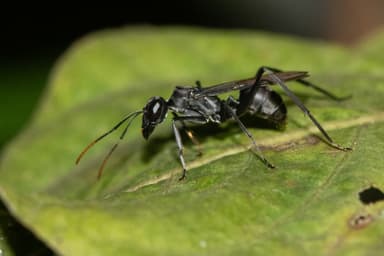
Among the more intriguing ants available to the dedicated hobbyist, Gigantiops destructor — sometimes referred to as the giant-eyed ant — stands out not only for its striking appearance but for a behavioral repertoire matched by few formicines. Queens are robust, measuring 14–16 mm, while their monomorphic workers range from 12–14 mm, all sharing a slender, long-legged build and enormous, forward-facing compound eyes that give the species its scientific name. These visual adaptations underpin a truly unusual lifestyle: G. destructor forages diurnally as solitary hunters, relying on exceptional vision and landmark-based navigation to return to the nest (Hölldobler & Wilson 1990). Colonies are modest, rarely exceeding 250 workers, and the founding type is fully claustral, meaning the queen sequesters herself without additional food until her first workers eclose. Their native range stretches across the Amazon Basin, from the eastern foothills of the Andes to the Atlantic forest, bounded roughly between 10°N and 20°S latitude — a region of warm, wet, and highly stable conditions (GBIF occurrence data). This ecological background is essential for understanding their needs in captivity, as every parameter must echo the humid tropical forests they call home.
Unsurprisingly, Gigantiops destructor is rated as an expert-level species. The designation is not due to aggression — they are not particularly defensive — but because they demand unwavering environmental stability and a keeper’s ability to read subtle signs of stress. Even brief fluctuations in humidity or temperature, or excessive vibration, can cause brood neglect, poor foraging, and colony decline. Their small maximum colony size means every worker and piece of brood is precious; recovery from setbacks is slow. This ant is best suited for keepers who have already succeeded with more forgiving tropical species and who possess reliable, automated climate control equipment. Beginners and those without experience in maintaining precise microclimates should look elsewhere until they have mastered the fundamentals of humidity regulation and disturbance mitigation. Patience and observational acuity are the keeper’s greatest assets here.
Housing must replicate the hot, moisture-laden forest floor of the Amazon. The core of the setup is a nest — plaster, ytong (aerated concrete), or a high-quality 3D-printed nest with a water reservoir — designed to maintain internal humidity between 70% and 90% at all times. Temperature should be held steadily within a 24–30°C range, with a gentle thermal gradient allowing workers to self-select their preferred zone. A heat cable or small heat mat attached to one side of the nest and controlled by a thermostat is ideal, while the outworld can remain slightly cooler. Substrate is not merely cosmetic; a deep layer of coco coir, fine bark, or a mineral-coir mix in the outworld helps buffer humidity and provides a naturalistic foraging environment. Crucially, avoid any mesh lids that would allow rapid moisture loss — a glass or acrylic top with minimal ventilation holes, paired with occasional misting, works best. The nest itself should offer several humid chambers, as colonies will move brood around in response to microclimatic shifts. Because these ants are diurnal and visually oriented, the outworld should be placed in a location that receives indirect natural light or gentle LED illumination, allowing you to observe their fascinating navigational behaviors without over-brightening the nest.
Diet for Gigantiops destructor follows the standard protein‑carbohydrate split of most formicines, but with an emphasis on fresh, high-quality offerings. In the wild they are active hunters, and in captivity they accept a range of live or freshly killed insects: fruit flies, small crickets, roach nymphs, and mealworm segments are all suitable. Protein should be offered two or three times per week, sized according to the colony’s appetite — left uneaten, insect remains will quickly mold in the high humidity. Carbohydrates are readily taken from sugar water, honey diluted to a thin syrup, or specialized ant nectars. A small feeding dish or absorbent pad prevents drowning and keeps the outworld tidy. Fresh water must be constantly available, either in a test tube with a cotton plug or a dedicated water feeder. Given the extreme humidity, be vigilant about mold and mites; remove any uneaten food within 24 hours and consider using springtails as a clean-up crew within the outworld’s substrate.
One welcome simplification is the complete absence of a hibernation requirement. Gigantiops destructor originates from equatorial latitudes where seasonal temperature variation is minimal, and the data confirm no winter diapause is needed. Colonies remain active year-round, maintaining brood production as long as temperature and humidity are held constant. While this makes them an engaging display species through every calendar month, it also removes the rest period that can mask husbandry errors in temperate ants. Keepers must maintain their meticulous routine uninterrupted; there is no seasonal reprieve. The nuptial flight period, reported with low confidence from October to March during the wet season, occurs in warm, humid afternoons following rainfall — a timing that further underscores the eternal summer this species expects in captivity.
When your G. destructor colony arrives — often as a founding queen or a queen with a handful of workers — the first days are critical. Keep them in the initial test tube or shipping container for as long as reasonably possible; this reduces stress and allows them to settle. Place the tube in a dark, vibration-free location within a prepared outworld, and gently connect it to the nest once they’re ready. For a claustral queen alone, absolutely no feeding is necessary until her first workers appear. For a small colony, offer a micro-drop of sugar water on the second or third day and a tiny, pre-killed insect fragment afterward. Watch for the workers to explore: their large, inquisitive eyes will scan the environment as they begin to memorize visual landmarks (Macquart et al. 2006). Do not disturb the tube or force them to move; the colony will relocate when they deem the new nest suitable, a process that can take days or weeks. Monitor the water level in the tube, but otherwise, intervene as little as possible. Early signs of success include workers returning frequently to the queen with trophallaxis-fed mouthparts, a cleanly groomed brood pile, and steady foraging activity (Beugnon et al. 2005). Should you observe continuous antennation toward the tube’s cotton or ceaseless pacing, humidity or temperature may need micro-adjustment. With patience and precision, you will be rewarded with a front-row seat to one of the most visually sophisticated ants in the world.