Diacamma
Diacamma rugosum
Nuptial Flight Calendar
Flight months: Apr, May, Jun, Jul, Aug, Sep
Care Guide
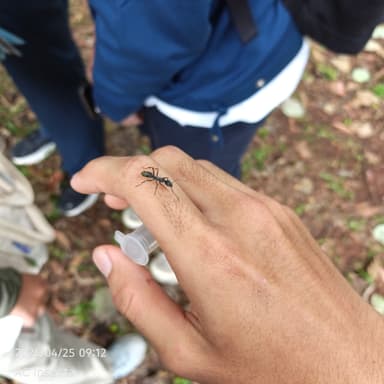
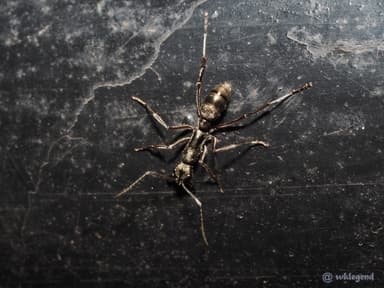
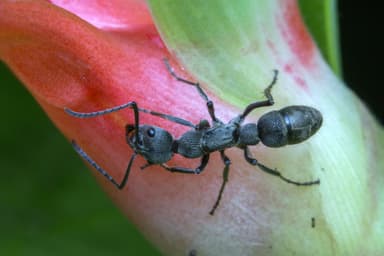
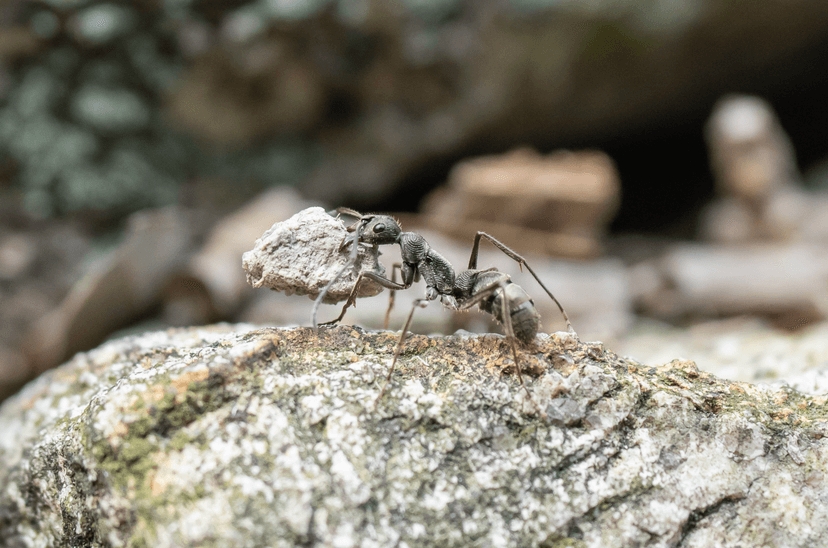
Diacamma rugosum is a striking ant that immediately captures the imagination with its unusual colony structure. Unlike most ants, this species entirely lacks a distinct queen caste; instead, reproduction is carried out by one or several mated workers known as gamergates (Peeters & Higashi 1989). The workers themselves are robust, measuring 10 to 13 mm in length, and possess a heavily sculptured, dark exoskeleton often bearing deep longitudinal grooves across the head and thorax. Colonies are modest in size, normally peaking at around 300 individuals, and they propagate not through solitary queen flights but by fission—a process in which a group of workers accompanied by a gamergate buds off from the mother colony to establish a new nest (Fukumoto et al. 1989). This queenless social system, complete with dominance hierarchies among the ergatoid females, makes D. rugosum endlessly fascinating for any keeper eager to witness the remarkable diversity of ant societies.
Due to its specific requirements and unusual founding strategy, Diacamma rugosum is best suited for keepers who have at least some prior experience. It is rated as an intermediate species and is not recommended for complete beginners. Successfully maintaining a colony that depends on high humidity and stable warmth, while also understanding the nuances of a fission‑based reproductive cycle, requires a more thoughtful setup than many classic beginner ants. However, for the enthusiast who has successfully kept more common exotic species and wants to explore the world of queenless ants, this species offers a richly rewarding experience. Observing the subtle behavioral interactions among workers and the gamergate—from policing to cooperative brood care—is a daily lesson in social evolution.
Housing this species correctly is the cornerstone of long‑term success. In the wild, D. rugosum ranges from the Indian subcontinent across Southeast Asia and north into subtropical parts of East Asia, occupying warm, humid microhabitats. Captive nests should maintain a temperature gradient between 22 and 28°C, easily achieved with a small heat mat placed beneath one side of a glass or acrylic setup. Equally critical is humidity, which needs to stay between 65% and 85%. A substrate that holds moisture well—such as a mix of sand, clay, and coco fiber—is ideal, as it encourages natural digging and helps buffer humidity levels. Many keepers find that a naturalistic, soil‑based nest with a cork bark hide works well, while the foraging area can be decorated with leaf litter and small branches to give the active workers room to explore. Hydration is best provided by a water tower or regular misting, though drainage must be sufficient to prevent stagnation. Thermal tolerance studies (Baudier et al.) indicate these ants can handle brief fluctuations, but prolonged exposure outside the recommended range will quickly cause stress.
A varied diet is essential to keep the colony vigorous. Diacamma rugosum workers are keen hunters and will readily accept both insect prey and carbohydrate sources. Offer a steady rotation of appropriately sized live or pre‑killed feeder insects—like small crickets, mealworms, or roach nymphs—for protein two to three times per week. Carbohydrates, in the form of watered‑down honey, maple syrup, or soft fruit pieces, can be provided once or twice a week, always in tiny amounts to prevent spoilage. Clean drinking water must be accessible at all times, ideally through a test tube waterer or a shallow dish with a cotton wick to eliminate drowning risk. Remove all uneaten food after 24 hours, because the high humidity these ants crave also invites mold.
One practical advantage of this tropical species is that it requires no hibernation period whatsoever. You can maintain the same temperature range year‑round, and the colony will remain active, continuing to rear brood without a seasonal pause. This makes D. rugosum an excellent candidate for a display colony that can be enjoyed in any season, though it also means you must reliably supply live insect prey throughout the year. The absence of a cooling phase simplifies the care routine but removes a natural checkpoint, so keepers must be especially disciplined about monitoring humidity and cleanliness continuously.
When you first receive your Diacamma rugosum colony, patience is everything. Transport is stressful, so place the sealed container in a quiet, dimly lit room and allow the ants several hours to settle. A tiny drop of sugar water offered on a slip of foil can help them refuel immediately, but hold off on solid protein until the workers are moving calmly and exploring, usually after a day. If you are transferring them to a prepared nest, connect the travel tube and let them discover it on their own; forcing a move risks injury and extreme stress. During the first few days, watch for any dead individuals and remove them promptly, and verify that the gamergate is being groomed and attended—a sign of a functioning colony. Keep disturbances to a minimum, resisting the urge to check constantly, because the excessive light and vibration can delay acclimation. With gentle handling and a stable environment, your colony will soon settle in and begin to reveal the intriguing social dynamics that make this queenless ant so captivating.