Tetraponera
Tetraponera rufonigra
Nuptial Flight Calendar
Flight months: Apr, May, Jun
Care Guide
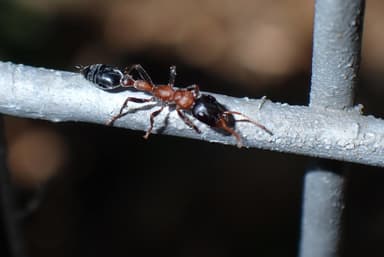
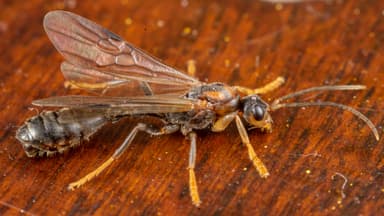
Among the true twig ants of the genus Tetraponera, few species capture the imagination of seasoned ant keepers quite like Tetraponera rufonigra. Commonly known as the slender ant or arboreal stinging ant, this striking insect exhibits an elongated, glossy body that shimmers with a deep reddish-brown to almost black hue, set upon remarkably long legs and crowned with large, kidney-shaped eyes that lend it exceptional vision. Workers are distinctly polymorphic, producing both minor and major castes; minor workers measure 8 to 10 millimetres, while the robust major workers can reach up to 13 millimetres. The queen is a genuine showpiece at 14 to 17 millimetres, her thorax built for both flight and the demanding semi-claustral founding phase that makes this species so intriguing. Mature colonies in the wild may house up to 2,000 individuals, a modest number by ant standards, yet their highly active, arboreal lifestyle and vigorous defence of their twig nests lend them a commanding presence. Native to a broad sweep of South and Southeast Asia, from India and Sri Lanka across to southern China and the Indonesian archipelago (Ward 2001, Bingham 1903), Tetraponera rufonigra is a denizen of warm, humid lowland forests. Their taxonomy and ecology are well documented (AntWeb, AntWiki), and like many of their cousins, they excavate nests in dead twigs and branches, often in sun-exposed vegetation — a sculptural microhabitat that must be thoughtfully replicated in captivity.
This ant is unequivocally a commitment for the expert keeper. The care difficulty rating reflects not only the species’ demanding environmental requirements but also the inherent challenges of a semi-claustral founding strategy, acute escape sensitivity, and a famously painful sting. Unlike fully claustral queens that seal themselves away to raise first workers solely on internal fat reserves, a freshly mated Tetraponera rufonigra queen must regularly venture out to hunt and forage while her brood develops — a behaviour that demands constant provisioning and a perfectly secure, escape-proof setup from day one. The workers are swift, alert, and react aggressively to disturbances, delivering a sting that is disproportionate to their size and can cause prolonged burning. For these reasons, the species is entirely unsuited to beginners; it belongs in collections of those who have successfully raised other demanding, semi-claustral species, who are comfortable with crafting arboreal formicariums, and who can maintain stable tropical microclimates without fail. If you relish a high-stakes display animal that rewards meticulous husbandry with constant visual activity and a complex social structure, Tetraponera rufonigra will be a deeply rewarding challenge.
Housing must be carefully designed to emulate the hollow twig environment these ants call home, while meeting their temperature and humidity tolerances precisely. A wooden nest with pre-drilled galleries of varying widths (roughly 4 to 8 millimetres) mimics natural nesting sites beautifully; alternatively, a cork-lined nest or a test tube fitted with a slender balsa wood insert provides a readily adjustable foundation. The nest should be connected via a short tubing run to a well-ventilated foraging arena furnished with climbing twigs, bark, and a thin layer of inert substrate like sand or clay pebbles merely to stabilize humidity. Temperature control is critical: maintain a gradient of 24 to 30°C, ideally by positioning a heat mat under one end of the nest so the ants can self-regulate. Humidity should hover between 50 and 70 percent, achieved through regular misting of the foraging area, a water-filled test tube, or a plaster nest insert kept damp without becoming saturated — condensation is unwelcome, as it encourages fungal growth in their tight quarters. Escape prevention is non-negotiable; a fine mesh lid combined with a fresh Fluon or talc barrier along the arena’s upper rim is standard, but for this acrobatic species, a tightly locking lid becomes the final line of defence.
A diet that satisfies both the protein-hungry larvae and the sugar-loving adults is key to colony vigour, and for a semi-claustral queen, it makes the difference between success and failure. A founding queen should be offered tiny prey items such as flightless fruit flies, freshly killed pinhead crickets, or finely chopped mealworm segments within 24 hours of being housed, along with a micro-droplet of honey or sugar water placed on a slip of foil. Once the first workers emerge, expand the menu to include a steady rotation of small to medium-sized insects — small roaches, crickets, or moths — always sliced open or crushed to facilitate feeding by the younger minors, while majors capably dismantle larger pieces. Carbohydrates are best supplied as pure honey, diluted maple syrup, or by offering freshly cut fruit such as melon or apple; change these out promptly to prevent spoilage. While these ants do forage actively on plant surfaces in the wild (Ward 2001), they are not granivorous, so seeds and grains are ignored. Fresh water must always be available either in a drinking tube or as a moist nest sponge, as dehydration is rapidly fatal.
Tetraponera rufonigra is strictly tropical and requires no hibernation period whatsoever. This species does not undergo diapause; any attempt to overwinter them at cool temperatures will result in stress, brood loss, or colony collapse. The natural phenology suggests nuptial flights take place in April through June, timed with warm, humid evenings just before the monsoon rains break, a clue that they expect year-round warmth. Keep their enclosure at a steady 24 to 30°C regardless of the season, and maintain day-night light cycles with a simple timer if natural light is insufficient. A consistent environment not only sustains brood production but also keeps the colony’s defensive tenacity at a manageable level, as abrupt drops in temperature often coincide with increased worker restlessness.
The first days after your Tetraponera rufonigra package arrives are a delicate transition. Upon unpacking, place the travel container in a dim, vibration-free area and allow the ants to calm down for an hour before attempting any transfer — these ants are notably high-strung. A lone queen should be introduced to a pre-prepared small nest tube with a wooden insert and a hydration chamber, then offered a tiny food item and honey as described; avoid staring or jostling her, as she may eat her initial eggs if stressed. For a colony with workers, connect the shipping vessel to their permanent nest and let them move at night on their own, a far safer strategy than forced relocation. Provide sugar water immediately, but wait a day before offering prey, allowing them to settle and explore their new boundaries. Monitor for signs of panic such as workers frantically patrolling the lid seam; if detected, darken the arena and reassess the barrier integrity. Watch also for moisture balance — overly dry nests cause shrivelled brood, while persistent condensation warrants additional ventilation. With steady warmth, correct humidity, and a respectful distance, you’ll witness the colony gradually establish foraging trails and defend their territory with that characteristic, upright-legged alertness, marking the true start of a fascinating and highly educational ant-keeping partnership.