Tapinoma
Tapinoma erraticum
Nuptial Flight Calendar
Flight months: Jun, Jul, Aug, Sep
Care Guide
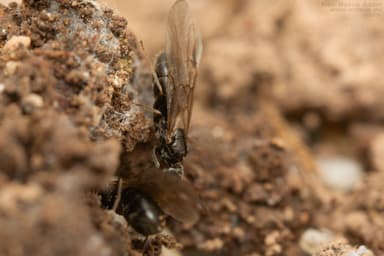
Among the most spirited and agile denizens of Europe’s warm, open landscapes is Tapinoma erraticum, a dolichoderine ant whose common name — the erratic ant — perfectly encapsulates its character. Workers are diminutive and monomorphic, ranging from just 2.5 to 4 mm, while queens are notably larger at 4.5 to 6 mm. Their integument is a deep, glossy brown to black, and when disturbed they adopt a frenetic, zigzagging gait that has fascinated myrmecologists for centuries (Seifert 2018). A single mature colony can balloon to an impressive 30,000 members, often operating as a polygynous, budding network where multiple queens and satellite nests are common. One of the species’ most memorable traits is the pungent, rancid-butter odor produced by its anal glands when workers are crushed — a chemical defence that can quickly fill a collecting vial and is a hallmark of the genus. In the wild, Tapinoma erraticum constructs shallow soil nests under stones or in dry turf, frequently relocating in response to microclimate shifts, a behaviour that keeps keepers on their toes.
This ant is best suited to hobbyists with some foundational experience. The care difficulty is squarely intermediate, not because the colony is fragile but because their small size, breakneck speed, and escape-artist tendencies demand a meticulously prepared setup. There is no room for gappy connections or ill-fitting lids — a worker of just 2.5 mm can exploit the tiniest crack, and their coordinated exodus can be startling. Furthermore, they require a true hibernation period, which means a dedicated cooling strategy, something that may deter a purely casual keeper. If you have successfully overwintered Lasius or similar species and are looking for a faster, more unpredictable small ant with boundless energy, T. erraticum will reward you with an endlessly watchable colony.
When designing a formicarium, prioritise escape-proofing above all else. A glass or acrylic setup with finely milled joints, a tight-fitting lid protected by a fluon or PTFE barrier, and connection tubing of an internal diameter that you can verify is secure are non-negotiable. Tapinoma erraticum thrives at temperatures between 20 and 28°C, and a gentle gradient from a warm foraging arena to a cooler nest zone allows self-regulation. Humidity should be maintained in the 40–60% range, which mimics the well-drained, sun-exposed soils of its natural habitat. A ytong or gypsum nest with a pre-shaped chamber layout works excellently, as these materials hold a modest amount of moisture without becoming sodden. If you prefer a more natural look, a sand-loam mix with small stones will be eagerly excavated, though you must then monitor hydration from below to prevent collapse. Avoid deep, permanently saturated nests — this species abhors stagnant humidity and may abandon a nest that feels swampy. The typical distribution of T. erraticum, from the Iberian Peninsula up into southern Scandinavia (GBIF), tells us it is a temperate ant that experiences distinct seasonal dryness, so a light misting every couple of days in the outworld, and a water source like a small, refreshed cotton-plugged tube, is sufficient.
A varied diet fuels their constant activity. Offer small insects — fruit flies, pinhead crickets, or chopped mealworms — twice a week as the primary protein source, and always remove uneaten prey after a day to prevent mould. Carbohydrates are equally important; a tiny droplet of honey, sugar water, or diluted maple syrup on a piece of foil will be mobbed within minutes. These ants are enthusiastic drinkers, so a permanent, shallow water supply is essential, but use a sponge or cotton to prevent drowning. Because they are small, even a droplet of water can become a hazard, so always test any liquid feeder with a single worker’s access in mind. Workers recruit heavily to rich food sources, and watching them navigate back to the nest, abdomens bobbing, is a highlight of keeping this species.
A rigid winter dormancy is obligatory. Tapinoma erraticum requires a hibernation temperature of around 8°C, typically for at least three months. Begin reducing the ambient temperature gradually in late autumn, and once the colony is between 5 and 10°C, they will cluster within the nest chambers and cease foraging. Check every few weeks for signs of excessive condensation or dehydration, but otherwise leave them in a dark, quiet space — a wine cooler or a cold stairwell works well. As spring arrives, warm them slowly back to room temperature over one to two weeks, offering only water and a tiny sugar boost on the first day of activity before reintroducing protein. Skipping or shortening this diapause will almost certainly lead to a gradual decline in queen fecundity and worker lifespan, a pattern well-documented in north-temperate ants (Seifert 2018).
Your newly arrived colony will be stressed and disoriented after transit. Connect their transport tube or container directly to the prepared nest and outworld, then cover the entire setup with a breathable dark cloth. Do not feed them for the first 24 hours; instead, ensure a small cotton-plugged water source is present. On the second day, place a miniscule drop of sugar water on a card near the nest entrance, and retreat. You will likely witness a single, tentative scout soon after, and within a day a steady stream of foragers will map the arena. Keep the environment dim and undisturbed for the first week, resisting the temptation to peek constantly. Watch for workers chewing at ventilation mesh or gathering at silicone seams — if you see this, immediately reinforce those areas with fluon and double-check all closures. Once settled, the colony will begin rearranging its nest almost immediately, and the furious, erratic ballet will tell you they are finally home.