Proatta
Proatta butteli
Nuptial Flight Calendar
Flight months: Apr, May, Jun, Sep, Oct
Care Guide
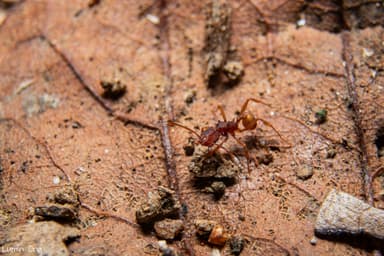
Proatta butteli is a beguilingly cryptic ant that rewards the observant keeper with glimpses into a miniature society where physical form dictates function. At first glance, you might mistake a worker for a stray grain of bark — mature colonies are modest, topping out around 3,000 individuals, but their dimorphic worker caste lends them a quiet complexity. Minor workers measure a petite 2.5 to 4.5 mm, scurrying nimbly through leaf litter, while the majors, with their blocky heads and stronger mandibles, serve as living doorways and defenders. Queens are a more substantial 6.0 to 7.5 mm, and like all Proatta, they are claustral founders, sealing themselves away to raise the first brood on stored body reserves. What truly fascinates, though, is the behavioural repertoire teased out by Moffett (1986): foraging trails are slow, deliberate, and almost spider-like, with minors acting as scouts and majors lumbering behind to carry back larger prey fragments. The species was originally described by Forel in 1912 from material collected in the Oriental region, and today its known range arcs from southern Sumatra to Borneo and the Malay Peninsula, hugging warm, humid lowland forests.
As a captive, Proatta butteli sits at an intermediate care difficulty, making it an ideal project for the keeper who has successfully maintained a claustral desert species or a temperate formicine and now craves the rhythms of the Asian tropics. This is not a beginner’s ant because the narrow environmental envelope requires consistent monitoring; a desiccation event or a sudden temperature spike can quickly undo months of slow growth. You’ll need to enjoy observing subtle behaviours, because while the colony does grow, the pace is measured and the ants themselves are somewhat retiring. The absence of a hibernation period is a double-edged sword: you can enjoy an active colony year-round without the stress of a cooling phase, but you also lose the seasonal pause that lets equipment rest. Patient keepers with an interest in polymorphic genera will find Proatta richly satisfying — every time a new major ecloses and takes up its role as a gatekeeper or heavy lifter, the internal logic of the colony snaps into sharper focus.
Housing must replicate the stable, saturated air of the Southeast Asian forest floor. A naturalistic vivarium setup with a deep layer of coconut coir, leaf litter, and well-rotted wood will evoke their native haunts, but a classic plaster or ytong nest within a temperature-controlled formicarium works superbly, provided you hold the gradient tight. Aim for an ambient temperature between 24 and 28 °C; a gentle heat mat under one corner of the nest allows the ants to self-regulate. Humidity is the critical parameter: the nest chamber should hover between 70 and 90 % relative humidity. This can be achieved through a combination of a moistened substrate, a water tower or sponge-fed hydration port, and periodic misting of the foraging arena with dechlorinated water. Avoid condensation pooling in the nest, as chronically wet surfaces foster fungal blooms that Proatta is slow to abandon. A small ventilation port on the dry side of the nest helps balance the tropical dampness without encouraging stagnant air.
Feeding Proatta butteli is straightforward but demands attention to protein variety for successful brood rearing. In the wild, Moffett (1986) observed them carrying a mixture of small arthropod fragments and scavenged insect carcasses, so offer a rotation of fruit flies, pinhead crickets, diced mealworm, and occasionally a sliver of cooked egg yolk or a freshly crushed spider. Carbohydrates are taken with enthusiasm; a small feeding dish with organic honey diluted in water, a slice of ripe melon, or a dab of maple syrup will fuel foraging activity. Always include a clean water source — a test tube with a cotton plug is ideal — separate from the sugar feeder to prevent accidental drowning. As with all ant colonies, remove uneaten protein after 24 hours to prevent mould, and be vigilant that sugary liquids do not ferment in the warm, humid environment.
One of the great mercies of keeping this species is that it asks for no winter rest. Proatta butteli originates from equatorial latitudes where temperatures vary more diurnally than seasonally, so you will never need to chill the colony. This non-hibernating life cycle means the queen will continue laying eggs at a more or less steady clip throughout the year, provided the basic environmental parameters are met. However, do not interpret this as an invitation to neglect photoperiod entirely; a regular day-night cycle using a small LED light on a timer will maintain circadian rhythms and keep workers from becoming restless. You may notice a slight peak in brood production in the warmer months, but there is no genuine diapause to manage, which simplifies long-term planning.
The first days after your Proatta butteli queen or small founding colony arrives are a delicate period that demands minimal interference. If you have a freshly mated queen, house her in a standard claustral setup — a glass test tube half-filled with water, blocked by a tight cotton plug, and placed in a darkened, warm drawer at 26 °C. Check on her no more than once a week; she will not eat until the first tiny minors eclose, which may take six to eight weeks. For a young colony of a few workers, attach a small foraging outworld to the tube and offer a droplet of sugar water and a pre-killed fruit fly on day three. Expect the workers to explore cautiously for the first 24 hours; major workers may wedge their heads in the tube entrance, a normal gatekeeping behaviour that tells you the colony feels secure. Watch for any signs of chronic stress: workers dragging brood out of the nest, the queen losing condition rapidly, or an inability to drink from the water source. If the cotton plug becomes soiled or mouldy, gently transfer the colony to a fresh tube using a soft brush, but only if absolutely necessary. With steady warmth, high humidity, and a light touch during these critical weeks, Proatta butteli will settle into a rhythm of quiet industry that will continue to intrigue for years.