Hypoponera
Hypoponera eduardi
Nuptial Flight Calendar
Flight months: Jul, Aug, Sep
Care Guide
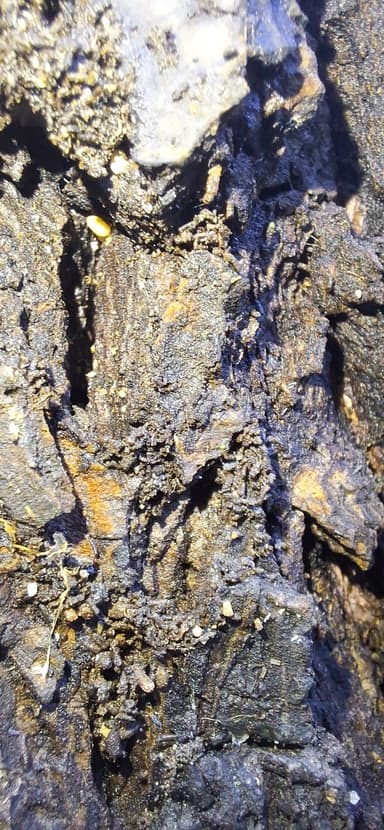
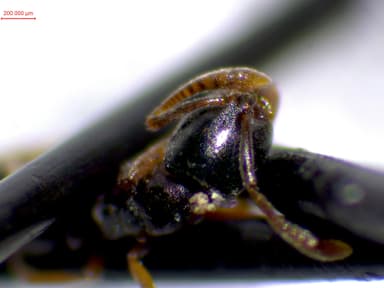
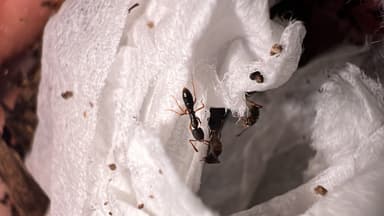
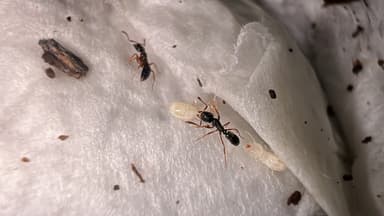
Hypoponera eduardi is a tiny, soil-dwelling ant that captivates expert keepers with its unusual biology and reclusive habits. Queens measure just 2.8 to 3.5 mm, while the monomorphic workers range from 2 to 2.5 mm, making them some of the smallest ants maintained in captivity. Their coloration varies from pale yellowish-brown to a darker amber, and their minute size belies a colony potential of up to 500 individuals. What truly sets this species apart is its reproductive strategy: rather than relying solely on large, winged reproductives, Hypoponera eduardi frequently employs ergatoid males and sometimes ergatoid queens that mate within the nest (Buschinger & Schreiber 2002). This intranidal mating, often occurring under warm, humid conditions in late summer across Southern and Central Europe, means that single colonies can contain a complex mix of dealate queens, wingless males, and workers that blur the line between castes. The species is widely distributed throughout the Old World, from the Mediterranean to northern temperate zones, and its secretive, hypogaeic lifestyle has made detailed field observations a challenge, leaving much to be discovered by the dedicated hobbyist.
Due to its miniature dimensions, demanding environmental requirements, and cryptic nature, Hypoponera eduardi is firmly recommended only for keepers with significant experience. This is not a species for casual observation; workers are barely visible against soil and can escape through the tiniest of gaps. Maintaining the precise humidity and temperature ranges, successfully simulating a winter diapause, and providing a suitable live prey diet all require advanced micro-management skills. Anyone attempting to keep this ant should be comfortable with crafting fully escape-proof setups, monitoring moisture gradients, and exercising the patience needed for a colony that may rarely be seen above ground. In return, you are rewarded with a window into one of the most fascinating reproductive models in the ant world, a living system in which a single colony can become a self-contained breeding population.
Housing must prioritize moisture retention and absolute security. A nest constructed from plaster, aerated concrete (ytong), or a very fine clay-sand mixture is ideal, as these materials can be kept evenly damp without flooding. The species thrives at temperatures of 20–26°C and requires a relative humidity of 70–90% at all times; a humidity gradient within the nest is beneficial, allowing the ants to choose their preferred microclimate. Substrate depth is critical: in the wild they burrow through soil and leaf litter, so a deep layer of a moist, sandy loam or a plaster insert with pre-formed narrow chambers will replicate their natural habitat. The foraging arena should be tiny, entirely coated with an effective barrier such as fluon, and any ventilation holes must be lined with fine stainless steel mesh or dental cotton to prevent escape. Because these ants are exceptionally susceptible to drowning, free water should be provided only on tightly rolled cotton wicks or via the test tube reservoir, never as open droplets.
Feeding Hypoponera eduardi is straightforward in principle but requires consistency and small prey items. They are generalist predators of microfauna, and in the wild their diet consists of springtails, mites, and other soft-bodied soil invertebrates. In captivity, the best protein sources are freshly killed or live springtails and flightless fruit flies, supplemented with finely chopped mealworm segments or pinhead crickets for established colonies. Offer tiny amounts daily or every other day, removing uneaten food promptly to prevent mold in the humid nest environment. A dilute sugar water or honey water mixture can be made available on a needle-sized drop, though many colonies show a strong preference for protein and may ignore carbohydrates entirely. Always provide a reliable source of fresh water within the nest, as dehydration is a primary threat.
A true hibernation is obligatory for long-term colony health. Native to temperate regions, Hypoponera eduardi experiences a pronounced cold season that triggers essential physiological and reproductive processes. The hibernation temperature should be gradually lowered to around 12°C and maintained for three to four months. A wine cooler, a cold frame, or an unheated room with a stable temperature is suitable. During this period the colony becomes nearly inactive; feeding should cease a week before cooling begins, and the nest must remain just moist enough to prevent desiccation. When spring arrives, slowly return the colony to the standard temperature range over several days, and resume minimal feeding. A successfully overwintered queen will rapidly ramp up egg production, often leading to a flush of brood visible shortly after the temperature rises.
The first days after acquiring a newly mated queen require minimal intervention. She will arrive in a standard test tube setup with a water reservoir, and she is fully claustral, meaning she needs no food until her first workers emerge. Place the tube in utter darkness at a steady 24°C and resist the urge to check on her more than once every two weeks. Look only for signs of mold, excessive condensation, or a drying water plug; otherwise, disturbance can cause her to consume her eggs. The founding phase is slow, and the initial nanitic workers are barely larger than a speck of dust. Once half a dozen workers are active, you may introduce a single, freshly killed springtail on a slip of paper just outside the tube entrance, then gradually connect a prepared nest and miniature foraging arena as the colony grows. Watch closely for escape, as these first workers are notorious for finding gaps, and maintain the high humidity that is the colony’s lifeline. With patience and precise care, you will cultivate one of the ant world’s most secretive and intellectually rewarding societies.