Pheidole
Pheidole pilifera
Nuptial Flight Calendar
Flight months: Jun, Jul, Aug, Sep
Care Guide
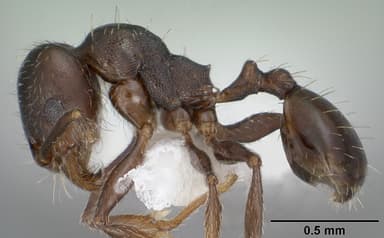
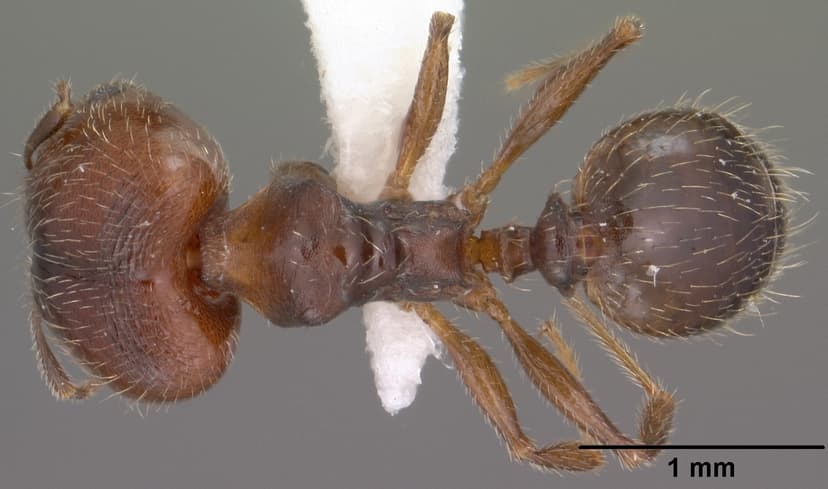
Among the long-legged, big-headed harvesting ants of North America, Pheidole pilifera stands out as a compact and adaptable beginner species with a fascinating social structure. Queens range from 6 to 7.5 millimeters in length, while the true showstoppers are the polymorphic workers: minors measure a mere 2.2 to 4 millimeters, and the robust major workers, with their disproportionately large, blocky heads, serve as seed crackers and defenders. In the wild, this species can build colonies that swell to as many as 10,000 individuals, all headed by a single claustral queen who raised her first brood on nothing but her own fat reserves (Wilson 2003). Found across the eastern and central United States from Texas to the Dakotas and eastward to the Atlantic, P. pilifera thrives in open woodlands, prairies, and even suburban yards (Coovert 2005; GBIF). Their nuptial flights occur on warm, humid afternoons between July and September, often just after summer rains, making those sultry evenings a prime time to spot a freshly mated queen scurrying across a sidewalk.
For the hobbyist, Pheidole pilifera is a delightfully undemanding ant. Its care difficulty is rated as beginner, not only because the species tolerates a wide range of conditions, but also because the founding queen requires no feeding during her claustral period and the young colony grows rapidly once the first workers eclose. The presence of two distinct castes — gracile minors that forage and rear brood, and muscular majors that process seeds and defend the nest — offers a window into the division of labor that captivates experts as well. Anyone from a first-time keeper to a seasoned myrmecologist will find joy in watching the bustling activity of a mature colony, especially during feeding time when minors recruit nestmates in neatly organized trails to a droplet of sugar water.
Creating the right home for P. pilifera is straightforward. In nature they nest beneath stones or directly in the soil, so a formicarium that mimics a subterranean environment will be most successful. Plaster, ytong, or a classic sand-loam substrate nest all work well, provided the humidity inside the nest stays between 40 and 60 percent. A temperature gradient from 21 to 28 degrees Celsius (70–82°F) encourages healthy brood development; a small heating pad under one corner of the nest will allow the ants to self-regulate. Keep the outworld similarly warm and provide a thin layer of sand or coconut fiber substrate so the workers can scatter debris and feel secure. Ventilation is key at these humidities, so ensure the setup has small air holes to prevent condensation from flooding the nest. A byproduct of their southwestern and prairie heritage is a tolerance for drier spells, but they should never be allowed to desiccate — a test tube with a water reservoir or a lightly misted corner of the outworld will keep them hydrated.
Feeding P. pilifera reveals the purpose of those oversized major jaws. The colony thrives on a mix of insect protein and carbohydrates. Offer small, pre-killed insects like fruit flies, pinhead crickets, or pieces of mealworm two or three times a week, removing any uneaten portions after a day to avoid mold. For sugars, a smear of raw honey, maple syrup, or a commercial ant nectar solution on a small dish or foil piece will send the minors into a frenzy of gaster-flagging excitement. These ants also naturally harvest and store seeds, so a pinch of crushed nyjer or poppy seeds in the outworld provides not only nutrition but enrichment, as you will see majors methodically crack open the tough coats (Wilson 2003). Always keep a fresh water source, ideally in a cotton-plugged tube, and never let it run dry.
Do not ignore the seasonal calendar: P. pilifera requires a true hibernation. Across its broad range, which reaches as far north as 49 degrees latitude, colonies shut down for several months during the winter. To mimic this, gradually lower the temperature to approximately 10 degrees Celsius (50°F) over the course of two weeks in late autumn. Keep them at this cool, dark state for three to four months, checking monthly that a water supply remains available. Without this dormancy, queen fecundity plummets and the colony may decline. In the first year, you can hibernate even a small founding colony with just a few workers, as long as they are healthy and have stores. When spring arrives, warm them gradually to room temperature and watch the queen resume egg-laying with renewed vigor.
The first few days after your queen arrives are a test of patience, not of skill. Let the test tube settle in a quiet, vibration-free spot at room temperature and resist the urge to peek more than once a day. Within 24 hours, you may offer a microscopic dab of honey on a sliver of wax paper right at the tube entrance, though a founding queen does not strictly need food until workers arrive. Avoid introducing live prey — even a small insect can stress or injure a solo queen. Keep an eye out for signs of excessive condensation inside the tube, which can trap the ant in a water droplet, and for any fuzzy mold growth that would require an emergency move to a clean tube. Once the first tiny minors appear, usually after five to eight weeks, you can begin feeding the colony in earnest and gradually connect the tube to a small foraging arena. From that moment on, Pheidole pilifera will reward your minimal early intervention with a ceaselessly industrious and long-lived society.