Leptomyrmex
Leptomyrmex nigriventris
Nuptial Flight Calendar
Flight months: Jan, Feb, Oct, Nov, Dec
Care Guide
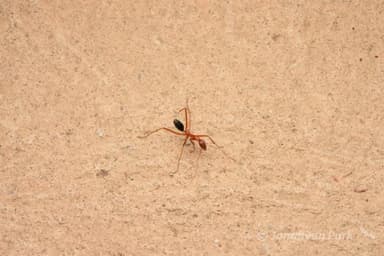
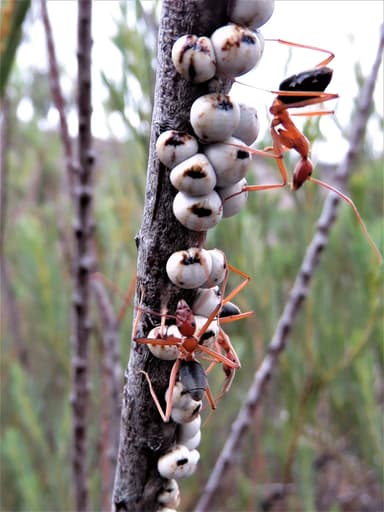
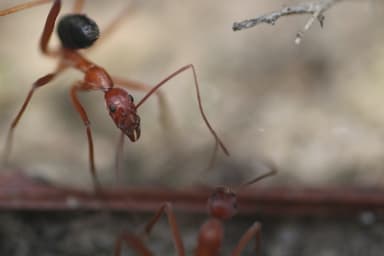
Among Australia’s most elegant formicines, Leptomyrmex nigriventris — commonly called the black-bellied spider ant — immediately captivates with its wasp-like gait and slender, elongated legs. Queens are notably large, reaching 12 to 15 millimetres, while workers fall between 6 and 10 millimetres, all sharing a glossy black gaster and amber to dark body tones that gleam under observation. The species ranges down the eastern coast from approximately latitude 10.5°S to 28°S, a distribution spanning tropical Queensland to the subtropical margins of New South Wales (AntWeb; Lucky & Ward 2010). What truly sets L. nigriventris apart, however, is its possession of repletes — a functional liquid‑storage caste. Unique among most ants kept in captivity, these repletes are living reservoirs, their crops ballooning with sugars and fluids to be shared with nestmates during lean times (Smith 1859; AntWiki). Mature colonies can grow to an impressive 3,000 workers, forming a restless, visually striking display that rewards the dedicated keeper.
Caring for this species is an expert‑level undertaking and should only be attempted by hobbyists who have already succeeded with other semi‑claustral founding species. The difficulty rating is no exaggeration: L. nigriventris queens are semi‑claustral, meaning they cannot sequester themselves permanently inside a sealed chamber after mating. Instead, a founding queen must periodically emerge to hunt for herself until her first workers are raised, a phase that demands meticulous attention to feeding and security. If you have kept only claustral ants — where the queen seals herself away and subsists on energy reserves — think of this as a step‑change in complexity. The queen requires a furnished outworld from day one, with live micro‑prey and carbohydrate sources within easy reach, yet she is easily stressed by excessive disturbance. Only keepers who can provide a stable, quiet environment and who understand the subtle signs of hunger or stress in a solitary queen will likely see the colony through its delicate founding weeks. The payoff is enormous, as a thriving colony exhibits complex foraging behaviors, fluid exchange among repletes, and a constant, graceful motion that few other ants match.
Housing must mimic the warm, humid conditions of the species’ coastal forest habitat. Maintain a temperature gradient between 20°C and 28°C, with a basking spot in the higher end of the range and cooler retreats; this can be achieved with a small heat mat applied to one side of the nest, monitored with a reliable thermostat. Humidity should sit between 50% and 70%, and many successful keepers use a plaster‑ or gypsum‑based nest that allows water to be injected directly into a hydration chamber, ensuring steady evaporation without flooding. A deeper digging substrate of sandy loam, whether attached as a satellite burrowing area or included within a large soil‑based formicarium, is strongly recommended — the ants naturally excavate and often tuck repletes into stable micro‑chambers. The outworld must be perfectly escape‑proof, because these leggy ants are astonishing climbers that can scale fluon‑coated barriers if a single streak is missed. Offer ample branches, dried leaf litter, and a small water source; a natural day‑night light cycle from ambient room light is sufficient, but avoid direct sunlight on the nest.
A balanced diet underpins colony health. For protein, provide freshly killed or live, appropriately‑sized insects — fruit flies, pinhead crickets, small mealworm sections — at least every two to three days, increasing frequency as the larva count grows. Carbohydrates are equally important, especially given the replete castes’ role; offer diluted honey, sugar water, or a commercial ant nectar substitute on a small dish or soaked cotton pad. Overfeeding of sweets can cause repletes to become so engorged that they risk rupture or impede mobility, so restrict sugar portions to what the colony consumes within a few hours. Clean water must always be available, either through a test‑tube sipper or a dedicated water feeder, separate from the sugar source to prevent fermentation. A periodic treat of mashed fruit adds variety and micronutrients, but remove all uneaten material promptly to keep the outworld free of mould.
Unlike ants from temperate zones, Leptomyrmex nigriventris does not hibernate. This subtropical species stays active year‑round, and any attempt to cool it to typical hibernation temperatures will harm the colony. Keep conditions stable throughout the winter months, with the temperature never dropping below 20°C. If your ant room naturally cools by a couple of degrees in winter, that gentle shift is harmless and may even provide subtle seasonal cues, but deliberate chilling is unnecessary and risky. The absence of a dormancy period simplifies long‑term care, allowing you to enjoy the colony’s busy rhythms irrespective of the calendar.
The first days after your queen or small colony arrives are critical. Immediately place the queen into a prepared founding setup: a standard test tube with fresh water and a cotton plug, connected to a small, darkened outworld that contains a shallow substrate layer and a tiny hide such as a cork bark sliver. Keep the temperature at a steady 24–25°C and leave her completely undisturbed for at least 24 hours so she can recover from shipping stress. After that acclimation period, carefully offer a droplet of honey on a piece of waxed paper and a single pre‑killed fruit fly or freshly crushed cricket leg. She must be able to find this food within a short walk; if she ignores it, try placing it closer to the tube entrance. Check daily to remove uneaten food, but keep checks brief and in dim light. A settled queen will begin to forage intermittently and, if all goes well, will lay her first batch of eggs within a week. Resist the urge to inspect too often: a stressed queen may cannibalise her eggs or refuse to forage, quickly spiralling downward. Once the first nanitic workers emerge, you can slowly extend the outworld and increase feeding to match the growing colony’s demands, while remaining vigilant for the fluid‑sharing rituals that make this species so extraordinary.