Messor
Messor aciculatus
Nuptial Flight Calendar
Flight months: May, Jun, Jul
Care Guide
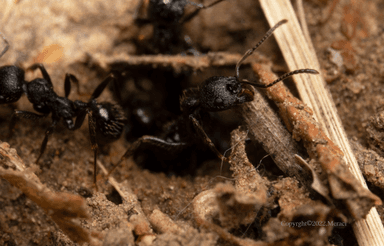
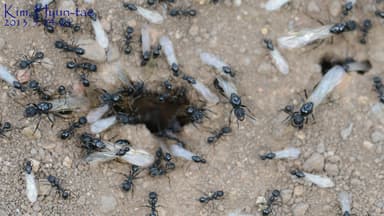
Messor aciculatus is a captivating East Asian harvester ant that offers the dedicated keeper a front-row seat to one of the most charming spectacles in the ant world: the systematic collection, storage, and milling of seeds into a granular “ant bread.” Distributed across Japan, Korea, and mainland China (GBIF occurrence data; Terayama 2009), this species inhabits open grassy slopes, roadsides, and disturbed ground, where it thrives in temperate to subtropical climates. The colony is robustly polymorphic, with a clear division into two worker castes: minor workers of 4–5 mm that tend brood and forage, and bulky major workers up to 8 mm whose oversized, blocky heads and powerful mandibles are perfectly adapted to cracking the tough coats of grass and weed seeds. The queen is a stately 10–12 mm, cloaked in a deep, glossy brown-black, while workers typically display a gradient from reddish-brown minors to darker, almost black majors (Japanese Ant Color Image Database; AntWiki). Colonies are monogynous and can slowly grow to around 5,000 individuals, a moderate size that remains manageable in captivity. Newly mated queens found claustrally after nuptial flights that occur on warm, humid afternoons following early-summer rain, typically from May to July (Terayama 2009). For the myrmecophile, the opportunity to observe a complete cycle—from a lone queen sealing herself into a chamber, to a bustling society engaged in elaborate seed processing—makes Messor aciculatus a deeply rewarding species.
Care for this ant is best described as intermediate, making it an excellent step up for keepers who have already experienced the steady rhythm of easier genera such as Lasius or Camponotus. The challenges are not rooted in aggression or rapid colony explosion, but rather in replicating a precise humidity gradient and providing a faithful seasonal diapause. Messor aciculatus is not a particularly fast or escape-prone forager; instead, the keeper must master the husbandry of stored seeds, ensuring they remain dry enough to prevent mold but not so desiccated that the ants can’t process them. This species suits the patient hobbyist who enjoys witnessing natural behaviours—majors methodically chewing seeds beside a granary pile, minors grooming the queen—more than constant surface activity. Because the colony’s rhythm is tied closely to the annual cycle of a temperate climate, anyone unwilling to provide a controlled, cold hibernation each winter should consider a more tropical ant; however, for those ready to offer a truly seasonal home, M. aciculatus is an enchanting long-term companion.
Housing must reconcile the species’ dual requirements of a slightly humid brood chamber and a truly dry granary. A favoured strategy is to use a plaster, ytong, or grouted soil nest with at least two distinct chambers: one kept at 50–60% humidity for the queen and developing larvae, and another left bone-dry, often heat-cabled to around 25–26°C, where the colony will pile its precious seed cache. The foraging arena can be a simple plastic box with a talcum-powdered rim, filled with a few centimetres of a sand-clay mix that the ants will enjoy rearranging, though they are not prolific diggers in an artificial setup. Ambient temperature across the setup should sit between 20 and 28°C, easily maintained with a small heat mat or cable attached to one side of the nest. Avoid overall high humidity; constant moisture above 60% will lead to seed spoilage and stressed workers. A well-ventilated granary chamber is the secret to success, and many experienced keepers simply place a small, dry test tube within the arena as a dedicated storage site that the ants will adopt naturally.
Diet is overwhelmingly granivorous, with seeds forming the very fabric of the colony’s nutrition. Offer a varied, year-round mix of small seeds: poppy, canary grass, chia, sesame, millet, and amaranth all work beautifully, introduced in tiny pinches on a dry card or in a shallow lid. The majors will crack and chew these into a paste that the colony consumes directly; you will rarely see them take sugary liquids, though a minute drop of honey water once a month may be accepted as a novelty. True protein requirements are modest—a single crushed fruit fly or the tip of a freshly killed mealworm once or twice a week is ample for colonies under 500 workers, and protein feeding can even be paused during extended periods of plentiful stored seeds. Water must always be present, best provided through a cotton-stoppered test tube or a small water tower positioned far from the granary to avoid accidental spills. Watch for discarded seed husks and any uneaten insect parts, removing them promptly to maintain hygiene.
One of the most critical aspects of Messor aciculatus care is the annual hibernation, which is not optional. Across its native range, winter temperatures regularly drop to single digits, and the colony’s physiology is attuned to a cold rest. In the late autumn, when brood production wanes and workers become less active, begin gradually lowering the temperature over a period of two weeks until the nest reaches a stable 8°C. A temperature-controlled wine fridge or a cold cellar works well, provided the temperature does not fluctuate wildly. During this 3–4 month diapause, the colony needs darkness, a small water source (a cotton-plugged tube is sufficient), and absolutely no food. In early spring, warm them gradually back to room temperature. Skipping or shortening this cold period will almost certainly lead to a decline in queen fecundity, a disorganized colony, and ultimately a shortened lifespan, as the Japanese ant-keeping community has long observed (Japanese Ant Database, pers. experience).
When your new colony first arrives—usually as a semi-claustral queen with a small cohort of workers in a shipping tube—resist the urge to immediately upgrade their home. Place the sealed tube in a dim, vibration-free spot at around 25°C and let them settle for 24 to 48 hours. After this rest period, connect the tube to a minimally furnished foraging arena and provide a small pile of the mixed seeds on a dry platform. Within hours you should see workers tentatively exploring and relocating seeds to the driest part of the tube; this is the critical moment to confirm your setup isn’t too humid. Do not feed protein for the first week, and wait until the worker count reaches at least 20–30 individuals before considering a nest with a dedicated granary. Keep an eye on the water tube—if condensation builds in the seed area, adjust ventilation. With quiet, patient attention, those first seeds will be nibbled into the colony’s first ant bread, and you’ll witness the quiet heart of M. aciculatus begin to beat.