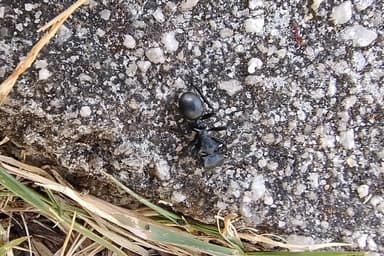
Cephalotes
Cephalotes atratus
Nuptial Flight Calendar
Flight months: Jan, Oct, Nov, Dec
Care Guide
Among the arboreal ants of the Neotropics, few species command the same awe as Cephalotes atratus, the giant turtle ant. This is a creature that seems plucked from a miniature science-fiction epic: jet‑black, heavily sclerotized, and gliding through the canopy air with a precision that defies insect gravity. Queens measure an impressive 20–25 mm, while the polymorphic workers range from 8 mm minors to robust 14 mm soldiers whose flattened, shield‑like heads are evolutionarily perfected for phragmosis — plugging nest entrances with their own bodies like living doors (Powell 2008). Mature colonies can number up to 10,000 individuals, all cooperating in the high branches from southern Brazil to the Amazon Basin and Central America. Their astonishing directed aerial descent, in which falling ants make rapid U‑turns and steer back to the tree trunk, was famously documented by Yanoviak et al. (2005), giving them the nickname “gliding ants.” A queen founds claustrally, sealing herself in a crevice to rear her first brood alone, and nuptial flights in the southern tropics occur during the early wet season (October to January), on warm, humid afternoons after fresh rains. For the dedicated keeper, Cephalotes atratus is a window into a highly specialized arboreal world, but it is a window that demands expert hands.
This species is unequivocally rated for expert‑level care, and it is not a title given lightly. Their environmental needs are narrow and unforgiving; a slip in humidity or a poorly sealed foraging area can lead to rapid colony decline or the spectacle of ants gliding off your shelf. Cephalotes atratus does not forgive improvisation. It suits the keeper who already has a solid grasp of tropical formicarium design, precise humidity control, and an escape‑proof setup. Beginners will find them stressful and likely lose their colony. The difficulty is not aggression — they are not prone to sting or bite defensively — but their physiological dependency on high, stable humidity and warmth, combined with their capacity to exploit even tiny gaps. If you have successfully maintained other demanding arboreal species like Crematogaster or Asian Colobopsis, you may be ready for the giant turtle ant.
Housing must replicate the vertical, humid hollows of a tropical tree. A tall glass or acrylic terrarium with a custom nest made of cork bark, ytong, or plaster is ideal. The nest chamber itself should maintain a constant relative humidity of 70–90%, achieved through regular misting, a water‑infused substrate layer, or an external hydration system. Temperatures must be kept within 24–30°C; a gentle heat cable on one side of the nest allows the ants to thermoregulate. Because they are canopy specialists, provide plenty of vertical climbing surfaces — sandblasted branches, rough tree‑fern panels, or textured backdrops — but avoid any surface polished enough to become an escape route. A generous application of fluon or PTFE barrier on the top rim of the foraging arena is mandatory, yet even with this, be vigilant: large workers can sometimes bridge over barriers using debris or each other’s bodies. The foraging area should be sparingly decorated with a thin layer of coco coir or sphagnum moss to aid ambient humidity, but the nest itself is best kept bare for sanitation. Incorporate narrow tunnel entrances roughly 5–7 mm wide to encourage the soldier caste’s natural door‑blocking behaviour, a fascinating display of phragmosis that remains a highlight for observers (Powell 2008).
In the wild, Cephalotes atratus forages in the canopy, lapping up plant exudates, extrafloral nectar, and scavenging small arthropods. Their diet in captivity must mirror this with a strong emphasis on carbohydrates. Offer fresh sugar water, diluted honey, or commercial ant nectar in small, shallow feeders, replacing it every other day to prevent fermentation. Protein should come from pre‑killed or appropriately sized live insects: fruit flies, pinhead crickets, chopped mealworms, or roach nymphs, provided two to three times per week. A pinch of bee pollen occasionally scattered on a leaf can be an appreciated supplement, though it is not essential. Clean water must always be available, ideally via a test tube setup or a wicking water tower. Given the high humidity, uneaten insect parts will rapidly mould, so remove leftovers within 24 hours. Mould and mites are the principal enemies of this species in captivity, and rigorous feeding hygiene is your most powerful defence.
Hibernation is entirely absent from the biography of Cephalotes atratus. They are obligately tropical and expect year‑round warmth. Do not attempt to cool them for a winter rest; any sustained drop below about 22°C will trigger a lethal decline. Keep the setup stable across all seasons. Similarly, breeding in captivity remains an elusive prize — the nuptial flight details provided here are helpful for field collection but have almost never resulted in successful captive mating. You will likely start with a single mated queen or a small founding colony obtained from a specialist retailer.
When your Cephalotes atratus colony first arrives, quietude is everything. Unpack gently and place the colony’s transport container or tube inside the prepared nest setup, allowing them to discover the new space at their own tempo. Ensure the water source is full and that a tiny droplet of sugar water is placed near the nest entrance. Then minimize disturbance: resist the urge to observe more than briefly, keep vibrations to zero, and leave the room dim. For the first 24–48 hours, simply monitor humidity and look for signs of severe stress — a queen that walks continuously in circles or workers that double‑over with curled antennae may indicate dehydration. Do not introduce insect prey until the second or third day, and even then, offer a single very small insect. A successful settlement will see the queen resting calmly in the darkest recess while a few workers explore the foraging area after a day. Patience in these early moments builds the trust that will allow you to eventually witness one of nature’s most astonishing ant behaviours: the canopy acrobats gliding home.