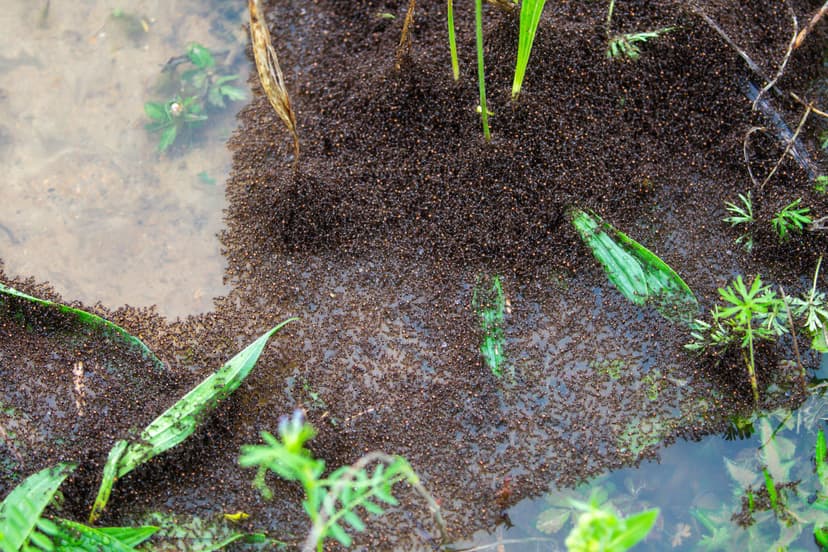
Solenopsis
Solenopsis richteri
Nuptial Flight Calendar
Flight months: Jan, Feb, Mar, Apr, May, Jun, Sep, Oct, Nov, Dec
Care Guide
Solenopsis richteri, the black imported fire ant, is a robust and endlessly fascinating species native to the temperate grasslands of South America, with a range stretching from southern Brazil through Uruguay into central Argentina. Queens measure a substantial 8 to 10 mm, while their polymorphic workers span a continuum from petite 2.5 mm minors to formidable 6 mm majors, creating a strikingly diverse workforce within a single colony. This caste dimorphism, with distinct minor and major workers, is one of the species’ most engaging traits for keepers: you can observe small nurses tending brood while large, broad-headed soldiers handle defense and heavy dissection of prey. Mature colonies can explode to 240,000 individuals, rivaling their close cousin Solenopsis invicta in sheer biomass, though S. richteri colonies typically remain monogynous and slightly less aggressive in disposition. Their deep brown to black cuticle, often with a subtle reddish tinge on the mesosoma, distinguishes them from the redder S. invicta, and their nuptial flights paint the afternoon sky in the austral summer (October through March) or, in introduced populations of the southeastern United States, during the warmer months of April to June and again in September and October, always on humid, post-rainfall days with temperatures topping 24°C (Streett et al. 2006; Tschinkel 2006).
This species is best suited to keepers with some prior ant-keeping experience, given its intermediate care difficulty. While not as aggressively escape-prone as tropical army ants, S. richteri demands respect: they sting enthusiastically when disturbed, their colonies grow with exponential speed once established, and their small size permits them to exploit gaps in even well-sealed setups. A first-time ant keeper would be overwhelmed by the logistical demands of feeding, hydrating, and containing a fast-growing fire ant colony, so I recommend this species for those who have successfully maintained a slower-growing formicarium for at least a year and are prepared for active containment protocols, including a secure outworld with a fluon barrier and regular inspections.
Housing must prioritize escape prevention and environmental stability. These ants are subterranean nesters in the wild, so they thrive in setups that mimic soil conditions: gypsum or ytong nests with a single entrance hole into a foraging arena work well, while a naturalistic soil setup is also feasible if you can manage humidity gradients. The nest should maintain a temperature gradient between 22°C at the cooler periphery and 30°C near the brood area, which can be achieved with a gentle heat mat placed under one side of the nest. Humidity is equally critical; aim for 50–70% relative humidity inside the nest chambers. A test tube water source or a regular misting regimen can maintain this, but avoid condensation that drowns workers. The foraging arena can be drier, decorated with a thin layer of sand or coconut coir, and must include a fresh water source like a byFormica liquid feeder. Substrate is not strictly necessary in the nest if using a carved formicarium, but a small amount of moist substrate in a corner can aid humidity regulation and provide material for larval cocoon spinning.
Feeding S. richteri is straightforward but requires consistency to match their rapid metabolism. As voracious omnivores, they need a balanced menu of insect protein and carbohydrates. Offer small, freshly killed insects—fruit flies, small crickets, or chopped mealworms—two to three times a week for a young colony, increasing to daily for one with thousands of workers. protein sources should be supplemented with a sugar solution: pure honey, sugar water, or a commercial ant nectar offered in a small, shallow dish or soaked into a cotton ball. The colony will also scavenge for proteins, so don’t be surprised to see workers dragging off bits of boiled egg or cat kibble. Clean up uneaten food after 24 hours to prevent mold, and ensure constant access to fresh water. During the early stages, a founding queen will rely entirely on her own metabolic reserves and does not require feeding until her first nanitics appear; this classic claustral founding strategy means you can leave a newly collected queen undisturbed in a test tube setup for several weeks (Tschinkel 2006).
One of the great conveniences of keeping S. richteri is that they do not require any form of hibernation. Native populations experience mild winters in the southern hemisphere, but their active season is year-round in captive warmth, and introduced North American colonies easily endure frosts without a true diapause. Simply maintain the nest at the recommended temperatures throughout the year, and you will avoid the stress and mortality that often accompany artificial cooling attempts. The colony will naturally slow down if temperatures dip slightly at night, but there is no need to refrigerate them for months. This trait makes them an appealing subject for continuous observation, as you never have to pause the action for a dormant period.
After purchasing a newly mated queen or a small founding colony, the first days are delicate. If you have a single queen in a test tube, place her in a darkened, vibration-free spot at 24–26°C and resist the urge to check on her more than once a week. She will lay eggs within days and may consume some of her first larvae if stressed, so minimal disturbance is key. For a small colony with a few dozen workers already present, connect the test tube to a tiny outworld and offer a micro-drop of sugar water and a pinhead cricket after 24 hours of settling. Watch for excessive clustering near the cotton plug or frantic running, which signal stress; if this occurs, re-darken the tube and wait another day. Once the workers are calmly foraging, you can begin the gradual step of transferring them into a small formicarium, but only when the colony reaches at least 30–50 workers, as premature moves often lead to colony collapse. With patience and careful husbandry, you will soon witness one of the most captivating spectacles in ant keeping: a thriving, polymorphic fire ant metropolis operating with tireless precision. (AntWiki; AntWeb; GBIF; Buren 1972)

