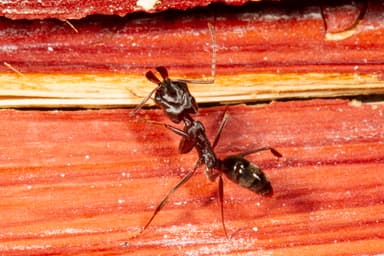
Odontomachus
Odontomachus brunneus
Nuptial Flight Calendar
Flight months: May, Jun, Jul, Aug
Care Guide
Odontomachus brunneus, known colloquially as the trap-jaw ant, is a captivating species that draws immediate attention with its formidable, elongated mandibles held permanently agape at 180 degrees. These glossy, dark reddish-brown ants range from 9 to 12 millimeters for the monomorphic workers, while the single queen reaches a slightly more robust 12 to 14 millimeters. Their colony structure remains modest, rarely exceeding 300 individuals (Hart and Tschinkel 2012), and new colonies are founded claustrally by a solitary queen who seals herself away to rear her first nanitic workers. What truly sets O. brunneus apart, however, is its explosive predatory strike — the fastest animal movement ever recorded. The mandibles snap shut at over 60 meters per second, generating forces that can stun prey or, remarkably, propel the ant backward in a defensive somersault jump (Spagna et al. 2008). Found across the southeastern United States, particularly in Florida, and ranging south through the Caribbean and Central America, these ants inhabit warm, humid leaf litter in pine flatwoods and hardwood hammocks, as documented by Deyrup (2017). Their combination of lightning-fast mechanics, manageable colony size, and year-round activity makes them a genuinely thrilling addition to any serious ant keeper’s collection.
Caring for Odontomachus brunneus is best undertaken by keepers who have moved beyond beginner species and are comfortable maintaining precise environmental conditions. The care difficulty is intermediate, not because the ants are fragile, but because their spectacular jumping ability demands an escape-proof setup and their humidity needs leave little room for neglect. This species is ideal for hobbyists who want to observe dramatic hunting behavior up close and don’t mind a slightly more hands-on approach to hydration. New keepers may find the speed of the workers startling, and the risk of losing a wandering ant during feeding or maintenance is real if enclosures lack effective barriers. A well-sealed foraging arena with a tight-fitting lid and a PTFE-based escape barrier is non-negotiable. With the right precautions, however, these ants are hardy and endlessly entertaining.
Housing must replicate the warm, humid microclimate of their native leaf litter. A temperature gradient between 22 and 28 degrees Celsius is ideal, which can often be maintained at room temperature with a gentle heat pad placed against one side of the nest if needed. Humidity is critical and should stay between 60 and 80 percent; too dry, and the brood will desiccate, while excessive condensation can lead to fungal issues. A nest made of plaster, ytong (aerated concrete), or a well-humidified gypsum design works wonderfully, as these materials wick moisture evenly and provide a surface the ants can grip. The nest should include a hydration chamber that can be filled regularly without flooding the interior. Substrate in the foraging area can be a thin layer of coco coir or sand mixed with leaf litter, offering a naturalistic hunting ground, though these ants do not excavate deep chambers. Provide small pieces of bark or crumpled leaf litter for cover, as they appreciate dark, tight spaces for retreat. Ventilation is important, but it must be balanced with humidity retention; a few small, screened holes in the foraging area lid will suffice.
The diet of Odontomachus brunneus is heavily protein-biased in the wild, with the ants using their trap-jaws to capture fast-moving springtails, small spiders, and other soft-bodied arthropods. In captivity, offer a steady supply of freshly killed or live protein feeders such as small crickets, fruit flies, roach nymphs, or mealworm segments. They will also readily accept carbohydrates in the form of sugar water, honey diluted with water, or a tiny dab of maple syrup. Always provide a clean water source within the foraging area, such as a small test-tube setup with a cotton plug, though many keepers find the ants drink from droplets on the nest walls after misting. Feed protein two to three times per week, adjusting quantities so leftovers can be removed before spoiling, and offer sugars once a week, monitoring consumption to avoid mold.
There is no hibernation period for this tropical species. Since their range extends from southern Florida to the equator, they remain active year-round, so no winter cooling is necessary. Maintain consistent warmth and humidity regardless of the season, and you can expect steady brood development with no diapause interruptions. This continuous activity is part of the appeal, allowing you to enjoy their behaviors in every month.
When your Odontomachus brunneus queen and her first workers arrive, the first few days are crucial for a smooth transition. Place the setup in a quiet, dimly lit area and resist the urge to check on them constantly. If the queen is still in her founding tube with a small clutch of eggs, simply attach the tube to the foraging arena or nest, allowing the ants to explore at their own pace. Wait at least 24 hours before offering any food. After this settling period, place a small, freshly killed fruit fly or a drop of sugar water just outside the tube entrance. Watch for the workers’ tentative foraging — they will often freeze or bounce away at vibrations before cautiously dragging the food inside. Expect them to be skittish; any sudden movement may trigger their defensive backflips, so move deliberately during observations. Check daily that the hydration remains adequate and that no mold is appearing on uneaten food. Avoid overfeeding during the small colony phase, and within a couple of weeks you will see the colony gain confidence, the queen’s egg-laying accelerate, and the characteristic trap-jaw ambush displays that make this species so extraordinary.