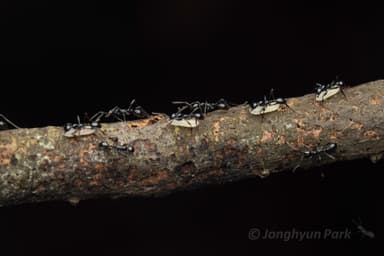
Aenictus
Aenictus laeviceps
Nuptial Flight Calendar
Flight months: Apr, May, Jun, Jul, Aug, Sep
Care Guide
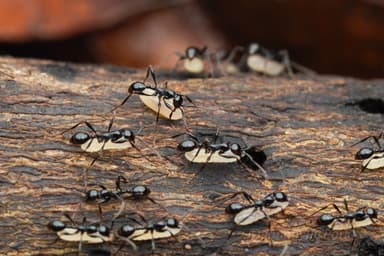
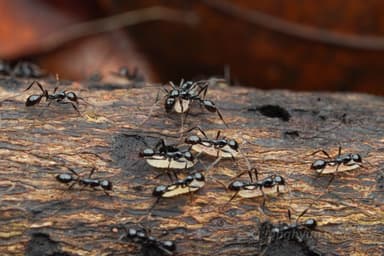
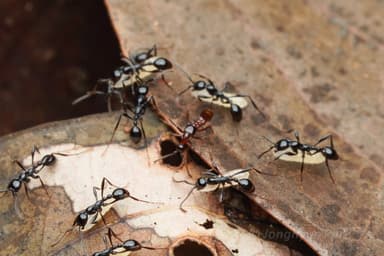
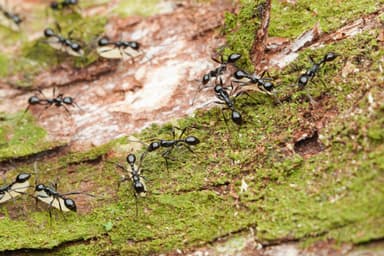
Aenictus laeviceps is one of the true army ants, a species that embodies the restless, predatory spirit of the tropical forests of Southeast Asia. Workers are slender, amber to reddish-brown, and remarkably uniform in size, typically measuring between 3 and 4.5 millimetres, with no distinct soldier subcaste. The ergatoid queen, however, is considerably larger—7 to 9 millimetres—and resembles a robust worker, lacking wings entirely. Unlike the familiar claustral queens of most garden ants, she never performs a nuptial flight; instead, colonies multiply by budding, a process in which a segment of a massive colony splits off with one or more ergatoid queens to form a new nomadic group (Jaitrong & Yamane 2011). Mature colonies can reach extraordinary sizes of up to 60,000 individuals, and their life revolves around a cycle of nomadic foraging phases alternating with stationary periods during which the queen lays eggs. What makes this species so fascinating—and so challenging—is its obligate group-raiding behaviour: thousands of workers emerge in sweeping columns to overwhelm live prey, primarily soft-bodied insects, leaving no doubt that you are witnessing a miniature ecological event right in your formicarium.
This ant is categorically graded as expert only, and that designation should not be taken lightly. Keeping Aenictus laeviceps is not a step up from Camponotus or even Pheidole; it is a completely different order of commitment. The colony’s nomadic nature means it cannot be confined to a static nest. The ants must regularly relocate their bivouac—the living cluster of workers that forms the colony’s heart—and they will relentlessly attempt to move through any barrier if the environment ceases to meet their needs. This is a species for the advanced hobbyist who has already mastered high-humidity tropical setups and who can dedicate a permanent, purpose-designed space. The ideal keeper has experience with species that require live food on a large scale, understands the intricacies of maintaining a balance between high humidity and ventilation without mould, and is prepared for a colony that will likely never be a display piece in the traditional sense. It is a scientific project as much as a pet, and the keeper must be ready to make observations and adjustments daily.
Housing a nomadic army ant colony demands a shift in thinking. There is no ready-made formicarium for Aenictus. Instead, you must provide a sizeable foraging arena—the larger the better—with vertical and overhead surfaces, as the ants naturally gravitate toward hanging bivouacs from ceilings or hollows rather than digging into soil. Temperature must be maintained in the 24 to 30°C range, with humidity continually between 70 and 90 percent. A deep, moisture-retaining substrate such as coconut coir or a plaster floor helps, but the key is to create a space where every corner can potentially become the next bivouac site. Many successful keepers use a glass or plastic terrarium with a tight-fitting, escape-proof lid lined with fluon or a similar barrier; however, Aenictus are famously adept climbers and can scale almost any dry surface, so a moat barrier is often more reliable. Inside the arena, provide loose bark, cork tubes, or a darkened, humid hide box that can be repositioned. The colony will repeatedly pack itself into a chosen crevice, completely enveloping the queen and brood. Because they move their bivouac as local prey is depleted, the whole habitat must remain hospitable. A gentle temperature gradient can be created with a heat mat attached to one side, but never allow hotspots above 30°C, and ensure the humid zone never dries out. Ventilation must be carefully controlled—enough to prevent stagnant air, but never so much that the humidity drops.
Diet is, alongside housing, the greatest logistical hurdle. Aenictus laeviceps is an obligate mass-foraging predator that takes only live prey. Their natural diet consists heavily of other ants, termites, and soft-bodied arthropods (Gotwald 1995; Hashimoto et al. 1997). In captivity, the colony will need a constant and substantial supply of suitable insects: fruit flies, small crickets, mealworms up to a few millimetres, termites if you can culture them, and small roaches. Prey must be moving to elicit the famous raiding response; dead food is almost entirely ignored. A colony numbering thousands can consume dozens of cricket nymphs per day, so you must maintain feeder cultures on a scale to match. Water is obtained from prey moisture and from the humid environment, but a small test-tube waterer with a cotton plug placed in the arena will be used opportunistically. Do not offer sugar water, honey, or nectar—army ants are not adapted to liquid carbohydrates, and such offerings will quickly foul the setup. Feed in the evening, when raiding activity naturally peaks, and remove uneaten prey bodies promptly to keep the high-humidity microcosm clean.
No hibernation or diapause is required for this strictly tropical species. Aenictus laeviceps ranges from the Indian subcontinent through mainland Southeast Asia into the Malay Archipelago, where temperatures are consistently warm and day length varies little. In captivity, you must maintain a stable warm regime year-round, never dropping below 24°C. An artificial winter would be fatal. The colony’s reproductive cycle is tied to the availability of food rather than seasonal cues, so if you provide a continuous feast, the queen can generate brood almost perpetually, only pausing during the stationary phase when larvae pupate. Keeping conditions constant is the simplest part of their care; the real challenge is sustaining the daily pulse of live prey and the migrant bivouac.
The first days after receiving your Aenictus laeviceps colony—typically a queenright fragment in a ventilated container—are a critical settling period. Your pre-conditioned arena must already be at target temperature and humidity. Place the open transport vial or tube inside the arena in a shaded corner, and give the ants time to discover their new world; they will usually begin exploring at dusk. Do not attempt to shake them out or manipulate them. Offer a small quantity of tiny live prey immediately: wingless fruit flies or pinhead crickets are ideal. Watch for the moment the ants recruit to the prey in a miniature column—this raiding behaviour is a sign they accept the space. The most important observation is to confirm the ergatoid queen is present, undamaged, and moving with the bivouac cluster. Without her, the colony is doomed. In the first few days, you may see them form a bivouac against the enclosure wall; this is normal, and they may shift it several times. Keep disturbance to an absolute minimum—no tapping the glass, no sudden light changes. If after 24 hours the ants remain scattered and no food is taken, gently increase humidity or offer a more sheltered nook. Be patient: a successfully established army ant colony is among the most thrilling displays of coordinated insect behaviour a specialist keeper can witness, but it demands unwavering respect for their relentless, nomadic rhythm.