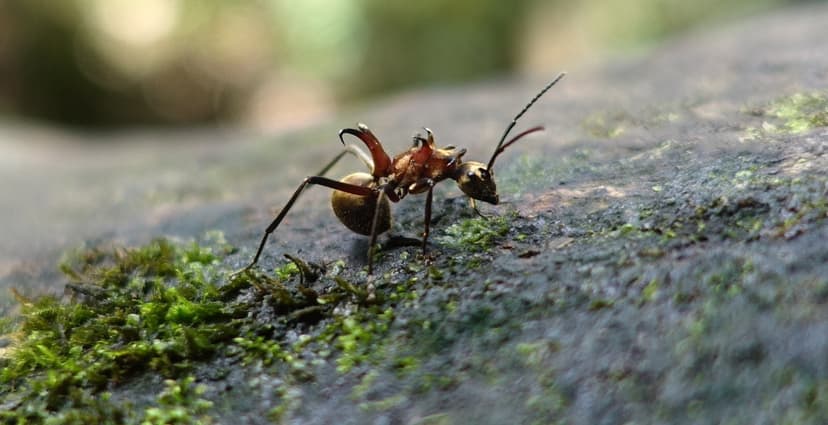
Polyrhachis
Polyrhachis bihamata
Nuptial Flight Calendar
Flight months: Apr, May, Jun, Sep, Oct
Care Guide
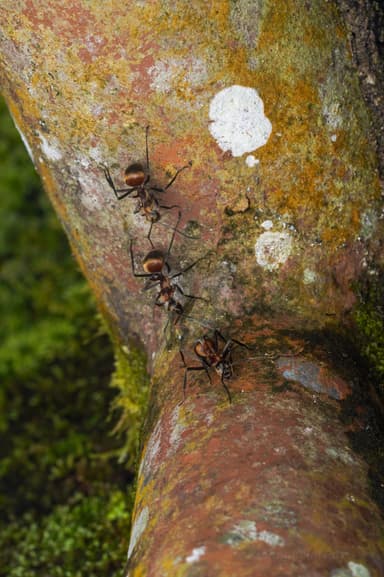
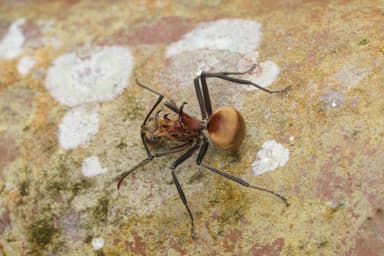
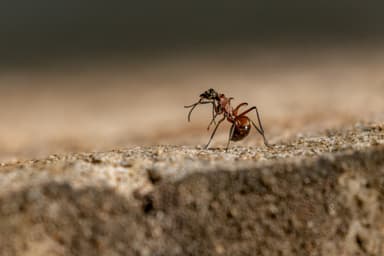
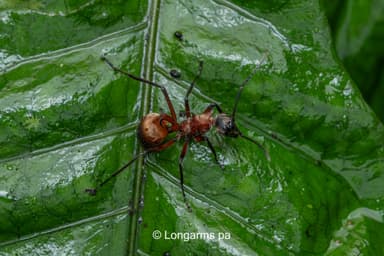
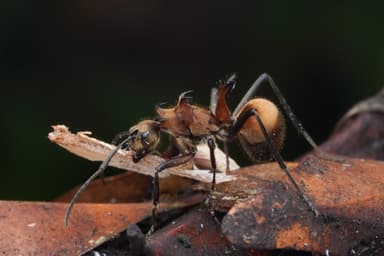
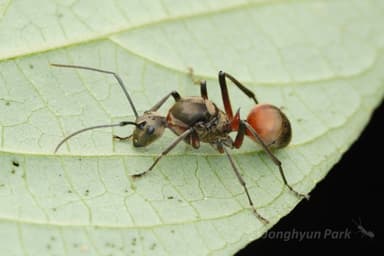
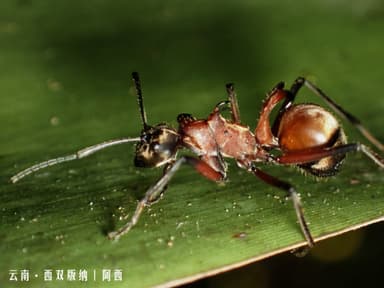
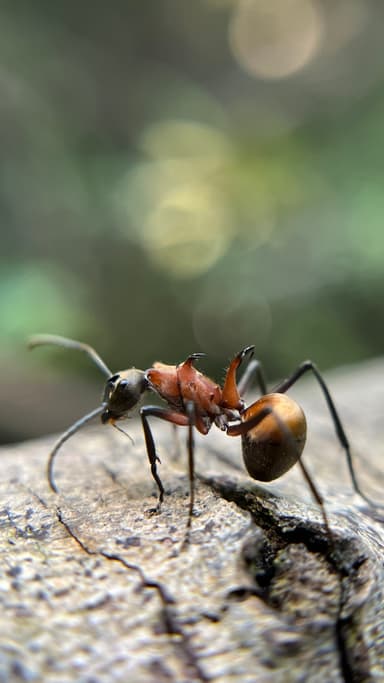
Few ants capture the imagination of the seasoned collector quite like Polyrhachis bihamata, a spectacularly armoured species that looks as though it marched straight out of a Mesozoic diorama. Queens measure a robust 14 to 16 millimetres, while their monomorphic workers range from 10 to 13 millimetres, each bearing the hallmark that makes this ant instantly recognizable: two enormous, forward-curving pronotal spines and an equally fierce pair of petiolar hooks. Mature colonies can grow to around 3,000 individuals, and new queens found their nests claustrally, sealing themselves away to raise the first generation from internal reserves. The species belongs to the subgenus Myrmhopla, a group exhaustively revised by both Dorow (1995) and Kohout (2008), and its native range, as documented by GBIF occurrence data, stretches across tropical Asia from the Indian subcontinent through the Indonesian archipelago, roughly between 72°E and 141°E and from 10°S to 28°N. Beyond its dramatic silhouette, P. bihamata weaves larval silk into elaborate arboreal carton nests, a behaviour that adds a layer of constant visual theatre to the keeping experience.
This is not an ant for the absolute beginner, yet a keeper who has successfully maintained a stable, high-humidity tropical setup will find the challenge entirely manageable. The intermediate care rating reflects a need for attentive environmental control rather than any particularly fragile constitution. Anyone comfortable with daily misting routines, monitoring analogue or digital hygrometers, and preventing stagnant air will be well prepared. The colony’s lack of polymorphism—there is only a single worker caste—simplifies husbandry somewhat, as you are not navigating the varied dietary demands of major and minor workers. That said, the species does best when kept by a hobbyist who can invest time in observing subtle cues: a sudden reluctance to forage or a preference for one corner of the nest often signals a humidity imbalance. Those who thrive on the ritual of microclimate management will find P. bihamata a deeply rewarding centrepiece.
A visually striking ant deserves a setting that both supports its health and showcases its natural behaviours. The enclosure should hold a constant temperature between 22 and 30°C, with a gentle gradient so the ants can self-regulate; a small heat mat taped to one external side of a glass or acrylic arena works well. Humidity is paramount, and the target band of 60 to 80 percent is best achieved with a deep, moisture-retentive substrate—coconut fibre blended with a little fine sand or clay holds moisture beautifully without becoming waterlogged. Because this species naturally builds silk nests around stems and branches in the wild, the outworld needs a three-dimensional framework of twigs, cork bark, and slender branches anchored vertically and diagonally. The ants will select a junction and begin weaving, a process that can take days and is a marvel to witness. A small water dish with a pebble or a cotton-plugged test tube serves as a drinking station, and gentle cross-ventilation prevents mould without desiccating the air. If you provide a pre-made plaster or ytong nest, offer only a small entrance; the colony will typically prefer to modify a naturalistic arboreal site instead.
Feeding Polyrhachis bihamata is straightforward, following the omnivorous pattern typical of the genus. Protein should come from soft-bodied live insects—flightless fruit flies, small crickets, or freshly killed mealworm segments—offered two or three times a week depending on brood volume. Carbohydrates are equally critical and can be supplied as a thin streak of honey, a cotton wick dipped in sugar water, or a slice of ripe mango placed on a feeding platform. Always provide free water. Be meticulous about removing uneaten prey within 24 hours to keep mites and mould at bay, especially given the high humidity. During the founding stage and the first few weeks of a young colony, the queen will not forage, relying entirely on her claustral reserves; once the first workers emerge, start with minuscule protein portions and a tiny droplet of sugar water, gradually increasing as the population grows. The combination of a steady carbohydrate source and a clean protein supply encourages steady brood production, and a healthy colony will exhibit constant, deliberate movement throughout their arboreal scaffolding.
*Polyrhachis bihamata* does not hibernate. Its tropical lowland origins dictate year-round warmth and activity, and there is no evidence of even a facultative diapause. Nuptial flight records, albeit with low confidence, suggest that alates fly in the evening during the monsoon transition months of April to June and again in September and October, when conditions are warm and sodden. For the keeper, this means the heating and humidity regime you establish on day one should remain consistent indefinitely. Seasonal shifts in the ant room, such as a winter drop in ambient humidity, need to be compensated with increased misting or a partial enclosure cover to hold moisture. The absence of a rest period accelerates colony growth relative to temperate ants, so be prepared for the nest to expand steadily, and plan a larger enclosure or satellite nests from the outset.
The arrival of your new colony is a delicate interlude. Place the shipping container or tube in the prepared, climate-stabilized enclosure and leave it undisturbed in gentle darkness for at least 24 to 48 hours. After this settling period, offer a tiny, easily accessible cotton ball soaked in sugar water just outside the nest entrance; watch for a worker to cautiously investigate. Do not introduce live prey until you see confident foraging and trophallaxis. Avoid the temptation to peek frequently—stress during these first days can cause the queen to stop laying or, worse, lead to the colony abandoning the nest. Within a week, you should see the first workers weaving silk at a chosen branch junction, a sign that they have accepted their new home and are ready to be gradually brought into your routine of feeding and observation. Steady, patient start-up care will be repaid tenfold as this living jewel of the Myrmhopla subgenus flourishes under your care.