Odontomachus
Odontomachus bauri
Nuptial Flight Calendar
Flight months: Mar, Apr, May, Oct, Nov
Care Guide
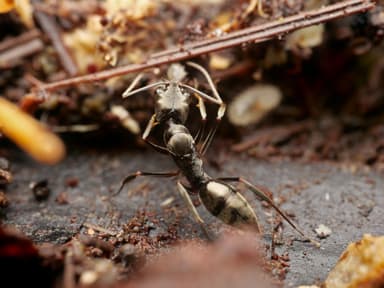
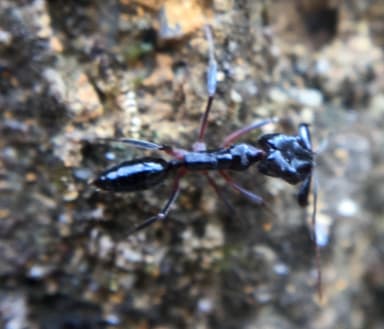
Odontomachus bauri is a trap-jaw ant that mesmerizes keepers with its astonishing biological toolkit. Workers are monomorphic, ranging from 9 to 12 mm, while queens are slightly heftier at 11 to 13 mm (AntWeb). Their slender, amber-to-chestnut bodies and long, tooth-tipped mandibles that lie parallel to the head give them an unmistakable, almost sinister elegance. Colonies stay modest, rarely exceeding 200 workers, and founding is claustral, meaning the queen seals herself away and relies on her own reserves to raise the first generation. What captivates scientists and hobbyists alike is the ant’s lightning mandible strike, one of the fastest animal movements known, clocking in at over 60 meters per second. Patek et al. (2006) revealed that this closing motion serves a dual purpose: it impales soft-bodied prey and can launch the ant several centimeters backward to evade threats, a behavior coined the “bouncer escape.” This explosiveness transforms the simple act of opening a lid into a potential jailbreak, making O. bauri a living spectacle that demands both respect and a thoughtfully engineered home. Their native range sprawls across the Neotropics, from southern Mexico through Central America and deep into South America (Brown 1976), where they inhabit warm, humid lowland forests and forage actively in leaf litter.
With an intermediate care rating, Odontomachus bauri is best suited to keepers who have successfully overwintered a few beginner species and now crave a more dynamic and attentive husbandry rhythm. The sting is mild but memorable, and the jump response means a lid left ajar can result in ants parkouring around the room. Yet for those willing to invest in proper containment, the rewards are constant: you will observe predatory strikes too fast for the eye to follow, meticulous brood nursing, and a colony that pulses with nocturnal energy. Because colonies remain small, the spatial footprint is modest, but the margin for error in humidity or temperature is notably tighter than for hardier temperate species, making this ant a focused yet manageable challenge.
Housing must replicate the steamy forest floor. Maintain a temperature gradient between 22 and 28°C, with relative humidity firmly in the 70–85% range (AntWiki). A plaster, ytong, or 3D-printed gypsum nest insert works beautifully, as long as it can be kept evenly moist without flooding; these materials wick water and prevent droplet formation that can drown tiny larvae. For the foraging arena, a deep layer of a sand–coco peat or fine bark mix gives workers the textured substrate they naturally excavate and patrol. Because a single mandible snap can fling an ant several centimeters high, a simple fluon barrier is rarely enough. Use a tightly sealing lid with a gasket or a vertically extended barrier at least 10 cm tall, and never skip a secondary containment tray. Add curved cork bark pieces, a scattering of leaf litter, and a few fragments of decayed hardwood to create hiding places and to trigger their nest-remodeling instincts.
In the wild, O. bauri is a specialist predator of soft-bodied arthropods, particularly termites, fly larvae, and freshly molted crickets (Ehmer & Hölldobler 1995). Offer a steady rotation of live or freshly killed insects: flightless fruit flies, small crickets, chopped mealworms, and termites are all eagerly accepted. Because they cue heavily on movement, gently wiggling a pre-killed insect with forceps can elicit a strike if the item is initially ignored. Supplement this protein diet with a carbohydrate station: a small wick of cotton soaked in honey water or a slice of ripe mango, placed as far from the nest entrance as possible to reduce mold risk. Always provide a clean water source, such as a test-tube drinker with a cotton plug, and refill it regularly. Feed two to three times weekly, removing leftovers after 24 hours, and always approach the arena slowly to avoid triggering a mass jump response.
Odontomachus bauri has no hibernation requirement; being strictly tropical, they remain active year-round, and you should simply sustain their warm, moist conditions without a winter cooling period. In the Neotropics, nuptial flights apparently occur in the wet season, often in the evening hours after a soaking rain, with records clustering around March to May and October to November, though the exact timing is still poorly documented. When you first receive your queen and her fledgling workers, place the formicarium in a dim, vibration-free spot and cover it with a red film or cloth. Resist the urge to feed for the first 24 to 48 hours; instead, verify that the humidity is stable and that no escape routes exist. Once you see a worker tentatively patrolling the arena, offer a single pre-killed fruit fly and a tiny droplet of sugar water on a slip of waxed paper. Watch for signs of stress, such as constant grooming at the lid or refusing to carry prey back to the nest—these may indicate that the environment needs adjustment. With patience and close attention, your colony will settle into a rhythm, and you will be treated to a front-row seat to one of the most dramatic predatory performances in the ant kingdom.