Formica
Formica paralugubris
Nuptial Flight Calendar
Flight months: May, Jun, Jul
Care Guide
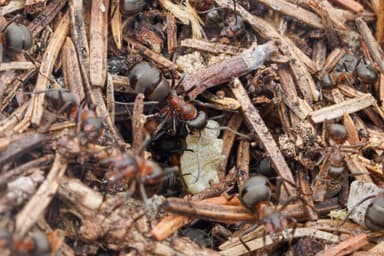
Formica paralugubris is a remarkable wood ant of the Formica rufa group, endemic to the alpine arc that sweeps from Switzerland through Italy and France. Workers exhibit distinct polymorphism with minor and major subcastes spanning 4.5 to 9 mm, while queens reach an imposing 9–11 mm. The bicoloured body—a deep reddish-brown head and thorax contrasting with a darker, velvety gaster—makes them instantly recognisable among mound-building species. Mature colonies can swell to a staggering one million individuals, constructing vast thatched mounds from conifer needles and resin, a behaviour that naturally incorporates antimicrobial tree resins (Castella et al. 2008). Unlike many ants that rely on independent claustral founding, F. paralugubris reproduces via budding, where a newly mated queen seeks to infiltrate a host colony or depart with a retinue of workers to establish a new nest. This social strategy, coupled with intranidal mating on warm, sunny afternoons in June and July after rain (Seifert 2018), makes their reproduction a captivating but challenging spectacle for the dedicated keeper.
This is unquestionably a species for the expert ant keeper. The sheer size a healthy colony can attain, the intricate humidity and temperature gradients required, and their bustling, highly defensive nature place them firmly outside the realm of beginner-friendly ants. Anyone attempting to keep F. paralugubris must be prepared for a long-term commitment to a large, dynamic setup that can accommodate millions of active foragers and their elaborate nest architecture. They are not a species that tolerates neglect; their substantial dietary demands, precise seasonal rhythms, and tendency to spray formic acid when disturbed demand constant vigilance and a deep understanding of formicine biology. If you have not already mastered the husbandry of more forgiving, slower-growing species, this ant will quickly overwhelm even the most enthusiastic novice. Yet for the advanced myrmecologist, their complex social organisation and the sheer spectacle of a thriving supercolony offer an unparalleled window into the life of a true alpine giant.
Providing adequate housing is the greatest logistical challenge. A purpose-built formicarium must accommodate a mature colony that can exceed a million workers, meaning a sprawling multi-chamber setup or a large naturalistic terrarium is essential rather than a small acrylic nest. The core nest chamber should maintain a stable temperature gradient between 18°C and 26°C, with a basking spot at the warmer end that never surpasses this upper limit, as sustained heat stress can be lethal. Relative humidity must be kept within 50–70%, with good ventilation to prevent stagnation and mould in their dense thatching material. The substrate itself should be deep enough to allow the ants to construct a mound; a mix of pine needles, finely shredded bark, and coarse sand works well, mimicking their native coniferous forest floor. Crucially, F. paralugubris will instinctively weave resin and debris into a cohesive nest structure, so providing small amounts of fresh fir or spruce resin can encourage natural building behaviour, though this must be monitored to avoid excessive stickiness that traps workers. An escape-proof barrier is non-negotiable; these ants are accomplished climbers and will exploit any gap, so a tight-fitting lid with a PTFE-based barrier or a moat system is required.
Diet must reflect their role as voracious predators and avid honeydew collectors. In the wild, they form mutualisms with aphids, and their carbohydrate needs are best met with a constant supply of diluted honey, sugar water, or an artificial honeydew substitute. This should be offered in a separate foraging arena, refreshed daily to prevent fermentation. For protein, F. paralugubris will readily tackle large insect prey, and a rotation of crickets, mealworms, and small cockroaches—gut-loaded and freshly killed—provides balanced nutrition. Given their immense colony size, feeding must be generous and frequent; a large colony may consume dozens of insects daily during the active season. Water is essential both for drinking and for maintaining nest humidity. Always provide a clean water source via a test tube or water tower, and consider misting a portion of the substrate lightly if the air becomes too dry, though never to the point of sogginess.
Hibernation is an absolute requirement and among the most critical periods in their annual cycle. F. paralugubris endures harsh alpine winters, and in captivity they demand a consistent cold period at around 5°C for three to four months. Preparation begins in late autumn by gradually reducing temperatures and withholding protein, allowing the colony to clear their digestive tracts. The nest should be kept at this stable, low temperature, ideally in a dedicated refrigerator or cool cellar that avoids temperature fluctuations above 8°C or below freezing. During this time the ants will cluster deep within their mound, barely moving; disturbances should be kept to an absolute minimum. A successful, undisturbed hibernation is the key to triggering egg-laying and healthy brood development the following spring, and failing to provide a sufficiently cold dormancy will lead to a dwindling, lethargic colony that may never recover full vigour.
Upon receiving a newly acquired F. paralugubris queen with her first workers, patience becomes your most valuable tool. Transfer them gently into a temporary, smaller setup that offers a tight humidity gradient and a secure, dark chamber, as the stress of transport can easily send a small founding unit into decline. Do not attempt to introduce them to a large arena immediately; instead, allow them to settle for at least 24 hours in darkness before offering a tiny dab of honey on a piece of foil and a single pre-killed fruit fly, placed near the nest entrance. Resist the urge to check on them constantly, as excessive vibration or light can cause the queen to stop laying or workers to become hyper-agitated. Monitor that the brood pile remains plump and that workers are tending the queen, and only after a few days of consistent feeding and calm behaviour should you consider moving them to their long-term, expansive nest. From that point forward, your role is to quietly orchestrate the conditions that will allow their colony to swell from a fragile handful of ants into a thrumming, million-strong mound that mirrors the alpine slopes from which they came.