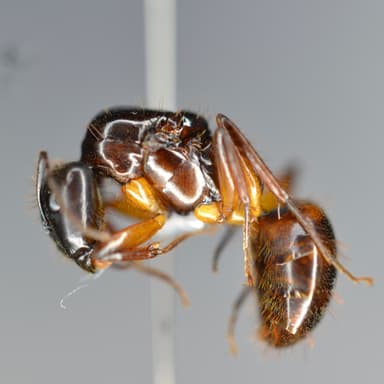
Camponotus
Camponotus atriceps
Nuptial Flight Calendar
Flight months: Jan, Feb, May, Jun, Jul, Aug, Oct, Nov, Dec
Care Guide
Camponotus atriceps is a remarkable carpenter ant with a vast natural range that stretches from the southernmost United States through Mexico and deep into South America, as far as northern Argentina and Paraguay. This geographic breadth, documented in specimen records from AntWeb and GBIF, hints at the species’ adaptability, but in captivity it reveals itself as a study in neotropical elegance. Queens measure a robust 15 to 18 millimeters, while their polymorphic workers span a dramatic 6 to 14 millimeters. The colony structure is defined by distinct minor and major workers, the latter sporting massively developed heads and mandibles that make them instantly recognizable. A mature colony can number upwards of 10,000 individuals, a density that creates a truly bustling microcosm. What makes this species especially captivating is its nocturnal foraging rhythm—workers emerge in darkness to coordinate trails and process resources, a behavior explored in depth by Hölldobler & Wilson (1990). Their ability to excavate living wood with powerful mandibles, while not aggressive toward keepers, lends a constant sense of architecture and industry to the formicarium.
Falling squarely into the intermediate care tier, Camponotus atriceps is best suited for keepers who have moved beyond beginner species and are comfortable maintaining controlled microclimates. There is no diapause requirement, which simplifies the yearly cycle, but the absence of a winter rest means the colony remains active and metabolically demanding every month. The primary challenge lies in providing unwavering warmth and humidity, as fluctuations can quickly stress the brood and provoke erratic behavior. First-timers may underestimate how rapidly a healthy founding colony expands once established, so prospective keepers should plan for housing upgrades that accommodate a large, polymorphic workforce. A patient, observant approach is rewarded; they are not a species that tolerates frequent disturbance, but for the dedicated hobbyist, the sight of a major worker delicately processing a prey item or the nightly exodus of foragers is deeply satisfying.
Housing must reflect the species’ tropical origins and wood-nesting proclivities. A temperature gradient between 22 and 30 degrees Celsius is non-negotiable, with a warm spot around 28°C located at one end of the nest to allow self-regulation. This is easily achieved with a heat cable or mat placed externally, as documented in Mackay & Mackay’s (2019) regional genus review. Humidity should stay within 50 to 70 percent, and many keepers find success with a plaster, Ytong, or 3D-printed nest that includes a hydration chamber for gradual evaporation. While Camponotus atriceps will readily excavate softwood given the opportunity, a simpler setup with a hardened plaster interior prevents uncontrolled tunneling and simplifies monitoring. A large outworld connected to the nest should contain a mixture of sand and soil along with bark pieces and small hardwood branches for texture; a tight-fitting lid and a slick PTFE barrier around the rim are essential, as these ants are accomplished escape artists that patrol enclosure boundaries nightly.
Feeding mirrors the species’ dual need for protein to fuel brood growth and carbohydrates to sustain the adult workforce. Worker ants eagerly accept chopped crickets, small roaches, and mealworms, always pre-killed or stunned to prevent injury to the colony. As the colony swells, the size and frequency of protein offerings must increase accordingly. Sugars can be provided as honey water or cut fruit such as apple and banana, presented on a small foil tray for easy removal. A fresh water source should always be available, ideally via a test tube plugged with cotton, as open dishes quickly foul. Because foraging peaks after dusk, place food items in the outworld during the early evening and clear away any remains by morning to keep mold and mites at bay.
One of the most attractive husbandry traits is that Camponotus atriceps requires no hibernation. Originating from lowland regions where seasons are defined by rainfall rather than cold, they flourish under consistent warmth throughout the year. Keepers can maintain the same temperature and feeding schedule without inducing a stressful cool phase. Some colonies may exhibit a subtle slowdown in brood production if the ambient temperature dips slightly in winter, but this is not a biologically necessary signal. A steady 25–27°C range keeps them in perpetual rhythm.
Upon receiving a newly mated queen, the first days are decisive. She will arrive inside a test tube setup, where claustral founding means she needs nothing but darkness and quiet. Place her tube in a warm spot around 26°C and resist all temptation to check her for at least five to seven days; constant interruption can cause her to eat her eggs in panic. Once the first tiny minor workers eclose—typically after six to eight weeks—introduce a microdot of sugar water and a minute piece of soft-bodied prey, such as a fruit fly. Watch for calm, purposeful behavior: workers grooming the queen and gently foraging on the cotton plug. If they appear restless, repeatedly pulling at the plug or clustering far from the water reservoir, humidity may be too low or temperature uneven. After twenty to thirty workers are present, you can gently connect the tube to a small outworld, and from that point on, the colony will steadily unfold into one of the most engaging and majestic displays the ant-keeping hobby can offer.