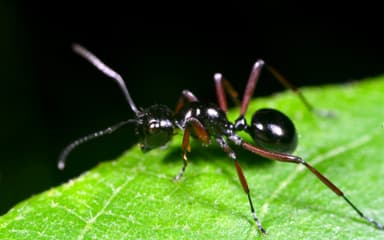
Polyrhachis
Polyrhachis rastellata
Nuptial Flight Calendar
Flight months: Jan, Apr, May, Jun, Jul, Aug, Sep, Oct
Care Guide
Polyrhachis rastellata is a visually stunning arboreal ant native to the tropical and subtropical forests of Southeast Asia, ranging from India and Sri Lanka eastward through Indonesia and north to southern China, as reflected in GBIF occurrence data. Queens measure a robust 9–11 mm, while the monomorphic workers range from 6.5–8.5 mm, all bearing the metallic bronzed to blackish sheen and strong thoracic spines typical of the subgenus Polyrhachis. Colonies are modest in size for a tropical formicine, reaching up to around 3,000 workers, and are founded claustrally by a single queen. What makes this species particularly captivating is its nest-building behavior: workers construct elaborate carton nests from chewed plant fibers bound with larval silk, often incorporating living foliage or bark crevices (Robson & Kohout 2007). These structures can resemble a patch of rough tissue paper plastered onto a branch, and observing the ants weaving fresh material into the walls offers a window into some of the most sophisticated construction in the ant world.
Care difficulty is intermediate, making P. rastellata best suited for keepers who have already mastered foundation species and are comfortable maintaining stable humidity and temperature. The colony’s need for a vertical, arboreal setup with reliable moisture gradients means that absolute beginners may struggle, but anyone experienced with tropical Camponotus or other tree-dwelling ants will find it a rewarding challenge. The claustral founding phase requires patience; the queen will not need to be fed until her first workers arrive, but she must not be disturbed during this sensitive period. Once workers eclose, the colony grows at a moderate pace, and their diurnal activity and intricate nest maintenance provide endless fascination.
Housing must replicate the warm, humid arboreal niche this species occupies. Aim for a temperature gradient of 22–28 °C, ideally with a daytime peak around 26–28 °C dropping slightly at night. Humidity should be maintained between 60–80%, with the nest interior kept towards the higher end to prevent desiccation of brood and the silk-bound carton, which can crack if too dry. A vertical formicarium with natural materials is essential: cork bark, hollow branches, or a glass-and-cork sandwich with a removable cover works well, as workers will readily weave nest walls using provided plant debris and silk from mature larvae. The outworld should be generously sized, furnished with smooth climbing branches (this species is a nimble climber) and a moisture-retentive substrate like coco coir to support ambient humidity without soaking the nest. Good cross-ventilation is critical to prevent mould in the carton, but direct airflow on the nest should be avoided. Many successful keepers house these ants in well-planted terrariums where live plants help buffer humidity, mimicking the sheltered tree-canopy conditions noted by Kohout (2006).
Diet must supply both protein and carbohydrates, with a strong preference for small, soft-bodied insect prey and sugary liquids. Offer freshly killed fruit flies, small crickets, or chopped mealworms two to three times per week; workers will also readily accept insect-based jellies. The carbohydrate portion can be provided as a dilute honey-water mixture, maple syrup, or a commercial formicarian nectar, refreshed frequently to prevent fermentation. In nature, P. rastellata likely gathers plant sap and honeydew from hemipterans, so ensuring a constant carbohydrate source is important for colony vigor. Fresh water must be available at all times, ideally through a water-filled test tube with a cotton wick, placed in the outworld away from the nest to avoid flooding the carton.
No hibernation or winter diapause is required for this purely tropical species. It can be kept at the same temperature and humidity year-round, with no need to simulate a seasonal cool-down. The absence of a resting phase means the colony remains active, feeding, and producing brood continuously, which is one of its great appeals for keepers who dislike downtime. This also means that maintenance must be consistent: never let the humidity drop drastically, as a single drying event can irreparably damage the paper-like nest and stress the brood.
When your queen or small colony first arrives, the priority is to minimize stress and allow them to settle. If you have purchased a founding queen, keep her in the test tube setup she arrived in, placed in a dark, quiet area at 24–26 °C for at least 48 hours before even thinking about checking on her. Do not offer food until she has her first workers; she will nourish the initial larvae entirely from her body reserves. For a colony with workers, connect the transport tube to a prepared arboreal nest and outworld, cover everything with a red film or cloth to maintain darkness, and leave them undisturbed for 24 hours. After that, place a tiny drop of sugar water near the nest entrance and a pre-killed fruit fly in the outworld, retreating immediately to give them confidence to forage. Watch for telltale signs of acceptance: workers patrolling the new terrain and beginning to gather debris for their carton are excellent indicators that they are settling in. Avoid re-opening the setup or introducing large prey items during this critical first week, and if the ants seem hesitant, simply re-cover and wait—patience is the key to a thriving Polyrhachis rastellata colony.