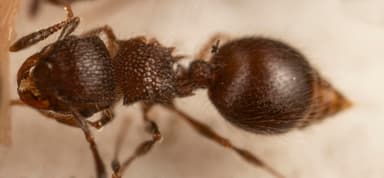
Meranoplus
Meranoplus peringueyi
Nuptial Flight Calendar
Flight months: Jan, Feb, Oct, Nov, Dec
Care Guide
Few ants in the southern African arid zone capture the imagination quite like Meranoplus peringueyi, a diminutive myrmicine whose armour-plated appearance and dramatic defensive displays make it a true conversation piece. Workers measure between 3.5 and 5 mm, while queens reach a robust 5.5 to 7 mm, and the entire colony rarely exceeds about 500 individuals. There is no true worker polymorphism — only a single minor-worker caste — but what the species lacks in complex division of labour it more than makes up for in personality. The most striking feature is the broad, shield-like pronotum fringed with lateral spines, giving the ant an almost trilobite-like silhouette under magnification (Bolton 1981). When threatened, instead of fleeing or attacking, workers often curl into a tight ball and remain motionless, a thanatosis display that startles would-be predators. This behaviour, combined with a slow, deliberate gait and a habit of tapping the substrate with their antennae, makes observing a foraging M. peringueyi colony a uniquely meditative experience. In the wild, the species is restricted to the winter-rainfall and coastal fringes of western South Africa and Namibia, roughly between 22° and 34.5° south and 14.5° and 32° east, where it nests directly in sandy soil and often constructs a small, thatched mound around the entrance.
Caring for Meranoplus peringueyi is decidedly not a beginner’s undertaking. The semi-claustral founding strategy means that a newly mated queen must leave her brood chamber regularly to forage, so she requires food from day one — insects and seeds must be provided throughout the founding period, and she is easily stressed by excessive disturbance. Added to that, workers of this genus are notorious escape artists: they can scale smooth glass and plastic with ease, so a full fluon or PTFE barrier of the highest quality is non-negotiable, together with a tightly fitting lid on any outworld. Colonies grow at a glacial pace, and brood rearing is sensitive to moisture fluctuations. The expert rating is therefore earned not because the ants are aggressive or venomous, but because their husbandry demands constant vigilance, patience, and a willingness to micro-manage the environment. The reward is a long-lived, visually arresting colony that will fascinate anyone with a taste for the unusual, but those still learning the basics of ant-keeping would do better to start with a more forgiving claustral species.
Replicating the sun-baked savannah and fynbos soils of the native range is key to housing these ants successfully. The thermal envelope spans 22–32 °C, with a distinct gradient preferred: a warm end of around 30 °C, often provided by a small heat mat taped to one side of the nest, and a cooler retreat at the opposite end. Humidity needs to remain low, between 30 and 60 %. A plaster, ytong, or ultracal nest block with shallow chambers works well, as it allows a tiny amount of moisture to be added to one corner via a water port, creating a gentle humidity gradient without saturating the air. In the outworld, use a deep layer of dry sand or a sand-loam mix; many keepers add a few flat stones or a piece of cork bark under which the ants will often cluster. A water source must always be available, but choose a method that minimises evaporation into the nest — a small test tube with a cotton plug, placed on the dry side, is ideal. Because these ants are so adept at climbing, the entire setup should be treated as a high-security enclosure: inspect fluon coatings weekly and never assume a lid is tight enough without a fine-mesh or foam seal.
Diet in captivity should reflect the species’ naturally omnivorous, partly granivorous habits. Small seeds — grass seeds, amaranth, chia, or crushed nyjer — are taken eagerly and stored in dry nest chambers, serving as a carbohydrate larder. Protein is equally crucial, especially for brood production; offer freshly killed or live fruit flies, pinhead crickets, chopped mealworms, or small termites two to three times a week, removing uneaten pieces promptly to prevent mould in the arid environment. Although not particularly attracted to liquid sugars, they will occasionally sip from a soaked cotton ball of sugar water or dilute honey, and such a treat can help a stressed colony recover. For the founding queen, provide a minute drop of sugar and a pre-killed fruit fly within the first 24 hours, and then every second day thereafter — starvation is the single greatest cause of failure during the semi-claustral phase. Always dust insect prey with a calcium or vitamin supplement occasionally if the colony is fed exclusively on captive-bred feeders.
No hibernation is required. Meranoplus peringueyi hails from a latitude where seasonal temperature swings are modest, and the research data confirm that a true diapause is absent; cooling below 22 °C for prolonged periods will be detrimental, not beneficial. You can keep the colony at a steady 25–28 °C year-round with no ill effects. Some advanced keepers choose to introduce a slight photoperiod adjustment, shortening the light cycle by a couple of hours during the austral winter (roughly May to August), but this is purely optional and the ants will continue to raise brood regardless. Nuptial flights in the wild reportedly occur during the warmer months, from October to February, triggered by the first good rains of the season; in captivity, alates are rarely produced in colonies this small, and no special seasonal cues are needed for routine care.
When your Meranoplus peringueyi queen or colony first arrives, resist the temptation to gawp. Place the set-up in a quiet, dimly lit spot and allow 24 hours of undisturbed settling. For a solo queen, immediately introduce a tiny dab of sugar water and a pre-killed fruit fly directly into her tube or chamber, then check the next day to see if she has fed — if not, remove the insect, wait a day, and try again. A small colony with workers should be connected to its outworld straight away, but do not offer food until the second day; they will first explore every millimetre of their new territory and test the barriers thoroughly. Expect to see workers freezing in their characteristic curled posture when you enter the room — this is normal and will diminish as they become habituated. The single most important job during the first week is to verify that the anti-escape barrier is effective, because a single undetected worker on the outside can quickly summon others to follow. With patience, splendidly dusty, golden-orange ants will soon be seen trundling across the sand, gathering seeds like miniature harvesters, and rewarding your diligence with a window into one of the most distinctive insect societies of the subcontinent.