Cataglyphis
Cataglyphis livida
Nuptial Flight Calendar
Flight months: May, Jun, Jul, Aug
Care Guide
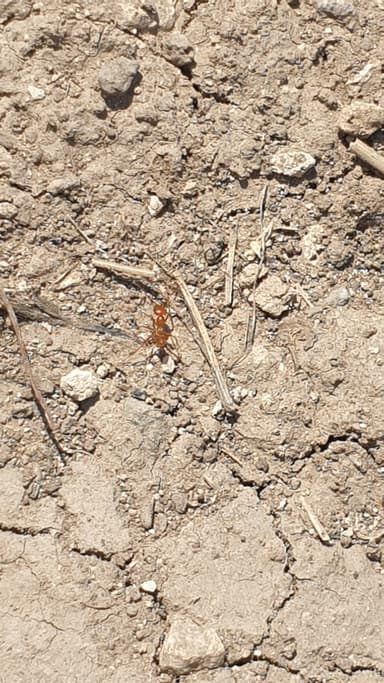
Cataglyphis livida is a desert jewel from the sun-baked coasts of the Eastern Mediterranean, occurring from mainland Greece and Turkey through Cyprus and the Aegean islands (GBIF occurrence data). This polymorphic ant exhibits two distinct worker castes — minor and major — with a bold size range of 5 to 10 mm, while queens measure a robust 11 to 14 mm. Mature colonies can reach up to 5,000 individuals, founded claustrally by a single queen after nuptial flights that reportedly take place on hot, dry summer mornings following light rain, between June and August (Agosti 1990). What makes C. livida truly captivating to keepers is its exceptional speed, keen navigational sense, and thermophilic lifestyle. Its long-legged workers forage diurnally even when surface temperatures soar, a trait shared by the famed Sahara ant, and their silvery, sometimes lead-blue sheen (the species name livida hints at a bluish cast) makes them a visual standout in any collection.
Care for this species is firmly at the intermediate level. It is best suited to keepers who have already mastered basic ant husbandry and are ready to manage a species with precise environmental demands and a strong wanderlust. The main challenges lie in recreating the pronounced dry-hot climate gradient, preventing escapes from a lightning-fast foraging force, and faithfully executing an annual hibernation. Beginners may find the combination of high activity, narrow humidity tolerance, and the need for a cool rest period overwhelming. If you are meticulous about monitoring temperature and humidity, and can provide a truly escape-proof setup, C. livida will reward you with a dynamic and highly visible colony.
Housing must echo the open, arid landscapes these ants call home. A formicarium with excellent ventilation and low humidity is essential; a ytong or gypsum nest with an integrated heating element works well, but clay-based or sand-nest inserts can also succeed. Maintain a thermal gradient from 24°C in one part of the nest to a basking spot around 32°C — a heat mat or cable placed under one third of the nest achieves this naturally. Humidity should stay between 30% and 50%, with the nest remaining predominantly dry; a single small water tower or a very lightly moistened chamber for brood is sufficient. The outworld must be spacious, as these ants cover ground rapidly and use visual landmarks for orientation, and it requires a secure lid and a fresh coat of Fluon or similar escape barrier. A layer of fine sand mixed with a little loam replicates their natural substrate and helps maintain the dry environment. Never let the nest become damp, as this can promote fungal growth that C. livida is ill-equipped to withstand.
The colony thrives on a protein- and carbohydrate-rich diet. Provide small live or pre-killed insects such as fruit flies, crickets, and mealworm segments; majors can handle larger prey, so offer a variety of sizes. Carbohydrates should be given as a shallow droplet of honey, maple syrup, or sugar water on a feeding tray. These ants are active foragers, so feed two to three times per week, removing uneaten remains the following day to prevent mold. Clean water is best supplied through a test tube with a cotton plug placed in the outworld, or by lightly misting one corner of the sand; workers will drink readily but do not require high ambient moisture. Avoid overfeeding sugars, as excess can ferment in a warm nest.
A true hibernation of two to three months at around 15°C is mandatory, mirroring the Mediterranean winter cooling (Agosti 1990). In late autumn, gradually lower the nest temperature over several weeks until it stabilises at 12–18°C, with 15°C as the ideal target. The ants will become sluggish and cluster together; feeding should be reduced to tiny amounts of sugar water every few weeks, and the nest kept almost completely dry. A wine cooler or a cool basement can serve as the hibernation space. When spring arrives, slowly warm the colony back to its active range, and resume full feeding once the queen begins laying eggs again. Skipping this dormant period often results in poor brood production and a shortened colony life.
When your C. livida queen or small colony first arrives, place the test tube or starter nest in a darkened, quiet spot at a steady 26–28°C and leave them strictly alone for 24 to 48 hours to recover from shipping stress. For a founding queen, wait until she appears calm before offering a minuscule dab of sugar water on a cocktail stick and a tiny pre-killed fruit fly. Check for egg-laying after the first week, but keep disturbances to a minimum. If you already have workers, prepare their outworld with the escape barrier before opening the tube, and be ready for a burst of rapid movement the moment the connection is made. Watch closely for mould growth near the water source, and never pry open the nest chamber unnecessarily. A smooth, stress-free acclimation sets the stage for a colony that will soon patrol its arid realm with the restless vigour characteristic of all Cataglyphis.