Tetraponera
Tetraponera nigra
Nuptial Flight Calendar
Flight months: Jan, Feb, Oct, Nov, Dec
Care Guide
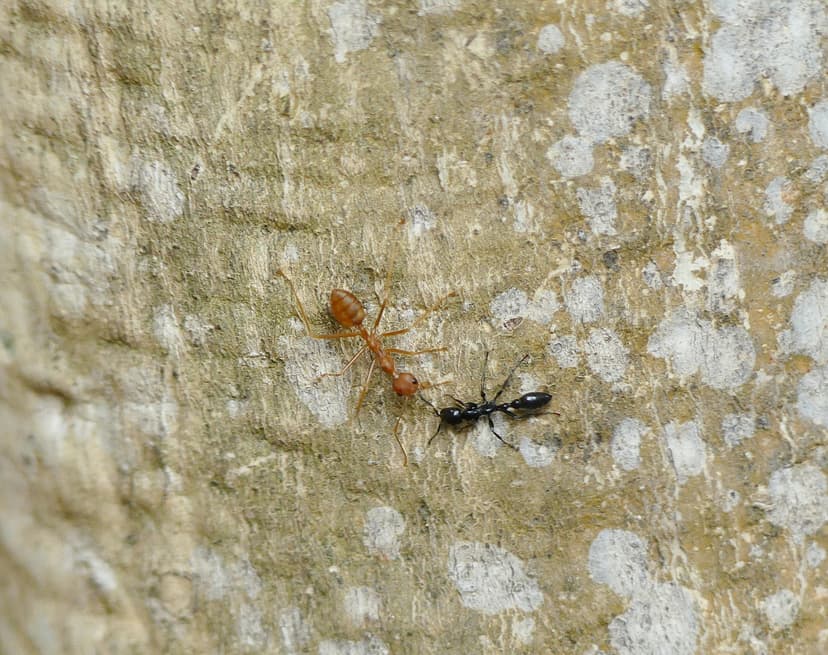
Among the arboreal ants, Tetraponera nigra stands out as a sleek, elongated species that commands attention despite its modest colony size. Queens measure 8–10 mm and workers a uniform 5.5–7.5 mm, presenting a monomorphic caste of minor workers that rarely exceed 1,000 individuals in a mature colony (Ward 2006). The body is an almost metallic black, slender and flattened, an adaptation to life inside hollow twigs and narrow plant cavities. Its distribution sweeps across Sub-Saharan Africa, bounded roughly between latitudes 25°N and 35°S, where GBIF records place it from West Africa through to eastern and southern savannahs. Nuptial flights take place during the warm, humid months of the rainy season, typically from October to February, although exact timing remains poorly documented and our confidence is low. This species is a claustral founder, the queen sealing herself away to raise her first brood without foraging, a trait that simplifies the founding stage but belies the challenges that come later. Its natural history as an acrobat on twigs, its rapid, fluid movement, and the rarity of captive colonies make Tetraponera nigra a genuine treasure for the myrmecologically obsessed.
The care difficulty is unequivocally expert-level. This ant is not for the faint of heart or the novice keeper testing new setups. Workers are lightning-fast, can climb smooth surfaces with ease, and their small, flat bodies allow them to squeeze through gaps that would stop most other species. A failed escape-proofing effort almost guarantees a lost colony. Moreover, because Tetraponera nigra relies on a very specific microhabitat — the interior of a hollow stem — providing a nest that balances moisture and ventilation without mold is a fine art. The keeper must monitor subtle environmental shifts daily. I recommend this species only to those who have successfully maintained other arboreal, humidity-sensitive ants such as Pseudomyrmex or certain Colobopsis, and who are comfortable tuning temperatures and airflow in a closed system. The reward is a window into the private life of an ant that most enthusiasts will never see in person.
Housing must replicate the twig-nesting habit. The ideal nest for Tetraponera nigra is a narrow, vertically or horizontally oriented cavity with an internal diameter that just accommodates the queen’s body. Drilled balsa or cork tubes, or laser-cut acrylic nests with 6–8 mm channels, work beautifully. Avoid overly spacious chambers, which cause stress and encourage workers to disperse waste inside. Temperature should be maintained between 22°C and 30°C; a gentle gradient across the nest allows the colony to self-regulate brood development. Humidity must stay within 50–70%, never saturating, as standing moisture invites fungal growth and drowns workers. A moist but not wet substrate layer of sand and clay in the outworld helps stabilize humidity. Ventilation ports covered with fine stainless-steel mesh are critical to prevent stagnation. The outworld itself needs a secure PTFE barrier applied all the way around the upper rim, as these ants will ascend any overlooked scratch or dust speck.
Diet in the wild likely includes small soft-bodied arthropods and plant-derived sugars. In captivity, offer a varied menu of small prey: fruit flies (Drosophila hydei or melanogaster), pinhead crickets, freshly chopped mealworm segments, and occasionally tiny termites if available. Pre-kill larger items to avoid injury to workers. Carbohydrate sources such as diluted honey, maple syrup, or commercial ant nectar can be provided on a small feeding tray. Feed small portions every two to three days, removing uneaten food before it spoils. A constant supply of fresh water is non-negotiable; use a test tube water reservoir or a plaster-filled water tower that provides humidity without drowning. Workers drink directly from damp surfaces, so ensure the nest has access to a moist but not flooded water source.
Tetraponera nigra hails from tropical and subtropical latitudes and experiences no true winter in its native range. Hibernation is not required. The colony should be kept at the same moderate-to-warm temperatures year-round, with no artificial cooling period. A stable 24–26°C ambient temperature and a local heat source for brood rearing will keep it active through all seasons. There is no seasonal diapause; if the colony slows, look to environmental stress rather than an internal clock. This continuous activity makes them fascinating to observe but also means there is no winter respite — the keeper must maintain vigilance every month.
In the first days after your Tetraponera nigra arrives, resist the urge to unpack and inspect immediately. Place the shipping container in the intended housing area, dim the lights, and let it settle for at least 24 hours. When you gently introduce the colony into the prepared nest, do so with minimal disturbance; if the queen is already in a founding tube, simply attach it to the nest entrance and let workers move at their own pace. Offer a tiny droplet of honey and a single pre-killed fruit fly after 24 hours, then retreat. Watch for workers that pace endlessly or refuse to enter the nest — signs of stress that may require adjusting humidity or temperature. Crucial early milestones: the queen should resume egg-laying within a few days, and workers should collect food and dispose of waste outside the nest. If after a week you see no eggs, or workers are pulling brood apart, reassess the moisture gradient and check for vibrations. This shy species rewards a gentle, patient approach, and once settled, it will offer a rare glimpse into the twig-dwelling ant world that Ward (2006) so meticulously documented.


