Polyrhachis
Polyrhachis ammon
Nuptial Flight Calendar
Flight months: Jan, Feb, Oct, Nov, Dec
Care Guide
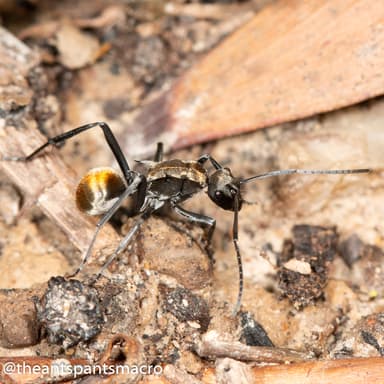
Polyrhachis ammon, a member of the incredibly diverse and often visually spectacular genus Polyrhachis, is a medium-sized ant endemic to Australia, where it ranges from the tropical north to the more temperate southern regions (GBIF occurrence data). This species, along with other members of the subgenus Hagiomyrma, is a ground-nester, unlike the silk-weaving arboreal Polyrhachis that often steal the limelight. Queens measure a robust 9 to 11 mm, while workers fall between 6.5 and 8.5 mm, displaying no caste polymorphism — all workers are of a similar size, or minor workers, as classified by Kohout (2013). What makes P. ammon truly stand out is its dense covering of fine, recumbent hairs that produce a shimmering golden or silvery sheen, particularly when caught under a bright light. Colonies are modest yet can reach up to 3,000 individuals (AntWiki), and they forage actively during daylight hours, making them a rewarding visual display species for the observant keeper.
This ant falls squarely into the intermediate care category, making it a challenging but fulfilling choice for a hobbyist who has already mastered the climatic demands of more forgiving tropical species such as some Camponotus or Iridomyrmex. The species does not hibernate, which simplifies year-round management, but it does require consistent, elevated temperatures and a careful hand during the founding stage. Complete beginners may find the precise humidity and temperature tolerances a little unforgiving, but anyone with a few months of experience successfully maintaining a warm-climate formicarium will find P. ammon a worthy next step. Its claustral founding mode means a queen can raise her first generation on stored body reserves, but once workers arrive, the colony’s dietary needs and escape-prevention measures will require attentive, proactive care.
Housing P. ammon calls for a nest setup that mimics the well-drained soils and sheltered microhabitats of its native range. A temperature gradient from 22 to 30°C should be established, with a warm end provided by a gentle heat mat or cable, and a cooler zone for the colony’s refuse and foraging. Relative humidity inside the nest should be kept between 50 and 70%, achieved through a combination of a moistened substrate and a water source. Because these ants are ground-nesters, a naturalistic soil or sandy-clay substrate is ideal if you are creating a vivarium; many keepers also succeed with a plaster or ytong nest that is partially buried in a thin layer of sand, which lets workers excavate without destroying the structural integrity. The nest entrance should be small to discourage the colony from moving brood into the foraging area, and a tight-fitting lid with a PTFE barrier is essential, as these active ants will readily climb smooth surfaces. Live plants in a larger outworld can help to maintain humidity, but avoid overly wet conditions that lead to mould — good ventilation is as important as moisture.
Diet for Polyrhachis ammon should be broad, reflecting their natural opportunistic feeding habits. Offer an assortment of small insects, such as fruit flies, pinhead crickets, and chopped mealworms, as protein sources two or three times a week, adjusting frequency to the colony’s size and brood level. Carbohydrates are equally important; a dilute sugar-water solution applied to a cotton wick, or small pieces of fruit, will be eagerly accepted. Many Polyrhachis species are known to visit extrafloral nectaries and sap flows in the wild (Kohout 2013), so a honey-water mix can also be provided sparingly. Fresh water must be available at all times, either through a test-tube drinker or a moistened sponge in the outworld. Take care not to let protein items spoil, and remove any uneaten food within 24 hours to prevent mite outbreaks.
As can be inferred from its Australian distribution, Polyrhachis ammon does not undergo a diapause or hibernation period. The colony should be kept at its active temperature range throughout the entire year. Any attempt to artificially chill this species will lead to stress, brood loss, and potentially colony collapse. This simplifies its care calendar, as you can observe foraging, brood development, and social behavior without a winter hiatus, but it does mean your electricity costs for heating will be a permanent feature of its husbandry.
In the first days after your new Polyrhachis ammon queen or small colony arrives, patience is the most important ingredient. If you have purchased a founding queen, keep her in the test tube she was shipped in, placed in a dark, warm, vibration-free spot at around 26°C. Resist the urge to check on her more than once a week; she will draw on her claustral reserves and may not lay her first eggs for a fortnight or more. For a small colony with workers, attach the shipping tube to a prepared nest and outworld, but allow the ants to move at their own pace — this may take a day or two. Offer a minute droplet of sugar water as an initial energy boost, and delay protein until you see workers actively foraging, which usually occurs within 24–48 hours. During this settling period, watch for signs of excessive stress, such as workers dragging the queen aggressively or an unwillingness to leave the tube. Minor disturbances at this stage can set the colony back weeks, so shield them from strong light and excessive movement. With careful adjustment, your P. ammon colony will soon establish itself and become the glittering centrepiece of your ant room.