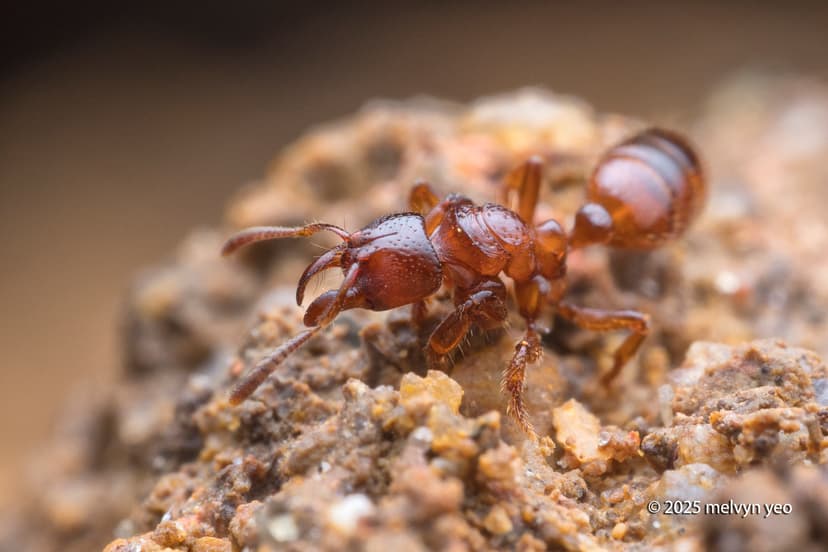
Centromyrmex
Centromyrmex feae
Nuptial Flight Calendar
Flight months: Oct, Nov, Dec
Care Guide
Centromyrmex feae is a truly captivating ant for the specialist keeper, offering a window into a highly specialized subterranean lifestyle. These relatively large ponerines are native to tropical and subtropical Africa, where they range from Senegal east to Ethiopia and south as far as Angola and Mozambique. Queens reach 11 to 13 millimetres in length, while the monomorphic workers span 7 to 9 millimetres, their elongated, cylindrical bodies and small eyes reflecting a life spent almost entirely below the soil surface. A mature colony typically houses up to a thousand individuals and is founded claustrally, meaning the queen seals herself away to raise her first workers without foraging. What sets Centromyrmex feae apart is its obligate termitophagy — these ants are specialist hunters of termites, equipped with powerful mandibles and a venomous sting adapted for breaching termite galleries. Bolton and Fisher (2008) have detailed the Afrotropical radiation of termitophagous ponerines, while studies on the closely related Centromyrmex bequaerti (Dejean & Fénéron 1999) illuminate the sophisticated group-hunting behaviours likely shared by C. feae. For the hobbyist, keeping them is an immersive project that rewards patience and precise environmental control.
Given their exacting needs, Centromyrmex feae is unequivocally a species for the expert keeper. The primary challenges lie in replicating the stable, high-humidity environment they demand and in providing a reliable, live-termite supply. Any lapse in moisture — even brief drops below the 70% threshold — can rapidly dessicate the ants, while an inability to offer termites will see the colony swiftly dwindle. This is not a species for beginners or those looking for a low-maintenance display; instead, it suits a keeper who already has experience managing delicate tropical setups and a willingness to cultivate a feeder termite colony or source wild termites ethically. If you are comfortable monitoring microclimates daily and can devote a small terrarium solely to this species, the reward is a rare glimpse into one of the ant world’s most intriguing predatory niches.
Housing must recreate the warm, humid, and deeply soil-like conditions of the ants’ natural tunnels. A temperature range of 24°C to 30°C is essential, with a humidity gradient between 70% and 90% — the higher end within the nest, gradually dropping towards the foraging area. Because these ants are obligate diggers, a naturalistic setup works best: a tank with a deep layer (at least 10–15 cm) of a moisture-retentive substrate such as a sand‑coco peat mix or a sandy loam with a little clay. Alternatively, a ytong or plaster nest block with a water reservoir can function if a thick layer of damp substrate is provided above it for tunnelling. The foraging arena should be kept humid as well, covered to trap moisture, and furnished with a drinking station — a test tube with water or a small plaster pad works well. Ventilation must be carefully balanced; a few small airholes covered with fine mesh prevent stagnation without drying the environment. Given their entirely tropical provenance, no hibernation or cooling period is needed; the colony remains active year-round as long as conditions are maintained.
Feeding Centromyrmex feae is the most specialised aspect of their care. Live termites are non‑negotiable. These ants rely on the chemical and physical cues of living prey to stimulate hunting and recruitment, and brood production will only proceed when termite protein is abundant. The best approach is to maintain a small termite culture — for instance, Reticulitermes or a tropical species — in a separate container and harvest nymphs and smaller workers every one to two days, offering enough so that a few remain uneaten overnight. Avoid large soldier termites, which can injure ants. If you must temporarily substitute, small crickets, fruit flies, or mealworm segments may be taken, but the ants rarely thrive on these long‑term. Carbohydrate needs appear minimal in this genus; a tiny droplet of diluted honey or sugar water offered once a month is sufficient, and many colonies ignore it altogether. Freshwater, as mentioned, should always be accessible, though the ants will also obtain moisture from their prey and from the damp substrate.
The first days after acquiring your queen or small colony are critical for establishing a rhythm without undue stress. Upon arrival, keep the ants in their shipping container for a few hours while you finalise the prepared nest, which should already be heated and moist. Transfer them gently into the setup, ideally by connecting their tube to the foraging arena and allowing them to move out on their own. Once the queen and workers have settled, introduce about half a dozen small live termites into the foraging area. Observe briefly from a distance; the ants may initially hide, but the scent of termites often triggers rapid recruitment. Then cover the arena and leave the colony undisturbed for a full week, only checking daily to mist the substrate if needed and to replenish termites. Watch for tell‑tale signs of distress — workers aimlessly wandering or refusing to enter the nest — which may indicate incorrect humidity or a failing queen. With steady conditions and a reliable termite supply, your colony will soon start excavating elaborate tunnels and raising the first home‑grown larvae, a testament to your skill as a myrmecological specialist.


