Myrmecocystus
Myrmecocystus semirufus
Nuptial Flight Calendar
Flight months: Mar, May, Jun, Jul
Care Guide
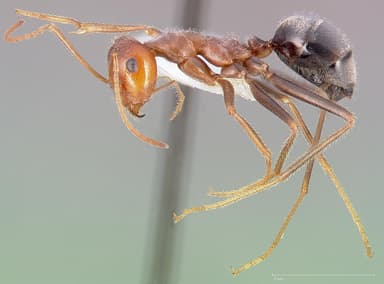
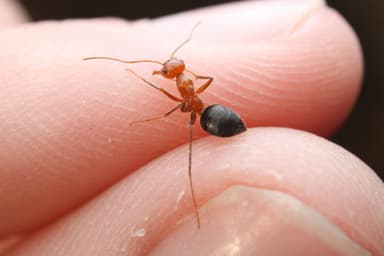
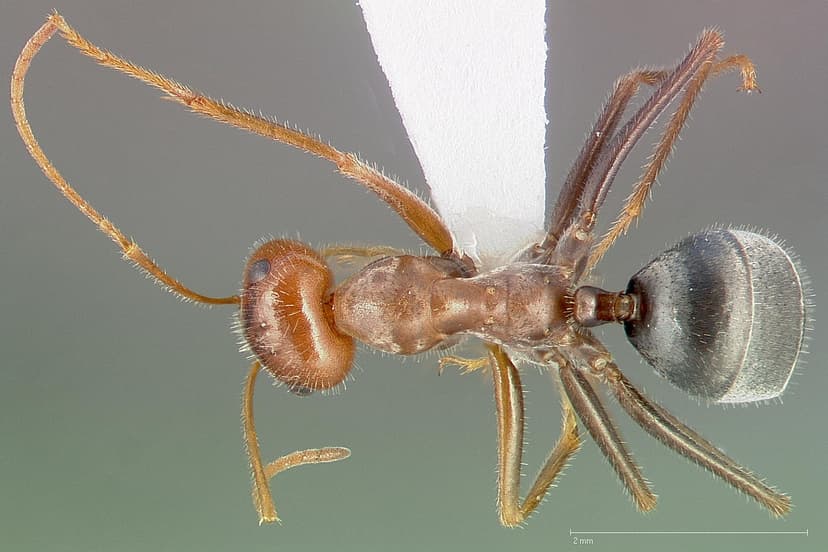
Reddish-gold workers scurrying through a desert outworld are the hallmark of Myrmecocystus semirufus, a true honey ant of the American Southwest. Queens measure a substantial 11 to 14 millimeters, while workers span an astonishing 5 to 10 millimeters, exhibiting strong polymorphism with two distinct worker subcastes plus the famous repletes. These living storage barrels, engorged with sugary solution, hang from the ceilings of their deep earthen chambers, a sight that has captivated naturalists since Snelling’s foundational revision of the genus (Snelling, 1976). The species ranges from the Great Basin south into the Sonoran desert, bounded roughly by latitudes 31°N to 42°N and longitudes 122°W to 106°W. In the wild, colonies may grow to around 4,000 individuals, and they do so from a semi-claustral founding: the newly mated queen must leave her fledgling nest to forage for herself and her first brood, making the founding stage both fascinating and demanding. Nuptial flights occur on warm, humid evenings following summer monsoon rains from May through July, an event that many ant keepers try to replicate to start their own colonies.
This species is undeniably a project for the expert keeper. The combination of semi-claustral founding, the need for a carefully engineered arid microclimate, and the long-term commitment to maintaining a functional replete caste places it well beyond a beginner’s reach. However, for the experienced enthusiast who has already succeeded with desert-adapted genera such as Messor or Pogonomyrmex, the rewards are immense. You’ll witness the gradual transformation of the first batch of callow workers into plump, amber-globed repletes, a behavioral spectacle that Conway (1990) describes as one of the most extraordinary adaptations in the ant world. Patience is a prerequisite: a freshly captured queen must be housed in a setup that allows her to forage safely while her first brood develops, and any lapse in her feeding schedule can prove fatal.
Housing must reflect the arid, thermoregulated subterranean world these ants inhabit. A vertical or flat formicarium that provides a stable thermal gradient from 22°C at the cooler end to 32°C at the warmest point is ideal. Humidity should be kept low, between 30% and 60%, and never allowed to become stagnant. Many successful keepers use a nest constructed of insulating ytong or plaster with a thin, layered substrate of fine sand and clay, deep enough to allow the ants to sculpt chambers and for repletes to suspend themselves. The foraging arena should be spacious and bone-dry, decorated with rocks and bits of cholla wood to mimic the desert floor. A heating cable or mat placed under one side of the nest will encourage the colony to move and cluster their repletes in the optimal temperature zone. Crucially, the nest must have a hydration source that the ants can access but that does not raise the overall humidity excessively; a water feeder plugged with cotton in the outworld suffices.
Diet for Myrmecocystus semirufus revolves around the interplay of protein and carbohydrates. The colony requires a steady supply of small insect prey—fruit flies, pinhead crickets, or mealworm pieces—to feed developing larvae. Workers especially relish freshly killed insects, which they will promptly dissect. Carbohydrates are the lifeblood of the replete caste; provide a mix of liquid sugars such as diluted honey, maple syrup, and sugar water in small, shallow feeders that prevent drowning. During the founding stage, the semi-claustral queen must be offered both protein and sugars every two or three days; a drop of honey water and a fruit fly placed near her chamber entrance will sustain her. As the colony grows, you can increase amounts, always removing uneaten food before mold takes hold. Fresh water, separate from sugar sources, must always be available. The repletes themselves will regulate the colony’s fluid reserves, swelling into glossy orbs that hang motionless for months—a sign that your husbandry is on point.
A period of hibernation is non-negotiable, as these ants experience cool winters across their native range. Begin lowering the temperature gradually in late autumn, aiming for a steady 12°C from December through February. The colony should be kept in darkness and slightly drier than during the active season, with only a small water source available. Do not offer food during this time; the workers will cluster around the queen and repletes, drawing on the stored reserves. After eight to ten weeks, warm them up slowly to room temperature before resuming the spring feeding routine. Neglecting this diapause can lead to erratic brood cycles, queen fatality, or the failure of repletes to form properly the following year.
When your queen or small colony first arrives, resist the urge to place them straight into a grand setup. For a founding queen, a test-tube-style chamber with a water reservoir and a thin sand substrate, connected to a tiny foraging arena via a short tube, is perfect. Offer a micro-droplet of sugar water and a pre-killed fruit fly on a small piece of foil within hours of introducing her, then cover everything and leave her undisturbed in a dim, warm room for at least 48 hours. Watch for her to venture out and feed—this is the critical sign that she is settling. For an established young colony, connect the transport tube to a small outworld and provide the same initial meal. Avoid bright light and vibrations for the first week. Monitor for any signs of dehydration (lethargy, shriveled gasters) or mold, but do not intervene except to replenish water and remove refuse. With the right gentle start, your colony will soon begin the astonishing work of building a desert pantry filled with living jewels.