Myrmecocystus
Myrmecocystus mimicus
Nuptial Flight Calendar
Flight months: Jun, Jul, Aug
Care Guide
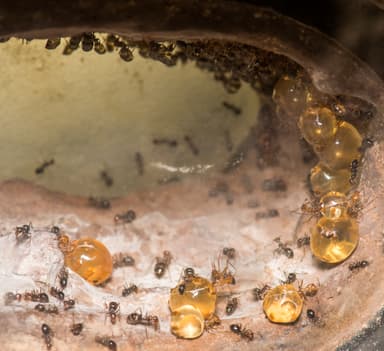
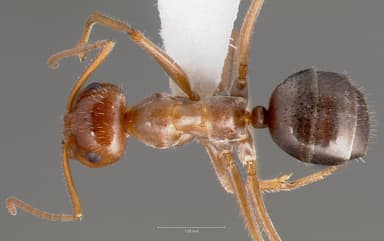
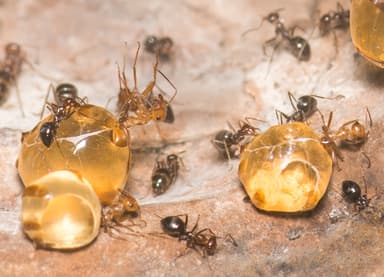
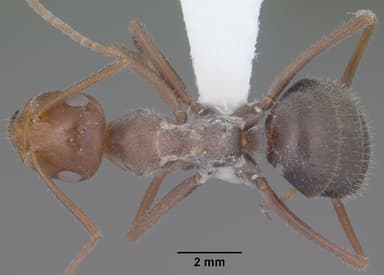
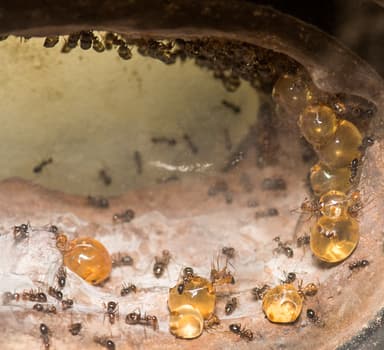
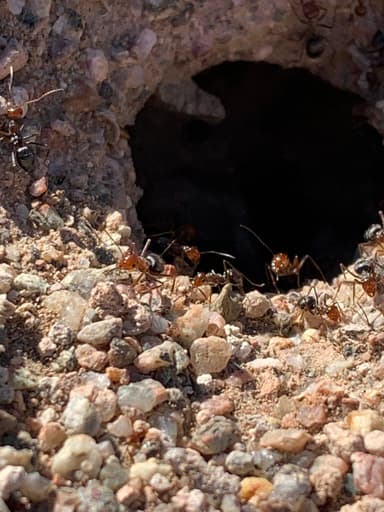
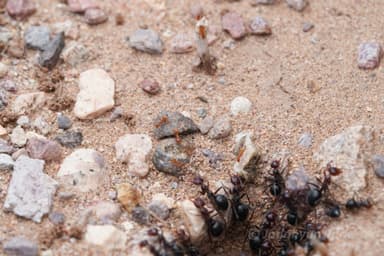
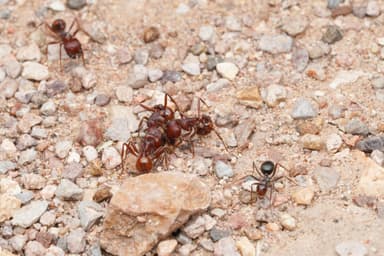
Myrmecocystus mimicus, the lesser honeypot ant, is one of the most captivating desert species you will encounter. In this ant, we see one of nature’s most remarkable adaptations: the replete caste. Workers collect nectar, honeydew, and other sugary fluids, then feed them to specialized nestmates whose abdomens swell to the size of small grapes, living larders that hang motionless from the ceiling of the nest. The queens measure a sturdy 9 to 11 mm, while the worker force displays continuous polymorphism, with minors as small as 4 mm and majors up to 8 mm, plus those engorged repletes. Mature colonies can grow to around 15,000 individuals, and their social lives are no less astonishing. Hölldobler (1976) first described the ritualized intercolony tournaments where workers from rival nests circle one another in a peculiar dance, standing tall on their legs and boxing without fatal violence—these displays establish territorial boundaries and are unique among ants. Their foraging strategies, mapped in detail by Hölldobler (1981), create dynamic spatiotemporal territories that shift with resource availability and competition. Natively, they range across the Southwestern USA from Arizona to Texas and south into Mexico, emerging for their nocturnal nuptial flights after the dramatic summer monsoon thunderstorms of July and August.
Care difficulty is best rated intermediate. This is not a species for the absolute beginner, though a dedicated keeper with a few successfully maintained colonies under their belt will find them manageable and deeply rewarding. The challenges lie in their specific environmental needs, the requirement of a true hibernation, and their potential for rapid population growth once established. You must stay ahead of their demand for sugars without causing excessive humidity, and the nest design must accommodate repletes safely. Their docility is an advantage—they are not aggressive toward a careful keeper—but if conditions stray too far from the desert norm, colonies can dwindle. Anyone fascinated by desert ecology, caste differentiation, and the spectacle of honeypots will discover that M. mimicus repays close attention with endless insights.
Housing should mirror the arid lowlands: think hot days and cooler nights, with humidity kept low. A temperature gradient of 22 to 32°C suits them, with a gentle basking spot around 30°C provided by a heat cable or mat placed on one side of the nest, never directly underneath all of it. Ambient humidity should stay between 30 and 60 percent; avoid condensation at all costs, as constant dampness predisposes the colony to fungal problems and drowning repletes. Many successful keepers use a ytong or gypsum nest with smooth, vertical chambers where repletes can cling, connected to a sand‑clay outworld where foragers can wander and dig. The idea is to give them a solid “ceiling” for their living honeypots to hang from. A small water feeder with a sponge or a cotton‑plugged tube in the outworld supplies drinking water without raising humidity inside the nest. Substrate in the outworld can be a blend of fine sand and a little clay, lightly moistened at one end to offer a humidity retreat, but the main nest should remain dry. Good ventilation is essential; a mesh‑topped outworld with a screen lid works perfectly.
These ants are enthusiastic consumers of both sugars and protein. Carbohydrates are the engine of replete formation: offer a 1:1 sugar‑water solution, diluted honey, or maple syrup from a small sipper in the outworld, and replenish it regularly, removing old drops before they mold. Protein fuels larval growth and egg production. Provide appropriately sized feeder insects—fruit flies, pinhead crickets, small mealworms, or chopped roaches—two or three times a week for a small colony, daily for populous ones. Pre‑kill any lively prey to avoid injury to the workers, and remove uneaten protein within a day to prevent spoilage. Clean water, as mentioned, must always be available separately from the sugar source. When a colony has settled in and the sugar flow is generous, you will see the first repletes swell within a few weeks, a sure sign that your husbandry is on the right track.
An unheated winter rest is non‑negotiable. In their native range, they experience a distinct cool season, and without a hibernation period at around 15°C, queens often cease egg production and colonies languish. From late November through February or March, gradually reduce the photoperiod and temperature, moving them to a dark place—a wine cooler, an insulated basement, or a cool garage that will not freeze—and keep them at a steady 12–15°C. Feed very sparingly during this time, if at all, and do not disturb them. In early spring, warm them slowly back to active temperatures over a week or two, and resume normal feeding. A well‑executed diapause rejuvenates the colony, triggers robust brood rearing, and truly anchors their long‑term health.
When your test tube colony first arrives, simplicity is your ally. Place the tube in a small, dark, quiet outworld or simply keep the tube covered with a sleeve and let them rest for at least 24 hours. After that initial calm, offer a tiny droplet of sugar water on a piece of foil or a plastic disk right at the tube entrance. Once they are drinking eagerly, add a single, pre‑killed fruit fly or a tiny cricket leg. Keep disturbance to a minimum for the first week; resist the temptation to peek constantly. Watch for the queen to begin laying a fresh clutch of eggs, and look for the first small larvae. Do not connect a large outworld prematurely—a colony of a dozen workers can comfortably live in the tube with a tiny foraging platform. Expand their domain gradually as the workforce grows. Above all, enjoy the slow‑burn reveal of one of nature’s most extraordinary ant‑keeping experiences.