Meranoplus
Meranoplus castaneus
Nuptial Flight Calendar
Flight months: Jan, Feb, Oct, Nov, Dec
Care Guide
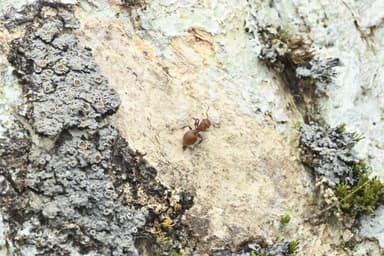
Meranoplus castaneus, a robust chestnut-coloured ant first described by F. Smith in 1857, captivates keepers with its otherworldly armour. Queens measure a stout 7–8.5 mm, while the attending minor workers, the only caste present, range from 5–6.5 mm. The entire exoskeleton is sculpted into a rough, granular crust, and the pronotum extends into distinctive tooth-like projections, giving the ant a shield-like silhouette that has earned the genus the common name “turtle ants.” This heavily armoured body is coupled with one of the most charming defensive behaviours in the ant world: when startled, workers will often freeze, tuck their legs, and drop to the ground, feigning death until danger passes (Schödl, 1998). Mature colonies are modest, reaching approximately 1,000 workers, and new colonies are founded semi-claustrally, meaning the queen must venture from her claustral chamber to forage while tending her first brood. The species is endemic to Australia, with nuptial flights recorded across its broad range—from Western Australia to eastern Queensland—during the austral summer from October to February, typically triggered by warm, humid conditions following rainfall (Andersen, 2007).
With an intermediate care difficulty rating, Meranoplus castaneus is best suited to hobbyists who already possess some foundational experience, such as successfully raising a fully claustral species. The semi-claustral founding stage demands regular attention, as the queen relies on external food to support her egg-laying, and the colony thrives only when its specific dry-heat preferences are met. This places the ant outside the beginner category—neglecting the queen’s need for small, frequent meals during the founding weeks will quickly lead to failure. That said, a keeper comfortable with monitoring a young colony and providing a warm, arid microclimate will find the species quite resilient. Their deliberate, almost ponderous movement makes them a pleasure to observe, and their thanatosis display never loses its charm.
Housing these ants requires replicating the warm, low-humidity conditions of their native arid and semi-arid habitats. A formicarium that offers excellent ventilation—such as a plaster or ytong nest with a minimal hydration port, or a well-aerated acrylic setup—works well. The internal temperature should be maintained between 22°C and 32°C, ideally with a gentle gradient so the ants can self-regulate. A small heat mat placed under one end of the nest is usually sufficient. Humidity must remain dry, in the 30–60% range; overly moist nests quickly lead to fungal issues and stress. Provide a layer of fine sand or sandy loam in the outworld, which mimics their natural foraging grounds and allows the ants to exhibit natural digging tendencies. A few small pebbles or bits of bark add structure, but avoid any materials that trap excess moisture, as this species is far less tolerant of dampness than many other commonly kept ants.
Diet should be varied and protein-rich. Small, pre-killed insects such as fruit flies, pinhead crickets, or cut mealworm segments form the staple protein source. Carbohydrates can be given as diluted honey, maple syrup, or sugar water offered on a tiny piece of foil or a dedicated feeding dish. There is some evidence that Meranoplus species opportunistically gather small seeds in the wild, so offering a pinch of crushed hemp or millet seeds as a supplementary item can encourage natural foraging behaviour, though this is not essential. Fresh water must always be available, best supplied in a test tube with a cotton plug placed in the outworld. For founding queens, this feeding regime must begin immediately: present a minute drop of sugar water and a freshly killed fruit fly every two to three days, ensuring the queen has the energy to raise her first nanitic workers without undue risk.
Hibernation is not required for Meranoplus castaneus, a fact that simplifies year-round care enormously. Populations from its entire Australian range experience mild winters without a true cold diapause; in captivity, maintaining stable temperatures within the 22–32°C window will keep the colony active, brooding, and foraging continuously. There is no need to cool them artificially, and doing so could actually stress the ants. Simply keep the heating element running through the cooler months and continue feeding as usual.
When your queen or small colony first arrives, patience is paramount. Place the test tube or container in a quiet, dimly lit space and allow at least 24 hours of total rest. After this settling period, offer an extremely small but fresh supply of sugar solution and a pre-killed insect. Watch closely: a healthy queen should eagerly drink from the carbohydrate source and may drag the protein back to her brood pile within the hour. Avoid the temptation to check repeatedly—disturbance in these early days can cause the queen to cease laying or even devour her eggs. Once you observe steady feeding and the appearance of the first larvae, you can consider moving the young colony into a small, dry nest setup, ensuring the transition does not alter temperature or humidity dramatically. With a gentle hand and respect for their arid origins, a colony of Meranoplus castaneus will slowly grow into a truly mesmerising display.