Polyrhachis
Polyrhachis rufifemur
Nuptial Flight Calendar
Flight months: Apr, May, Jun
Care Guide
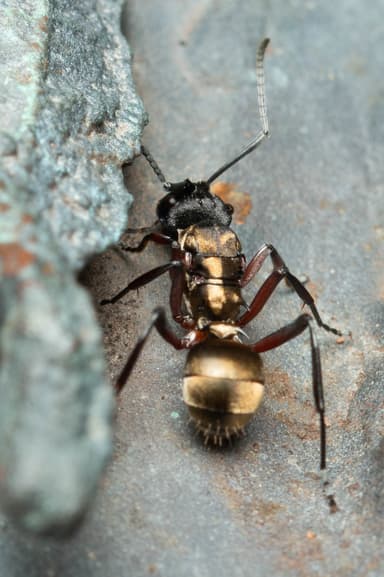
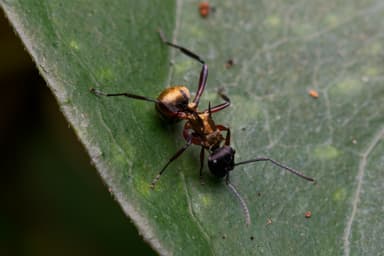
Polyrhachis rufifemur is a striking arboreal ant native to the tropical forests of Southeast Asia, with a distribution stretching across the Malay Peninsula, Borneo, Sumatra, Java, and surrounding islands, as reflected in occurrence records spanning from 10°S to 25°N and 95°E to 130°E (GBIF; AntWeb). The species gets its scientific name from the vivid reddish-orange femurs that contrast with its otherwise black, sleekly sculptured body, immediately catching the eye. Queens measure a robust 11–13 mm, while the monomorphic workers range from 7.5 to 9.5 mm, all sharing the same slender, spiny body plan characteristic of the subgenus Myrma (Kohout 2014). Colonies are claustrally founded, with the queen sealing herself away to raise her first brood without foraging. Mature colonies can reach up to 3,000 individuals, a substantial size for a weaver ant, though they lack polymorphic worker castes. What truly sets this species apart is its remarkable nest-building behavior: like many Polyrhachis, the workers use larval silk to bind together living leaves, twigs, and debris into intricate carton or silken pavilions high in the canopy, a trait that fascinates keepers able to provide the right conditions.
With a care difficulty rated as intermediate, Polyrhachis rufifemur is best suited for hobbyists who have successfully kept tropical ants before and are comfortable maintaining consistently warm and humid microenvironments. They are not an ideal starter species due to their sensitivity to fluctuations and their rapid, agile movements that can complicate husbandry and escape-proofing. However, for those ready to advance beyond beginner-level genera, they offer a deeply rewarding experience through their active foraging, complex social interactions, and the visible construction behavior rarely seen in other captive ants. Their year-round activity, with no hibernation required, appeals to keepers who want continuous colony growth and observation, though it does demand unwavering attention to environmental parameters. This species is perfect for a dedicated enthusiast with a well-equipped setup who can replicate a slice of rainforest humidity in a controlled space.
Housing Polyrhachis rufifemur successfully means embracing their arboreal lifestyle. A tall, vertically oriented formicarium works best, providing ample climbing opportunities with branches, cork bark, and suspended artificial vines. The nest itself can be a naturalistic setup where workers are offered fresh leaves, thin strips of paper, and soft plant fibers to incorporate into their silk-bound nest structure; many keepers use a combination of a hydration chamber and a foraging arena with a removable glass or plastic nest cell where the ants can weave. Temperature should remain between 22°C and 28°C, ideally with a slight daytime peak, easily achieved with a small heat mat attached to one side of the nest, never underneath. Humidity is paramount: maintain 60–80% by frequent misting of the arena, a water reservoir within the nest, and a substrate of coco coir, sphagnum moss, or a humus mix that holds moisture well without becoming waterlogged. Good ventilation is equally crucial to prevent mold, so ensure cross-ventilation in the foraging area and never let condensation build up directly on the nest walls where ants might drown.
In the wild, these ants have a varied diet, foraging for small arthropods and gathering honeydew from sap-sucking insects. In captivity, offer a balanced diet of protein and carbohydrates. For protein, provide freshly killed or frozen-thawed insects such as small crickets, fruit flies, roach nymphs, and mealworm pieces; tiny colonies do best with chopped-up prey offered every other day. Carbohydrates are equally important — supply a small drop of diluted honey, sugar water, or pure maple syrup on a feeding tray, replenished daily but in tiny amounts to avoid drowning. A cut piece of apple or banana can also serve as a sweet treat occasionally, though remove any uneaten fruit promptly to prevent fermentation. Always make fresh water available, either via a test tube waterer plugged with cotton or a small liquid feeder. Observe how much the colony consumes and adjust quantities to avoid waste; overfeeding decaying protein can rapidly foul the humid environment these ants require.
Polynirachis rufifemur does not hibernate. As a purely tropical species, it thrives under consistent year-round conditions. Keep temperatures and humidity within the optimal range every day, and you will see unbroken brood development and foraging activity. There is no need to simulate a winter cooling period; doing so could stress or kill the colony. Instead, use the stable conditions to observe the colony’s growth cycles and to plan for nest expansion as the population climbs towards that 3,000-worker ceiling. The absence of diapause is a double-edged sword: while it offers continuous ant-keeping engagement, it also means no natural break from maintenance routines, so be prepared for constant care.
When you first receive a founding queen or small starter colony, patience is key. If you have a newly mated queen, house her in a standard test tube setup with a water reservoir and keep her in a dark, quiet place at 24–26°C and high humidity. She will lay eggs and raise nanitic workers entirely from her body reserves. For the first two weeks after the first workers emerge, do not open the tube to prevent escape and reduce stress; you can place a tiny droplet of sugar water just inside the tube opening then seal it back. Once the colony reaches 10–15 workers, attach a small outworld via tubing, offering a dry run area with a thin layer of sand or dry coco coir. The first feedings should be minute — a pinhead cricket or fruit fly pre-killed, plus a dab of honey — placed in the outworld. Watch carefully: Polyrhachis workers are wickedly fast and will test every seam and ventilation hole. Secure all connections with fine mesh and silicone, and double-check lids. Expect the workers to start exploring and possibly attempting to weave silk onto any introduced materials within days; this is a sign of a settled, healthy colony. Avoid the temptation to peer into the nest too often during the first month; a red light and minimal disturbance will help them establish a strong foundation.