Nylanderia
Nylanderia terricola
Nuptial Flight Calendar
Flight months: Feb, Jun, Jul, Aug
Care Guide
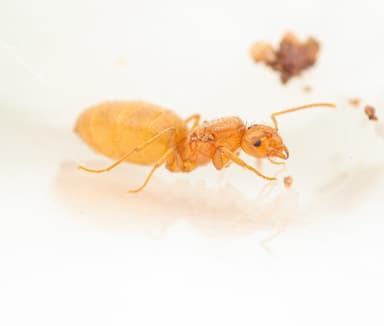
Nylanderia terricola is a small, unassuming member of the formicine subfamily that ranges across much of eastern North America, from the Gulf Coast to the Great Lakes and from the Atlantic seaboard west to the central plains. Queens measure 4.5 to 5.5 mm, while the monomorphic workers are a mere 2 to 2.8 mm long—delicate, yellowish-brown ants that move with the rapid, darting gait characteristic of their close relatives, the “crazy ants.” A mature colony can reach up to 3,000 workers, all of a single minor-worker caste, and they exhibit a fully claustral founding strategy. Though often overlooked due to their diminutive size and subterranean habits, N. terricola rewards the attentive keeper with glimpses of intricate social behaviors: they are avid scavengers that tend root aphids in the wild, and their colonies hum with constant, low-key activity. The species was redescribed and firmly anchored within Nylanderia by Trager (1984), who noted its affinity for moist, sandy soils in open woodlands and field edges—habits that will inform every aspect of captive care.
This ant is best suited to an intermediate keeper. While not excessively demanding, it does require precise attention to humidity regulation and mandatory hibernation, making it a step beyond the hardiest beginner genera like Lasius or Tetramorium. Their small size is both a charm and a challenge: workers can slip through gaps as narrow as a few tenths of a millimeter, and they will eagerly explore every seam in a formicarium. Thus, the keeper must use an escape-proof setup—glass or acrylic with tightly fitted lids, PTFE barriers on all smooth surfaces, and fine-mesh ventilation. N. terricola is not aggressive, but they are skittish and fast; a disturbance can send dozens of workers scrambling, so deliberate, calm movements during maintenance are key. If you have successfully maintained species that require a winter diapause and you enjoy watching a bustling community of tiny foragers, this species will be a delightful addition.
Housing must replicate the warm, humid microclimate of the soil-litter interface. Temperatures should be maintained between 20°C and 27°C, with a stable humidity of 50% to 70%. A popular approach is a modular plaster or ytong nest kept moist via a water reservoir, paired with a small foraging arena with a sandy or soil-based substrate. Because they are natural diggers, a thin layer of fine sand-clay mix in the nest area allows workers to sculpt their own chambers, but the hydration must be monitored carefully—too dry and the brood desiccates, too wet and mold takes hold. Good options include a double-chambered nest that provides a humidity gradient, or a simple test tube setup with a cotton plug for the founding queen and early workers, transitioning to a larger formicarium once the colony reaches a few hundred individuals. Ensure ventilation holes are covered with fine stainless-steel mesh (0.2 mm aperture) to prevent escapes and to admit air. A small heating element placed under one side of the nest helps establish the thermal gradient they enjoy, but avoid overheating; temperatures above 27°C can stress the colony and accelerate mold growth in the humid enclosure.
Feeding N. terricola is straightforward as they are generalized omnivores. Offer tiny protein sources two to three times a week: flightless fruit flies (Drosophila hydei or melanogaster), freshly killed pinhead crickets, or chopped mealworms. For carbohydrates, place a small droplet of sugar water, honey water, or a commercial ant nectar (e.g., ByFormica Sunburst) on a feeding disk in the outworld, replenishing as it is consumed. Because of their size, they can drown even in a shallow puddle, so any liquid should be offered in a saturated cotton pad or a micro-feeder. A permanent water source, such as a water-filled test tube with a tight cotton plug, is essential, especially once the colony grows and the nest’s humidity becomes harder to maintain. Remove uneaten protein after 24 hours to prevent spoilage and mite outbreaks. The colony will store liquid carbohydrates in their crops, enabling them to weather brief gaps in feeding, but consistency keeps them vigorous and encourages brood production.
A three- to four-month hibernation at 10°C is required to sustain the colony’s natural annual rhythm and ensure the queen’s long-term fertility. Without this cool period, the workers may grow sluggish, brood production can stall, and the queen’s lifespan may be shortened. Begin the dormancy in late autumn by gradually reducing temperatures over two weeks, mirroring the seasonal temperature decline of their native range. During diapause, keep the nest at a steady 10°C, ensuring that the nest remains slightly humid but never wet; a test tube filled with water and a cotton plug placed in a cool basement, wine cooler, or specialized ant fridge works well. The ants will cluster into a tight resting ball and require no food, though you must check weekly for condensation or excessive moisture. In early spring, warm them gradually back to the active temperature range over a week or two, and they will resume foraging with renewed energy.
When your new N. terricola colony arrives, immediately place the sealed shipping container in a dim, quiet corner of the room to let the workers and queen recover from the journey. After an hour, carefully open the container and connect it to the prepared formicarium or simply transfer the tube into the outworld, allowing the colony to move on its own terms. Offer a single droplet of sugar water on a micro-feeder and, after 24 hours, a freshly killed fruit fly. Resist the urge to observe them under bright light during this settling-in window; darkness and minimal vibration help reduce stress, which is often signaled by workers carrying brood about restlessly or clustering away from the nest. Inspect the setup for any escape routes immediately—these ants can locate hairline cracks with unnerving speed. With patience and steady parameters, the queen will soon begin laying eggs, and within weeks the first tiny nanitic workers will take their place as the foundation of a thriving colony that will, with proper diapause and care, live for years.