Discothyrea
Discothyrea neotropica
Nuptial Flight Calendar
Flight months: Mar, Apr, May, Oct, Nov
Care Guide
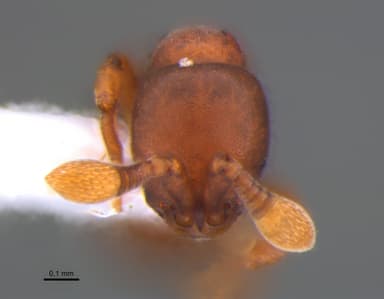
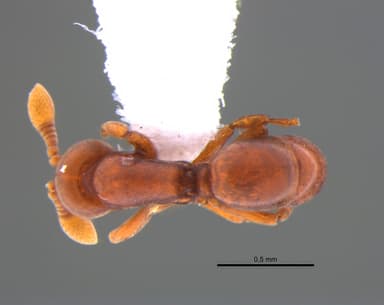
Discothyrea neotropica, described by Bruch in 1919, is a minute and enigmatic ant from the Neotropical region, ranging from Costa Rica southward into Brazil. The queens measure between 2.5 and 3.2 millimetres, while the tiny workers span just 1.8 to 2.4 millimetres. Colonies are equally diminutive, typically housing no more than 50 individuals, all of a single monomorphic worker caste, reflecting a simple social structure without polymorphic workers (Lattke 2003). Their cryptic, subterranean habits and specialization as predators of arthropod eggs — especially spider eggs — make them a remarkable oddity in the ant-keeping world. Unlike the larger, more boisterous ants commonly kept, D. neotropica lives quietly within the soil and leaf litter, rarely venturing into the open, which lends an air of mystery to their observation. Their claustral founding means a queen can rear her first generation entirely from her own body reserves, hidden away from the world, a process that demands patience but rewards the careful observer with a glimpse into one of the most secretive life histories among ants.
This is unequivocally an expert-level species. Their survival hinges on maintaining a very specific microclimate — consistent high humidity between 70 and 90 per cent and a narrow temperature band of 20 to 26 degrees Celsius — which leaves no room for error. Even brief drops in moisture can cause brood desiccation, while excessive wetness invites lethal fungal outbreaks. Their tiny size also means virtually any standard formicarium gap is an escape route, and escapees are nearly impossible to recover. Furthermore, their specialized diet complicates feeding; they often reject conventional feeder insects unless the prey items are appropriately miniature and soft-bodied. Only keepers who are deeply experienced in managing stable high-humidity nests and culturing micro prey should consider this species. For those who have perfected the art of climate control and enjoy the challenge of a truly cryptic ant, D. neotropica offers a uniquely immersive project.
Housing these ants demands a substrate-based, high-humidity nest that mimics their tropical forest floor habitat. The ideal setup is a plaster, ytong, or 3D-printed nest with a generous internal layer of coco peat, fine sand, and a bit of decayed wood or leaf litter, kept permanently moist but not waterlogged. The nest should be connected to a small foraging arena, though the ants will seldom explore far, and the arena itself should be equally humid to prevent desiccation during their infrequent excursions. Temperature must be regulated to the 20–26 °C range using a gentle heat mat or cable applied to one side, never directly heating the entire nest. A reliable hydration system is non-negotiable: a water reservoir or frequent misting that keeps relative humidity between 70 and 90 per cent. Because these ants are extremely photophobic, the nest must be kept in darkness at all times, with only brief, dim red-light observations. A tight-fitting lid with a fine mesh or a PTFE barrier is essential, as workers can squeeze through minute gaps.
Diet for D. neotropica revolves around small, soft-bodied protein sources. Springtails and freshly killed or pre-killed fruit flies are excellent staples; many keepers also report success with crushed spider eggs — the species’ natural prey — or chopped segments of small mealworms and pinhead crickets. Carbohydrates appear to be of little interest, though an occasional micro-drop of diluted honey or sugar water placed right at the nest entrance may be accepted; if not, do not force it. The ants seem to derive most of their energy from their proteinaceous diet, so focus on regular protein offerings. Feed tiny amounts every two to three days, and always remove uneaten food within 24 hours to prevent mould, which is a relentless threat in such humid conditions. Water is typically obtained from condensation and the moist substrate, but a tiny water source, such as a soaked cotton ball in a small cap, can be offered in the foraging arena.
As tropical ants native to a region without a cold season, Discothyrea neotropica does not undergo hibernation. This simplifies long-term care because you do not need to manipulate temperatures for a winter dormancy period; the colony will remain active year-round. Simply maintain the standard temperature and humidity ranges consistently. However, ensure that the ambient room temperature does not drop below 20 °C in cooler months, as even a slight chill can slow development and egg production. Without the natural cues of a changing photoperiod or temperature, the ants will continue to forage and the queen will lay eggs as long as conditions remain suitable, though this may occur at a deliberately slow pace given their tiny colony size.
When your new D. neotropica queen or small colony arrives, the foremost priority is to let them settle undisturbed. If you have received a newly mated queen in a test tube with a moist substrate plug, place the tube in a completely dark, quiet location at the correct temperature and humidity and do not even peek for at least two to three weeks. Claustral queens have all the resources they need, so no feeding is necessary until the first workers eclose. Once workers appear, offer a few exceptionally tiny prey items — springtails or fresh fruit fly maggots — directly inside the nest or at the entrance tube. After this first meal, you may begin observing with a red lamp very briefly, but avoid shining any bright light or causing vibrations. Watch for the workers’ behaviour: healthy ants will move slowly and deliberately, while curling or lethargy signals dehydration. With patience and a hands-off approach during those critical first days, you lay the foundation for a stable, albeit enigmatic, colony that can provide years of fascination.