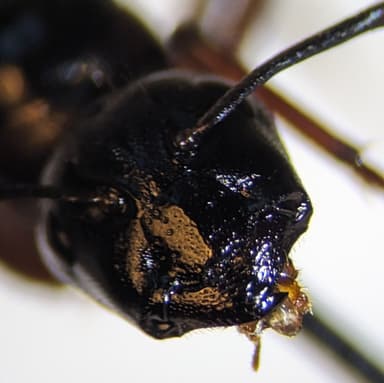
Camponotus
Camponotus semitestaceus
Nuptial Flight Calendar
Flight months: Mar, Jun, Jul, Aug
Care Guide
Among the diverse and charismatic Camponotus species of western North America, Camponotus semitestaceus stands out as a robust and rewarding ant for the intermediate keeper. This carpenter ant, described in early taxonomic works (Wheeler 1910) and later refined by Snelling (1988), exhibits the classic elegance of its genus: a jet‑black body accented by fine golden hairs, with shiny integument that catches the light. Queens are impressively large, measuring 14 to 17 mm, while a striking polymorphism defines the worker caste. Minor workers, at a mere 5 mm, hustle through foraging duties, whereas the broad‑headed majors, reaching up to 12 mm, serve as defenders and food processors. Mature colonies in the wild can number up to 10,000 individuals, a substantial but manageable size that gives the keeper a front‑row seat to complex social behaviors. What makes this species particularly fascinating is its adaptation to the dry, warm summers of its range—spanning from southern Oregon to northern Baja California and east to the Sierra Nevada—where it nests under stones and in rotting wood, and stages its nuptial flights on warm summer nights after rain (AntWiki; Wheeler 1910). The subtle geographic variation in coloration and pilosity adds an extra layer of intrigue for the observant hobbyist.
As an intermediate species, Camponotus semitestaceus occupies a sweet spot between the forgiving beginner ants and the demanding exotics. It is well suited to a keeper who has already succeeded with a claustral founder such as Lasius or Camponotus pennsylvanicus and is ready for a larger, more active colony with precise environmental needs. The ants are not overly delicate, but they do require a disciplined hibernation and steady temperature control to thrive. Beginners who are eager to learn and willing to invest in a quality setup can certainly succeed, provided they respect the species’ seasonal rhythms. The calm demeanor of the workers—rarely bolting, and stinging only mildly—makes observations and maintenance low‑stress, yet the colony’s size and rate of growth demand that the keeper be attentive to space and food supply. Because queens are fully claustral and found on their own, the exciting journey from a single newly mated queen to a bustling metropolis is one of the most gratifying experiences in ant‑keeping, though patience is required; brood development is slow, as is typical for carpenter ants.
Housing a colony of C. semitestaceus calls for a nest that mimics the stable microclimate of a sun‑baked stone in a dry woodland. Temperature should be maintained between 20 and 30°C, with a gentle gradient that allows workers to self‑regulate; a heating cable or mat placed at one end of the nest works beautifully. Humidity, on the other hand, is best kept moderate—between 40 and 60%—and should be carefully managed to avoid the condensation that can drown brood or promote fungal growth. This species is notably less moisture‑demanding than many carpenter ants, a reflection of its native chaparral and oak‑woodland habitats (Snelling 1988). Well‑ventilated setups such as ytong nests, plaster‑lined outworlds, or even a naturalistic soil‑clay mix with a generous dry area are excellent. Provide a thin layer of sand or fine gravel as a substrate, which aids in grip and gently wears down tarsi, while a piece of bark or a flat stone will become the colony’s favorite congregation spot. The nest should be expansive enough to accommodate the eventual population of many thousands, but in the early stages a small founding chamber connected to a foraging arena prevents the young queen from feeling overwhelmed and reduces the need to clean uneaten food.
Feeding Camponotus semitestaceus is a straightforward but rewarding task, as these ants are eager and efficient foragers. As in all ants, carbohydrates fuel the adult workers, and a steady supply of sugar water, honey, or a commercial ant nectar offered on a small feeder gives them the necessary energy. Protein, essential for larval growth and queen fecundity, should be provided in the form of freshly killed insects—fruit flies, crickets, mealworms, and even small pieces of cooked egg or lean meat are readily accepted. The major workers, with their powerful mandibles, are expert butchers and will process larger prey items with remarkable efficiency. Take care to remove any uneaten food after 24 to 48 hours to prevent mold, and always offer a separate water source; a test tube with a cotton plug works perfectly. While the colony is small, feed very small amounts twice a week; as numbers grow, food demand will increase sharply, especially during the warm months when brood production peaks. The workers also appreciate a nibble of fresh fruit occasionally—a thin slice of apple or grape is a treat—and this can be a delightful behavior to watch.
An absolute requirement for the long‑term health of C. semitestaceus is a proper hibernation. These ants hail from regions with cool, wet winters, and their biology is tied to a seasonal rest period. For three to four months, colonies must be kept at a stable 12°C. This dropping of the metabolic rate resets the queen’s egg‑laying cycle, and without it colonies often dwindle after a year or two. In practice, a dedicated wine cooler, a refrigerator with an external thermostat, or an unheated basement room that holds steady at the right temperature works well. Begin to reduce the temperature gradually over two weeks in late October, and reverse the process come February. The ants will cluster and become largely inactive, relying on stored fat reserves. Do not disturb them during this time, and check only occasionally to ensure humidity remains adequate but not wet. Many keepers worry about their first hibernation, but successfully guiding a colony through the winter and seeing the explosion of brood in spring is one of the most satisfying milestones.
When your new Camponotus semitestaceus queen arrives, having likely been collected after her nuptial flight on a warm summer night in June, July, or August, the first days are critical yet simple. She will arrive in a test tube setup with a water reservoir—this is her perfect founding chamber. Immediately place her in a dark, quiet, temperate (around 24‑26°C) location and resist the urge to check on her more than once every two weeks. She is fully claustral and will not need food; she will metabolize her wing muscles and fat bodies to produce her first tiny nanitic workers in about 6 to 8 weeks. When the first workers do emerge, begin offering a tiny drop of sugar water on a piece of foil and a freshly killed fruit fly. At this stage, keep disturbance minimal; a red flashlight allows for brief observations without distressing the colony. Watch for excessive moisture in the founding tube—if large drops of condensation appear, prepare a fresh tube and allow the colony to move at its own pace. Once the worker count reaches a dozen or so, connect a small outworld. This gradual expansion, paired with a keeper’s patience, will reward you with a strong, fascinating colony that can flourish for a decade under your care.