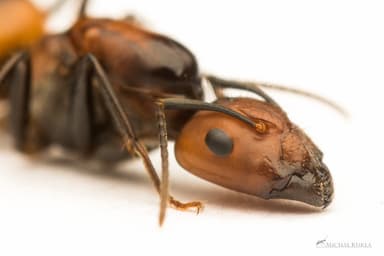
Camponotus
Camponotus nicobarensis
Nuptial Flight Calendar
Flight months: Jan, Feb, Mar, Apr, May, Jun, Jul, Aug, Sep
Care Guide
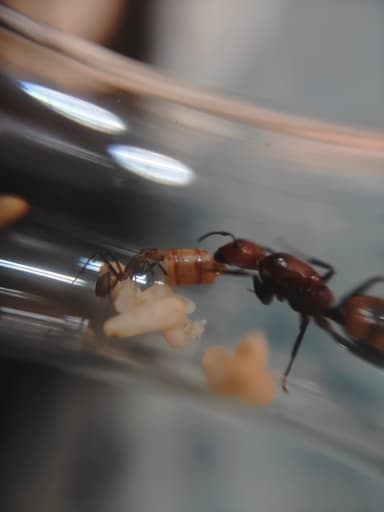
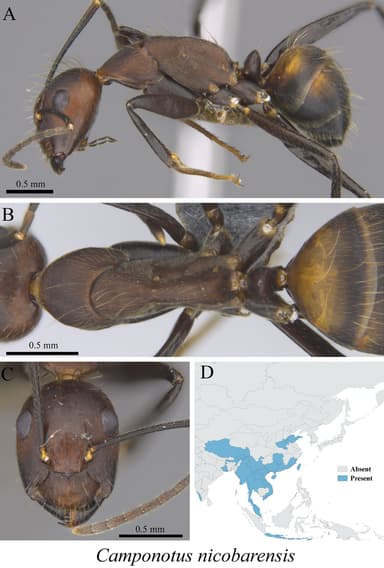
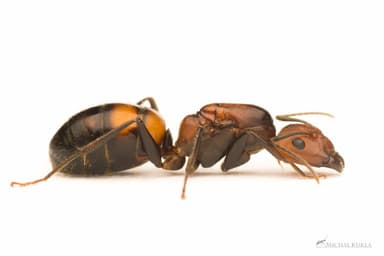
A jewel among beginner-friendly ants, Camponotus nicobarensis is a robust and visually striking carpenter ant native to the warm, humid lowlands of South and Southeast Asia. GBIF occurrence data maps its range from India across the Indochinese peninsula and into the Indonesian archipelago, a distribution that speaks to its adaptability within tropical conditions. Queens are large, measuring 15 to 17 millimetres, while the polymorphic worker caste spans a dramatic 6 to 12 millimetres, producing distinct minor and major workers (AntWiki; AntWeb). The majors develop noticeably enlarged, broad heads packed with mandibular muscles, which they use for nest defense and processing tough food items. A mature colony can grow to 10,000 individuals, offering keepers the rewarding spectacle of a bustling society that exhibits clear division of labour and complex social interactions without becoming unmanageably massive. Their active foraging, rapid brood development, and the dramatic size variation among workers make the species endlessly fascinating to observe, whether you are watching a minor delicately tend a larva or a major aggressively guarding the nest entrance.
This species is widely regarded as an excellent choice for novice ant keepers, and for good reason. Its care requirements align closely with typical indoor ambient conditions, and colonies are notably resilient to minor husbandry mistakes. The founding stage is claustral, meaning the newly mated queen seals herself away and raises her first workers using only her internal fat stores and wing muscle reserves, requiring no food during this period. This makes the early weeks incredibly simple for the keeper. For anyone captivated by the carpenter ant genus but daunted by the slow growth or finicky hibernation needs of temperate Camponotus, C. nicobarensis offers a fast-tracked, year-round alternative. Their beginner-friendly nature does not mean they are dull; quite the opposite. Keepers with more experience will find equal pleasure in managing a large, rapidly expanding colony that eagerly accepts a variety of foods and constructs intricate nesting networks, often revealing fascinating behavioural traits like the use of silk in weaving their nests under larval assistance (formiculture.com), a rare trait among Camponotus.
Providing the right housing is central to the colony’s well-being. Given their tropical origins, these ants require a consistent temperature range of 22 to 28 degrees Celsius. A heat mat attached to a thermostat and placed against one side of the nest creates a thermal gradient, allowing workers to shuttle brood to their preferred temperature zone. Humidity should be maintained between 50 and 70 percent; this is typically achieved by a water-filled reservoir within a plaster, ytong, or sand-clay nest block, or by a test tube setup in the founding phase. The queen and first workers thrive in a simple test tube with a water barrier, but as numbers grow, a larger nest is essential. Vertical, drier nest designs made of 3D-printed plastic or ytong work excellently, but they should always have a hydrated area to prevent desiccation, especially when pupae are developing. Substrate is not strictly necessary in the nest, but a bioactive outworld with a layer of coconut coir or sand, along with springtails, can help manage waste and maintain humidity gradients while offering a more naturalistic display. As expert escape artists, their outworld must be fitted with a tight lid and a fluon or talc barrier; a single gap is all a major worker needs to exploit.
Nutrition is straightforward, mirroring the typical carpenter ant diet of carbohydrates and proteins. Sugar sources drive the colony’s energy; feed them fresh-cut fruit such as apple or banana, a drop of honey, or a small piece of sugar water-soaked cotton. Protein is vital for larval growth and egg production. Offer freshly killed insects like crickets, mealworms, or fruit flies at least twice a week, taking care that the size of the prey is appropriate to the colony’s current needs—majors can dismember larger items for the brood. Avoid leaving uneaten proteins in the nest for more than a day, as they will mould. Clean, fresh water must always be available, either from the nest’s hydration system or a small water tower in the outworld. The colony’s appetite will surge as it grows, and a well-fed C. nicobarensis colony can produce a continuous cascade of brood, with the queen capable of laying a significant number of eggs daily once she is well established (AntsCanada community records).
One of the most convenient aspects of their care is that Camponotus nicobarensis does not require any form of hibernation or cool winter diapause. They maintain constant activity throughout the year, which means you never have to disrupt their rhythm with a refrigerator or chilly basement. This perpetual motion does, however, require a year-round supply of food and consistent environmental monitoring, but it also means you can enjoy observing their intricate society in every season. The nuptial flights in their native range occur from April to September, on warm, humid evenings following monsoon rains (AntWiki), which can inform your own breeding intentions but for most keepers simply underlines the tropical, moisture-loving nature of this ant.
The first few days after your queen and her tiny brood arrive are a critical settling period. Upon unboxing, place the test tube gently in a dark, quiet, vibration-free area. Do not be tempted to check on them frequently; light and disturbance are severe stressors for a founding queen. The initial clutch of eggs, larvae, and possibly a few callow workers will appear fragile, but resist the urge to feed them. Remember, the queen fuels this entire first generation through claustral means. Wait until the first workers have darkened and hardened fully, then offer a minuscule drop of sugar water on a sliver of paper or plastic. Watch for at least five active, foraging workers before introducing a tiny pre-killed fruit fly segment. If the queen seems restless or constantly tries to pull at the cotton plug, it is usually a sign of inadequate humidity rather than hunger—check that the water reservoir behind the cotton is still full. Once you see confident foragers, you can connect their test tube to a small outworld, but always let the colony migrate to a larger nest at its own pace; forcing a move too early can cause chaos. With patience and a light touch, your new colony will quickly transform into a vibrant, endlessly entertaining display of cooperative insect life.