Tetramorium
Tetramorium semilaeve
Nuptial Flight Calendar
Flight months: May, Jun, Jul, Aug, Sep
Care Guide
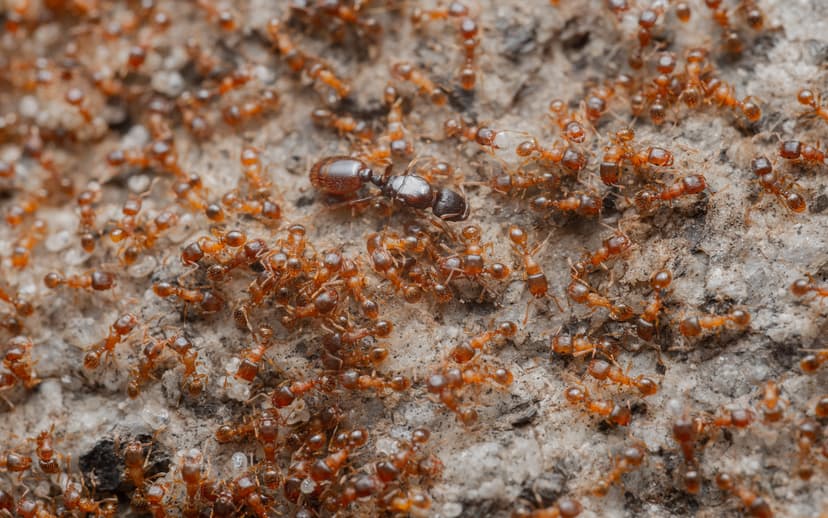
Tetramorium semilaeve is a gem of the Mediterranean ant fauna, a compact and tenacious species that punches well above its tiny weight. Workers are monomorphic, uniformly measuring a mere 2 to 3 millimetres, while the robust queen reaches a more impressive 5 to 6.5 millimetres in length. Colonies are founded claustrally by a single mated queen, who seals herself away and raises her first brood on internal fat reserves and metabolised wing muscle. Over time, a mature colony can swell to an industrious population of up to 10,000 individuals, a figure that reflects their prolific nature (AntWiki; Bolton 1979). Their distribution stretches across the Mediterranean Basin, from the Iberian Peninsula and southern France eastward to the Levant and Asia Minor, with occurrence records clustering between latitudes 28°N and 46°N (GBIF occurrence data). What makes T. semilaeve especially interesting to keepers is its textbook pavement‑ant behaviour: swift colony growth, unrelenting foraging, and a pugnacious territoriality that sees workers readily engaging in skirmishes for food and space. It’s a living demonstration of ant sociobiology in a manageable package, ideal for those who want to witness the dramatic lifecycle from a single queen to a bustling metropolis.
This species is firmly in the beginner‑friendly category, perfectly suited for newcomers to the hobby who are eager to see rapid results without the anxiety of sensitive husbandry. Their forgiving nature spans a comfortable temperature range of 22 to 30 degrees Celsius and a relative humidity between 40 and 60 percent, meaning they thrive happily at typical room conditions with a gentle heat boost. Their hearty appetite, tolerance of minor mistakes, and fast brood development make them a forgiving first colony. However, the small size of the workers demands respect: they are accomplished escape artists. All formicarium openings must be sealed with fine‑mesh stainless steel gauze (0.3 mm apertures or finer) or lined with a well‑applied PTFE‑based barrier, because a gap that a grain of sand can slip through is an open invitation to thousands of tiny explorers. This vigilance aside, T. semilaeve rewards even a novice keeper’s basic diligence with a constantly active, visually engaging display of ant life.
Housing should replicate the warm, well‑drained soils of their natural Mediterranean haunts. A simple, accessible setup pairs a plaster, ytong, or gypsum nest block with a spacious foraging arena. The nest can be kept slightly more humid than the outworld, but the species is notably drought‑tolerant; a nesting humidity of 50 to 60 percent, achieved by a water reservoir beneath the nest or a small water tower, is more than sufficient. In the arena, a shallow layer of a sandy‑loam substrate (a mix of sand, clay powder, and a touch of coir) allows workers to arrange grains and excavate shallow pits, a behaviour that enriches their environment. Temperature is best maintained between 25 and 28 degrees Celsius for optimal growth, with a gentle gradient so the colony can self‑regulate. Avoid overheating, as sustained temperatures above 30 degrees Celsius stress the ants and shorten their lifespans. Lighting can be a simple LED, but the nest should always offer a dark, secure chamber; red foil or opaque red lids allow observation without disturbance, since ants perceive red light poorly.
Feeding T. semilaeve is a straightforward exercise in variety: they are omnivorous generalists with a robust appetite for protein and sugars. Offer small pre‑killed insects such as fruit flies (Drosophila), pinhead crickets, or finely chopped mealworm pieces. For growing colonies, live prey can stimulate hunting behaviour, but always supervise to prevent injury to the ants. Carbohydrates are eagerly accepted in the form of diluted honey, sugar water, or commercial ant nectar, provided in a shallow dish or soaked into a cotton wad to prevent drowning. Many keepers report that workers also collect tiny seeds, such as poppy or chia, enriching their diet with oils and mimicking their natural granivory (a trait common in Tetramorium), though these should not replace insect protein as the main brood‑rearing fuel. Fresh water must be available at all times, ideally via a water‑filled test tube stoppered with cotton. Remove uneaten food after 24 to 48 hours to curb mould and mite outbreaks, a simple routine that goes a long way in maintaining colony health.
Despite their Mediterranean origin, T. semilaeve requires an annual hibernation to cue a healthy brood cycle and queen fecundity. In the wild, temperatures drop markedly during the winter months, and the colony enters diapause for two to three months. Hobbyists should replicate this by gradually reducing the temperature to a steady 12 degrees Celsius around mid‑autumn. I place the colony in a cool, dark space such as a wine cooler or a garage (monitoring with a digital thermometer) and keep them there from December to February. No food is needed during diapause, but a water source must remain available. When spring arrives, warm them slowly over a week to avoid shock. Workers will gradually reactivate, and the queen will resume egg‑laying, often with renewed vigour. Skipping hibernation can lead to erratic brood production and a shortened colony lifespan, so this step is non‑negotiable.
The first days after acquiring a founding queen or small young colony are critical for building trust and momentum. On arrival, keep the test‑tube setup or new nest in complete darkness and absolute stillness for at least 48 hours; the stress of transit can cause a queen to abandon her eggs or even die if prompted by constant vibration. After this settling period, offer a micro‑drop of fresh honey water on a piece of baking paper just outside the nest entrance. Watch closely: a hungry queen will drink greedily, then retreat. Do not push protein until the first generation of workers (nanitics) emerges, typically within six to eight weeks at 26 degrees Celsius. Once the first tiny workers are foraging, start with a single fruit fly or cricket leg, placed away from the brood chambers, and observe their cooperation. As the colony grows, the feeding portions can increase. The key is patience and minimal interference; a queen that feels safe and undisturbed will convert that security into a burgeoning egg pile, and within months you will witness the explosive growth for which this species is renowned.
