Temnothorax
Temnothorax interruptus
Nuptial Flight Calendar
Flight months: Jul, Aug, Sep
Care Guide
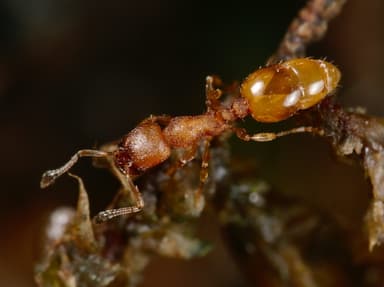
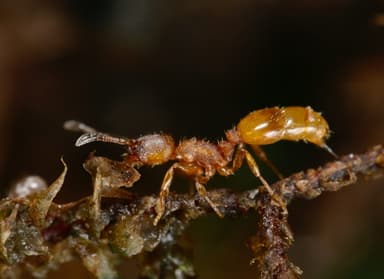
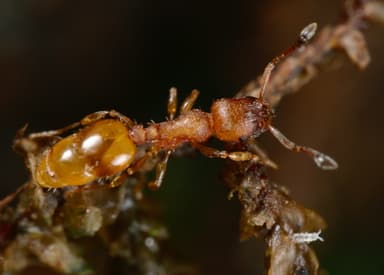
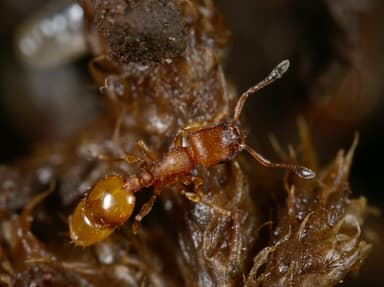
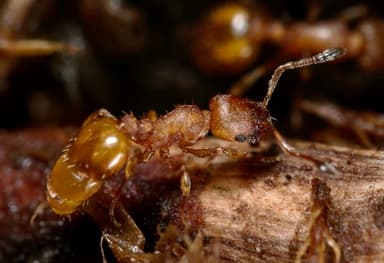
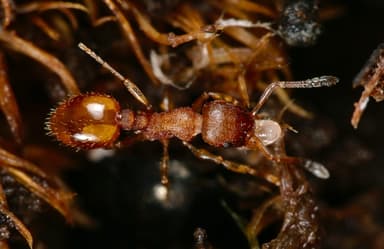
_Temnothorax interruptus_ is a jewel of miniature proportions, its workers barely reaching 2.5 to 3.2 millimetres and queens only slightly larger at 3.5 to 4.5 millimetres. Like many of its congeners, this ant carries the legacy of a taxonomic reshuffle, having once been placed in _Leptothorax_ before modern revisions settled it firmly within _Temnothorax_ (Seifert 2018). Colonies are modest, topping out at around 500 individuals, and the workers are entirely monomorphic, all falling into a single minor worker caste without physical differentiation. Their colouration is a warm amber to light brown, often with a darker gaster, and under magnification one can appreciate the fine sculpture of the head and mesosoma. The species occurs across a broad swathe of Central and Southern Europe, an area roughly bounded by a box stretching from the British Isles eastward to the Caucasus and from the Mediterranean north to central Germany — a distribution that hints at its preference for temperate, sun-warmed microhabitats. What truly sets _T. interruptus_ apart, however, is its remarkable founding strategy: it is an obligatory social parasite. A newly mated queen cannot rear her first brood alone; instead, she must infiltrate the nest of another _Temnothorax_ species, typically _T. nylanderi_ or a close relative, assassinate the host queen, and usurp the worker force to raise her own offspring. This delicate and often hostile takeover makes the species a captivating study in evolutionary adaptation.
Unsurprisingly, the social-parasitic founding places _Temnothorax interruptus_ firmly in the expert category of care difficulty. This ant is not recommended for beginners or even intermediate keepers unless they have solid experience with parasitic species and access to healthy host colonies. The process of introducing a founding queen requires precise timing: she must be provided with a small fragment of a host colony containing several workers and a modest amount of brood, ideally pupae or large larvae, which will imprint on her pheromonal signature. Even then, success is far from guaranteed; queens can be rejected or killed, and the host workers may perish before the first parasitic workers eclose. Once the transition is complete, however, the colony becomes self-sustaining and behaves much like any other small _Temnothorax_ society, albeit one that will never again produce host workers. This challenge is precisely why the species appeals to serious enthusiasts — it rewards patience, observational rigour, and a respect for the intricate dance of coevolution documented by Radchenko (2000) and refined by Seifert (2018). Only keepers comfortable with losing a queen and starting over should take on this captivating but unforgiving ant.
Housing must be designed with their tiny dimensions in mind. Standard formicaria with large chambers and wide tunnels are an escape risk and a stressor; instead, choose micro-nests made of plaster, ytong, or 3D-printed designs with passageways no wider than 3 millimetres. A small founding setup might be nothing more than a glass test tube with a water reservoir and a thin plaster insert, giving the colony a sense of security. Temperature should be maintained within an 18 to 28°C range, and while a gentle daytime gradient is beneficial, prolonged exposure to the upper limit can desiccate these thin-cuticled ants. Humidity is best kept moderate, between 40 and 60 percent, which can be achieved by lightly misting one section of the nest or providing a small water-feeder. Substrate is not strictly necessary for a contained nest, but if you opt for an outworld, a fine layer of sand or loam allows natural foraging behaviour and helps with waste management. Above all, escape-proofing is paramount: a fluon-coated barrier around the foraging arena must be maintained obsessively, as workers can exploit the tiniest flaw and a single breach can mean losing the entire colony.
Feeding _Temnothorax interruptus_ is refreshingly straightforward, though scale remains the watchword. Protein sources should be small and soft-bodied; fruit flies (_Drosophila melanogaster_ or _hydei_) are ideal, as are finely chopped mealworms, freshly killed aphids, or pinhead crickets. Offer a protein meal two to three times per week, removing uneaten remains within a day to prevent mould. For carbohydrates, a dab of diluted honey, maple syrup, or commercial ant nectar on a small piece of wax paper will be eagerly accepted; replace it every other day. Water is best supplied through a test-tube drinker or by keeping part of the nest medium moist, because the ants will drink from damp surfaces. Their diminutive size means you can easily overfeed or create sticky messes — less is almost always more. Once the colony grows past a few dozen workers, you can increase portions slightly, but never leave large insect carcasses that might rot.
Hibernation is not optional — it is a deeply ingrained physiological requirement. In the wild, this species experiences a pronounced Mediterranean or continental winter, and in captivity you must replicate that dormancy. From late October to early March, gradually lower the temperature to a steady 8°C. A household refrigerator, wine cooler, or an unheated basement can serve well, provided the temperature remains stable and does not drop below 5°C. Keep the nest slightly moist — not wet — and check every few weeks for signs of excessive condensation or dehydration. The ants will cluster together, moving sluggishly, and will not need feeding during this time. In early spring, warm them slowly over a couple of weeks to avoid thermal shock. Skipping hibernation will lead to malnourished queens, reduced brood production, and a colony that dwindles and dies within a year or two.
The first days after acquiring a queen or a small colony will set the tone for long-term success. If you have purchased a newly parasitic queen together with a host-worker retinue, she should already be housed in a narrow test tube or small incubator; resist the urge to move her into a larger nest until the first _T. interruptus_ workers have eclosed and are foraging. For an established colony, transfer them gently into their prepared micro-nest and cover it with a dark sleeve or red foil to minimise stress. Do not feed for the first 48 hours — the ants will need water, but solid food is secondary while they settle. On the third day, offer a single pre-killed fruit fly and a tiny droplet of sugar water, placed near the nest entrance. Watch from a distance: if foragers take the offerings within an hour, you can gradually begin the regular feeding schedule. Be alert for signs of fungal growth, listless workers, or the queen failing to oviposit, all of which demand immediate husbandry adjustments. With meticulous care and a dash of luck, your colony will grow into a thriving microcosm, a living tribute to one of Europe’s most intriguing social parasites.