Messor
Messor minor
Nuptial Flight Calendar
Flight months: May, Jun, Jul, Sep, Oct
Care Guide
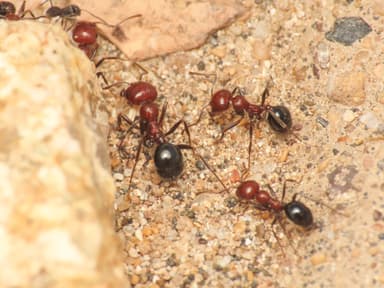
Messor minor is a charming and resilient seed-harvesting ant from the sun-drenched landscapes of the Mediterranean, first described by André in 1883 and later studied in detail by Bernard (1968) and Cagniant & Espadaler (1997) across Western Europe and North Africa. Queens measure 12–15 mm and display a glossy black to dark-brown integument, while the polymorphic workers range from 4 mm minor workers to robust 9 mm majors, often with striking reddish-brown heads that grow disproportionately large for milling seeds. This species’ colony structure is a miniature marvel of division of labour, with three distinct castes—minor workers tend the brood, media workers handle daily foraging, and the broad-headed majors crack open the toughest seeds with their powerful mandibles. Mature colonies can reach a modest 10,000 individuals, a manageable size that allows keepers to witness the full granary-building behaviour without the overwhelming expansion of some larger harvesters. What makes Messor minor particularly interesting is its obligate granivory combined with a calm, almost stoic temperament; workers methodically collect seeds, store them in dry chambers, and process them into a nutritious ant-bread, offering a window into the ecology of arid environments right on your desk.
With a care difficulty rated firmly at the beginner level, Messor minor is an ideal introduction to seed-harvesting ants and a forgiving species for those new to the hobby. It suits keepers who appreciate a clean, low-odour setup and don’t mind providing a seasonal winter rest. The ants are relatively slow-moving and less prone to escape-artist behaviour compared to many formicines, and their claustral founding means a single queen can be left undisturbed in a test tube until her first workers arrive, requiring no feeding during that vulnerable initial phase. This species copes well with occasional neglect once established, as their seed stores buffer against inconsistent feeding schedules, and they are not demanding in terms of humidity. However, they do require a proper hibernation period, so a keeper must have a cool location like a basement, wine cooler, or dedicated fridge set to around 12°C. For anyone looking to graduate from Lasius to a more specialised feeding biology, Messor minor is an excellent stepping stone.
Housing should mimic the dry, rocky Mediterranean habitats this species inhabits, based on occurrence data spanning from the Iberian Peninsula to the Aegean and south into the Maghreb (GBIF). A temperature gradient of 22–30°C is perfect, with the warmer end stimulating brood development and foraging activity; a simple heat mat under one corner of the nest suffices. Humidity needs are low at 30–60%, as excessive moisture quickly leads to seed mould and fungal outbreaks in the nest. I recommend a modular formicarium made of plaster, Ytong, or acrylic, with a thin layer of sand-clay substrate in the foraging arena where workers can deposit debris and mill seeds. The nest area itself is best kept dry with a single water source like a test tube filled with water and a cotton plug, allowing the ants to self-regulate. Avoid misting directly, and ensure good ventilation to prevent condensation. A well-designed outworld with a tight-fitting lid will stop these proficient climbers from exploring your home; a layer of fluon or a lid with fine mesh is essential.
The dietary cornerstone for Messor minor is a diverse mix of tiny seeds—poppy, chia, canary grass, and dandelion are firm favourites—which they eagerly gather and store. These seeds provide the main carbohydrate source; the ants will husk and chew them into a paste, rejecting inedible parts as neat piles of chaff in the outworld. Protein is also essential, particularly for the queen’s egg-laying and larval growth. Offer small insects such as fruit flies, tiny crickets, or pieces of mealworm once or twice a week. Always pre-kill prey to avoid risking injury to workers, and remove uneaten food after a day to prevent decay. Water is best supplied via a test tube or a small water tower in the arena; they drink sparingly, but constant access is vital. Interestingly, these ants will chew on bird grit or a tiny piece of cuttlebone to obtain minerals, which supports their seed-processing activities.
Hibernation is a non-negotiable biological requirement for Messor minor, with colonies needing a cool rest at approximately 12°C for 2–3 months during the winter. In nature, they retreat deep into soil chambers, slowing their metabolism as temperatures drop. To prepare, gradually reduce heating over a couple of weeks in late autumn while keeping them in darkness; stop offering insects and provide only seeds and water during the cooling phase. Place the entire setup in a cool room, wine cooler, or fridge, ensuring the temperature does not drop below 5°C or fluctuate wildly. Monitor weekly for condensation or excessive water loss, but avoid disturbing them. By late February or early March, gently warm them back to room temperature, and they will resume foraging with renewed vigour, often coupled with a burst of egg-laying. This seasonal rhythm is crucial for the queen’s longevity and colony health, aligning with the nuptial flight pattern that peaks in May–July and again in September–October across Mediterranean Europe, typically on warm, humid mornings after rain (AntWiki).
When your Messor minor queen and her first workers arrive, the initial days are a delicate settling-in period. Keep them in the shipping test tube, which already provides a humid, secure chamber, and avoid any major disturbance for at least 48 hours. After that, gently attach the tube to a small outworld or simply place it inside a foraging arena, allowing them to explore at their own pace. The first feeding should be a tiny pinch of poppy seeds and a droplet of water on a small cotton ball; do not offer insects until the colony has a handful of workers, usually after a week. Watch for signs of stress such as the queen racing around or workers refusing to settle—if this occurs, return them to darkness and silence. Expect the queen to look somewhat lethargic at first, as she has spent all her reserves; she will gradually regain condition once the first seed-harvesting generation matures. Over the first month, you’ll witness the beautiful emergence of the polymorphic worker castes, with the first tiny minors eventually being joined by the larger media and majestic majors, turning their humble test tube into a miniature granary brimming with purpose.