Lasius
Lasius americanus
Nuptial Flight Calendar
Flight months: Jul, Aug, Sep
Care Guide
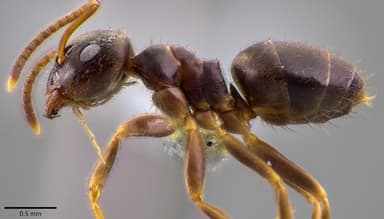
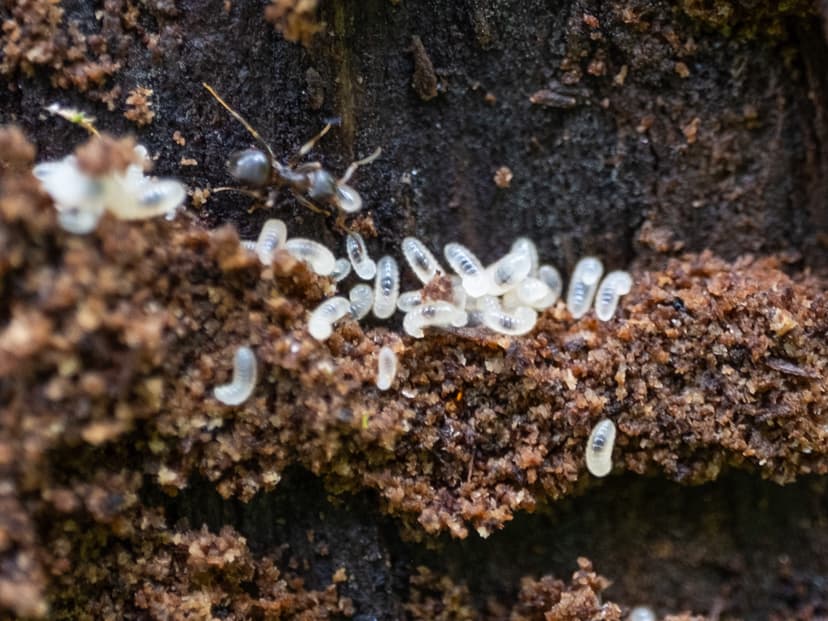
Lasius americanus is a modestly sized ant that has long been a staple of backyards and parks across eastern North America, where its range stretches from the Gulf Coast up into southern Canada, bounded roughly by the Great Plains and the Atlantic Seaboard. The queens are robust, measuring 7 to 9 millimeters, a rich dark brown that can appear almost glossy under good light. Workers, at 3 to 4.5 millimeters, are more slender and uniformly brownish‑grey, and – unlike many other familiar ants – they exist in a single monomorphic caste, no large majors or super‑majors to complicate the view. Mature colonies can grow to a bustling 10,000 individuals, though in captivity several thousand is more typical. What makes this species so captivating for the observant keeper is its behavior: colonies often tend aphids on plant roots or even build delicate soil‑covered galleries around stems, a habit that reveals their deep evolutionary history as Lasius ants (Wilson 1955; Schär et al. 2018). Their nuptial flights occur on warm, humid afternoons following summer rain, from July through September, when new queens take to the air, mate, and then seek out a claustral chamber – a sealed underground cell where, using only the energy from their spent wing muscles and fat bodies, they will rear their first tiny workers in total seclusion.
Care for Lasius americanus sits firmly in the beginner category, making it an ideal introduction to the ant‑keeping hobby. It is forgiving of minor fluctuations in temperature and humidity, grows steadily without demanding exotic foods, and rarely panics unless handled extremely roughly. The one non‑negotiable is hibernation, discussed below. This ant suits anyone who can offer a cool, undisturbed wintering space and who takes genuine delight in watching a colony gradually ramp up from a single queen to a busy, cohesive society. If you live in an apartment without a cool cellar or a dedicated small refrigerator, consider whether you can reliably provide a steady 5°C for three or four months each year; if not, this might not be the species for you. For everyone else, especially those who remember childhood fascination with the ants under the paving stones, Lasius americanus will feel like a familiar friend that rewards patience with daily activity.
Housing begins, classically, with a test‑tube setup. A wide‑bore glass tube with a water reservoir plugged by cotton and a dry cotton entrance provides everything a newly mated queen needs for her claustral founding. Once the colony reaches around fifty workers, it is time to transition them to a small formicarium. Plaster, ytong (autoclaved aerated concrete), or a hybrid acrylic‑nest with a gypsum insert all serve well, as long as one area retains moisture to maintain a relative humidity between 50 and 70 percent. Room temperature in the range of 20 to 26°C is perfectly adequate; a slight thermal gradient – perhaps by placing one side of the nest near a room’s ambient heat or a very low‑wattage heat cable – allows the ants to self‑regulate. The outworld, the foraging arena, need not house substrate but a shallow layer of fine sand or coco coir gives the workers natural purchase and encourages waste‑carrying behavior. Escape prevention is essential: a tight‑fitting lid with a barrier of fluon or petroleum jelly is mandatory, as these small ants are adept climbers and will explore every gap.
Feeding Lasius americanus is straightforward. Protein should come from small, pre‑killed insects – fruit flies, micro‑crickets, freshly cut mealworm segments – offered two or three times a week. Remove uneaten remains after a day to prevent mold. Carbohydrates, the real engine of adult ant energy, can be provided as a drop of diluted honey, maple syrup, or a commercial ant nectar on a small slip of foil or a cotton pad in the outworld. A permanent clean water source, separate from the nest’s humidity reservoir, can be a tiny test tube of water stoppered with cotton; it will double as a drinking station. If immediate hydration is needed, a moist cotton ball in the outworld suffices, but never spray water directly into the nest.
No aspect of keeping Lasius americanus is more vital than a proper hibernation. In their natural range, these ants experience cold winters, and the queen’s annual reproductive cycle depends on a prolonged chilling period. The guide temperature is 5°C, though a stable range of 3 to 8°C works. Begin preparation in late autumn: cease feeding protein a week beforehand, allow the colony to clear its crops, then gradually lower the nest temperature over several days. A small refrigerator with an external thermostat provides reliable control; inside, place the formicarium (with a sealed but breathable cover) inside a thermal box to buffer against cycling as the compressor clicks on and off. Check monthly for condensation or mold, but otherwise leave them undisturbed. A three‑ to four‑month diapause is ideal. In spring, warm them slowly, and you will soon see the queen resume laying.
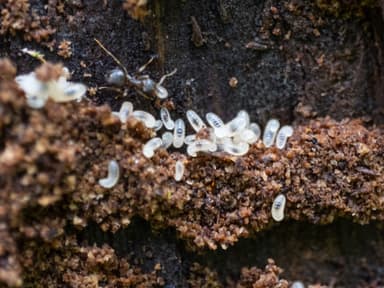
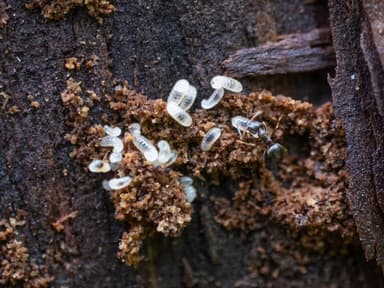
The first few days after receiving your ants set the tone for a healthy relationship. If you have purchased a single founding queen in a test tube, do not offer any food. She is fully claustral and feeding her now will only stress her and soil the tube. Keep the tube in a dark, vibration‑free spot at room temperature for at least a week, then peek briefly with a dim red light. You should see a small clutch of eggs fastidiously tended. After roughly six to eight weeks, the first nanitic workers will eclose; only then introduce a half‑drop of sugar water on a foil piece, and after another day a freshly killed fruit fly. If you have bought a queen with a small worker brood already, give them 24 hours of darkness to recover from shipping stress. Then place a sugar droplet near the nest entrance and observe. A calm colony will send out a few foragers soon afterward; if they seem excessively skittish, cover the setup again and wait. Watch for any sign of mold at the cotton plug and ensure the water tube remains full. With patience and gentle observation, you will witness the tenacity and understated beauty of Lasius americanus as it builds its miniature empire in your care, just as it has done in the soil of a continent for millennia (Schär et al. 2018).