Cerapachys
Cerapachys biroi
Care Guide
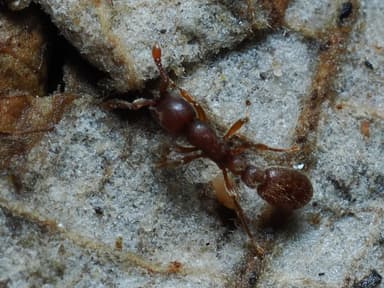
Exceptionally few ants captivate both the seasoned keeper and the research biologist quite like Cerapachys biroi — now placed in the genus Ooceraea, yet widely recognized by its former name. These diminutive ants, measuring just 2–2.7 mm as monomorphic workers, form colonies that number up to about 500 individuals and have evolved a suite of traits so peculiar that they are affectionately known as the clonal raider ants. There are no queens; instead, every worker is a thelytokous female that can produce diploid daughters clonally, while also engaging in cooperative brood care and obligate raiding behaviour (Ravary & Jaisson 2002). Their colonies reproduce by budding — small groups of workers simply peel away and begin a new nest — a mode fitting for a species with a global tramp distribution across tropical and subtropical regions, from Africa and Asia to the Pacific islands. Genomic and neurobiological tools, including the famous orco mutant lines (Trible et al. 2017), have made C. biroi a laboratory model, but for the advanced hobbyist they offer a rare window into a life history that combines the nomadic raiding of army ants with the reproductive uniformity of a clone line.
Caring for C. biroi is, without caveat, an expert‑level undertaking. This assessment rests on three pillars: a hyper‑specialised diet requiring constant access to the brood of other ants, a small body size that turns any flaw in containment into an escape route, and environmental sensitivities that leave little room for neglect. A keeper must be prepared to maintain a steady supply of live ant larvae and pupae — typically harvested from sacrificial host colonies — and to accept that colonies cannot be left unattended for more than a day or two. This species is emphatically not for the beginner, nor for anyone who balks at the ethical dimension of feeding brood from one ant species to another. If you have mastered a broad range of ants and are drawn to the biological frontiers of the hobby — where ant keeping meets developmental biology — then C. biroi will provide a genuinely unparalleled experience.
Housing must mirror the warm, humid microhabitats these ants select in nature. The ideal temperature range sits between 22°C and 28°C, with relative humidity held at 60–80%; a plaster or Ytong nest that can be kept permanently moist without water pooling is the finest option, as such materials buffer humidity and give the ants a surface they can grip securely. A very thin layer of fine sand or loam inside the nest chamber can further enhance comfort, but elaborate substrate is unnecessary and complicates observation. Given their size and restless raiding activity, the entire formicarium must be sealed with meticulous care — fine steel mesh, tight‑fitting lids, and a PTFE‑based barrier (such as Fluon) along all upper edges are non‑negotiable. The nest itself should be small and interconnected, offering narrow, crevice‑like chambers that mimic the soil voids where they naturally bivouac, and it should open into a subdued foraging arena that provides space to place an access tube to a host brood chamber.
The dietary regime is the most demanding aspect of their husbandry. C. biroi are obligate predators of ant brood; they do not accept honey, sugar water, or typical insect pieces in a reliable way, and their colonies will collapse within days if deprived of the larvae and pupae of other ants. Suitable brood can be sourced from common pest or beginner‑kept species such as Pheidole, Tetramorium, or Lasius, but the host must produce brood continuously — which may mean keeping multiple host colonies in rotation. Feed a portion of brood daily or every other day, offering enough that the larvae‑laden workers stop foraging within an hour. Fresh water should be available at all times, most simply via a water‑filled test tube plugged with cotton and placed in the foraging arena.
No hibernation period is required, nor any seasonal cooling; the colony’s tropical provenance means they perform best when the temperature regime is held steady year‑round. This consistency does simplify the calendar, but it also removes the natural “resting” window that allows many temperate species to tolerate a keeper’s occasional lapses in feeding. Every day of the year, the colony will be active and hungry, making uninterrupted care a more demanding commitment.
Upon first receiving your colony, patience and minimal interference are paramount. The workers will be stressed from shipping and will likely huddle tightly around their brood pile. Set up the permanent nest beforehand, moistened and conditioned, and gently introduce the entire founding unit — still in their transport tube, if possible — directly into the nest area, connecting it to a darkened foraging container with a pre‑loaded water tube and a small initial offering of fresh ant brood. Keep the temperature and humidity at their optimal ranges, drape the setup with a dark cloth, and resist the urge to observe for at least 48 hours. After this settling window, you may begin brief inspections to confirm that the workers are tending their brood and that the offered food is being accepted. Watch for signs of chronic restlessness, such as workers abandoning the nest site or wandering incessantly along the barriers; these usually indicate a flaw in humidity, temperature, or the suitability of the nest substrate. With attentive, research‑grade care, your clonal raider colony will steadily expand through budding, offering a front‑row seat to one of the most extraordinary social systems in the ant world.