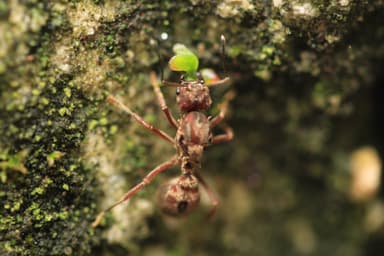
Acromyrmex
Acromyrmex disciger
Nuptial Flight Calendar
Flight months: Oct, Nov, Dec
Care Guide
Acromyrmex disciger, a leaf-cutting ant of the tribe Attini, captivates hobbyists with its remarkable fungus-farming lifestyle, a trait it shares with the more familiar Atta species but on a somewhat more manageable scale. Native to eastern South America—from Brazil’s humid forests southward into Paraguay and northern Argentina, as indicated by its broad latitudinal distribution (GBIF records)—this species has evolved a sophisticated symbiosis with a fungus it cultivates on freshly cut vegetation. Queens are robust, measuring 14 to 18 mm, while the workers display striking polymorphism, spanning 2.5-mm minors that tend the fungal garden to broad-headed 9-mm majors equipped with powerful mandibles for leaf cutting and colony defense (AntWiki; Della Lucia 2011). Mature colonies can reach immense sizes, occasionally containing up to 100,000 individuals, organized into a complex caste system of minor, media, and major workers. Founding is claustral, with newly mated queens sealing themselves in a chamber to rear their first brood and fungus garden unaided, and nuptial flights occur in the native Brazilian range during the afternoon warmth of October through December, typically after heavy rains (AntWeb). This ant’s intricate social structure and the mesmerizing process of leaf harvesting make it an extraordinary display species for the truly dedicated keeper.
Given the uncompromising environmental and dietary demands of fungus-growing ants, Acromyrmex disciger is unequivocally an expert-level species. It is not a beginner’s ant, nor even a species for the casually experienced; it requires a meticulous understanding of microclimate control and a long-term commitment to daily maintenance. Only those who have successfully kept other high-maintenance exotic ants and are prepared to replicate a slice of subtropical rainforest inside their home should consider this ant. If you are the sort of keeper who delights in precision monitoring and is fascinated by the inner workings of a living superorganism, A. disciger will reward you with a deeply engaging project. However, be aware that a single failure in humidity or a lapse in leaf supply can swiftly lead to the collapse of the fungus garden and the death of the colony (Forti et al. studies). With that caveat firmly in place, let us turn to the precise housing conditions this ant demands.
To thrive, A. disciger requires a custom-built formicarium that mimics the warm, humid hollows where it naturally nests. The core of the setup must be a well-ventilated yet highly humid chamber dedicated to the fungus garden. Temperature should be held steady between 22 and 28 °C, with 24–26 °C being an ideal target. Relative humidity inside the fungus chamber must be maintained at 70–90 %; falling below this range even briefly can cause the fungus to dehydrate and die. Many advanced keepers achieve this with a combination of a moisture-retentive base—such as a thick layer of plaster, ytong, or a naturalistic coconut-fiber substrate—and an automated misting system or a regular hand-misting schedule using dechlorinated water. The nest chamber can be connected to a drier foraging arena, which should still offer a humidity gradient and a water source. Avoid fully sealed setups, as stagnant air encourages mold; a small amount of passive ventilation, balanced with frequent moisture input, works well. The queen, brood, and fungus garden are moved together into this enclosure, and the fungus should be placed directly on the damp substrate where the workers will immediately begin expanding it.
The dietary needs of A. disciger are inseparable from its fungal symbiont, because the ants themselves eat very little solid matter. Their primary food is the gongylidia—nutrient-rich swellings—produced by their Leucoagaricus fungus as it breaks down the fresh plant material the ants supply. Consequently, you must provide a near-daily assortment of clean, pesticide-free leaves to sustain the garden. Bramble, privet, rose, hibiscus, citrus, and oak are all readily accepted; vary the offering to ensure a balanced fungal nutrition. Cut leaves into small pieces appropriate for the worker caste present. In addition, the adult ants appreciate a carbohydrate source, such as a droplet of sugar water, honey, or a slice of very ripe fruit placed in the foraging area, though this is secondary to the fungal harvest. A water tube or damp sponge must always be available in the outworld, but the colony obtains most of its hydration from the fungus and the moist leaves, which is why high chamber humidity is doubly critical. Remove any uneaten, dried-out leaf fragments after 24–48 hours to prevent rotting and the growth of spoilage molds that could compete with the fungus.
Hibernation is entirely absent in this tropical species; A. disciger remains active year-round and requires no winter cooling period. Instead, you must maintain its stable warm, humid regime continuously. For the new keeper receiving a founding queen or a small incipient colony, the first week is a delicate settling-in period. When your queen arrives with her small fungus garden, gently introduce her into the prepared, pre-warmed and humidified fungus chamber. Do not immediately offer leaves if no workers are present; a solitary queen will tend the garden herself and does not forage. If the colony already has a few workers, place two or three tiny, fresh leaf pieces directly near the nest entrance and watch; they will usually begin cutting within hours. In the first days, restrict disturbance to an absolute minimum: check temperature and humidity through a viewport, but resist opening the nest. The fungus should appear a healthy, creamy white to light grey, with a slightly fluffy texture. Any browning, shriveling, or strong odor signals immediate trouble—typically low humidity or contamination. Once the first batch of workers emerges and forages confidently, you can slowly increase the leaf supply. With consistent care, the garden will expand, revealing the mesmerizing rhythm of workers harvesting, processing, and tending their fungal crop—a sight that makes the rigors of expert husbandry entirely worthwhile.