Oecophylla
Oecophylla longinoda
Nuptial Flight Calendar
Flight months: Jan, May, Jun, Jul, Aug, Sep, Oct, Nov, Dec
Care Guide
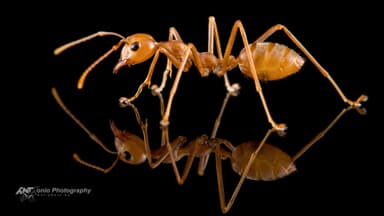
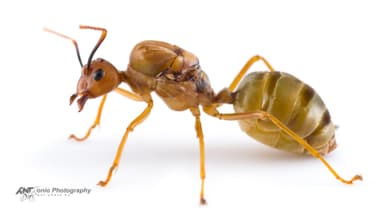
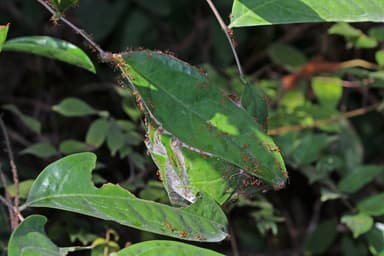
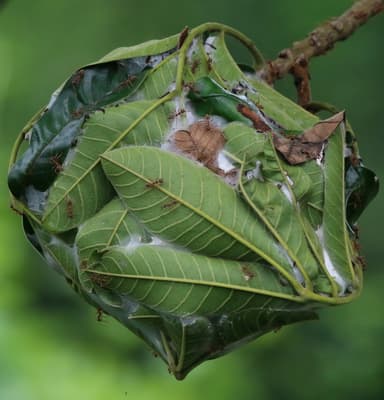
Among the pantheon of formicid marvels, the African weaver ant Oecophylla longinoda stands as a true giant—both in size and behavioral complexity. Queens are striking matriarchs reaching 20–25 mm, while the worker caste displays a distinct polymorphism, with diminutive minors as small as 5 mm and broad-headed majors up to 10 mm. This physical division of labor fuels colonies that can swell to an astonishing 500,000 individuals, constructing sprawling arboreal territories in their native Sub-Saharan Africa. Their common name derives from the breathtaking cooperative nest-building behavior: workers form living chains to pull leaf edges together, then gently manipulate silk-producing larvae to stitch the foliage into a secure bivouac. Hölldobler & Wilson (1990) immortalized this intricate weaving, and later work by Hölldobler (1983) revealed sophisticated territorial rituals, including chemical marking and group confrontations, that make them one of the most behaviorally rich ants to observe. Nuptial flights in their home range occur during the afternoon of warm, humid days from October into January, following rain, though captive breeding is an advanced challenge rarely attempted in the hobby.
Keeping Oecophylla longinoda is strictly an endeavor for the expert myrmecologist. Their demanding environmental requirements, formidable defensive arsenal—they deliver painful bites and spray formic acid—and astonishing escape abilities place them firmly beyond the reach of novice or even intermediate keepers. This is not a desktop pet; it is a high-maintenance tropical organism that demands a dedicated, well-researched setup and constant vigilance. Prospective keepers must be prepared for a very large, fast-growing colony that will quickly outgrow small enclosures. Those with experience in managing aggressive, arboreal species and who have the space for a sizable vivarium will find Oecophylla unparalleled, but the species is wholly unsuitable as a casual introduction to the ant-keeping world.
Housing must be thoughtfully designed to mimic the tropical forest canopy that these ants call home. A tall, well-ventilated arboreal vivarium or custom-built formicarium is essential, with a minimal footprint of at least 60×60 cm for a mature colony, though larger is always better. The interior should be adorned with sturdy branches, broad-leaved artificial or live plants (such as Ficus benjamina or robust silk plants), and multiple anchor points from which the ants can suspend their woven nests. Unlike ground-dwelling species, Oecophylla spend their entire existence above the substrate; a layer of coco coir or bioactive soil on the floor serves primarily to support plants and buffer humidity, but the ants will rarely walk on it. Temperature must be maintained between 24°C and 32°C, with a gradient that allows a warm basking zone near the upper end. Relative humidity of 70–90% is critical, achieved through daily misting and a partial enclosure lid, yet ample ventilation must prevent stagnant, mold-prone air. Barrier methods are paramount: a PTFE or Fluon-coated rim, a tightly fitted dual-lock lid, and a secure escape moat will save you from a nightmare scenario. Provide feeding platforms elevated near the nest sites to reduce disturbance.
Feeding these voracious predators is a daily commitment. Protein sources should be live or freshly killed insects such as crickets, locusts, roaches, and mealworms, offered in quantities proportional to colony size—a thriving colony of a few thousand workers can consume several large insects per day. Suppress the instinct to overfeed, but never allow them to go hungry, as underfed colonies become excessively defensive and prone to escape attempts. Carbohydrates are equally vital; in the wild, they tend trophobiont homopterans for honeydew, but in captivity a dilute mixture of honey and water, pure maple syrup, or slices of sweet fruit like grapes and mangoes, provided in a shallow liquid feeder, will be eagerly accepted. Always include a clean water source with a cotton wick or sponge to prevent drowning. Vitamin and mineral supplementation by occasionally dusting insect prey with a quality reptile supplement can support robust brood development, though this is not strictly necessary if diet is varied.
It is a relief to know that Oecophylla longinoda requires no hibernation period. Originating from equatorial regions with relatively stable day lengths and temperatures, they remain active and brood-rearing year-round. A constant warm, humid regime is therefore essential; any attempt to lower temperatures will result in severe stress, brood die-off, and likely colony collapse. This relentless activity means the keeper’s feeding, watering, and maintenance routines must likewise continue without seasonal break, making careful planning for holidays or absences a necessity well before acquiring the ants.
The first days after purchase are a critical acclimation window. Immediately upon arrival, place the colony in its pre-prepared, fully stabilized enclosure and resist the urge to disturb them. A darkness period of 24–48 hours will help the ants settle; cover the glass with a breathable cloth and keep the room quiet. Offer a tiny drop of sugar water on a slip of paper or cotton within a few hours, but wait until the second day before introducing a single pre-killed insect—a crushed fruit fly or pinhead cricket—to avoid overwhelming them. Monitor closely for persistent pacing, frantic escape attempts, or refusal to feed, which indicate stress or suboptimal conditions. If the queen and a core of workers retreat to a corner and begin gently plucking at a leaf edge, you are witnessing the first tentative steps of nest weaving—a profoundly hopeful sign. Gradually increase light and feeding as they establish, and resist any major enclosure changes for at least two weeks. With patience and rigorous attention to the parameters outlined, your Oecophylla longinoda colony can mature into a breathtaking exhibit of one of nature’s most sophisticated insect societies (Way 1954).