Stenamma
Stenamma westwoodii
Nuptial Flight Calendar
Flight months: Jul, Aug, Sep
Care Guide
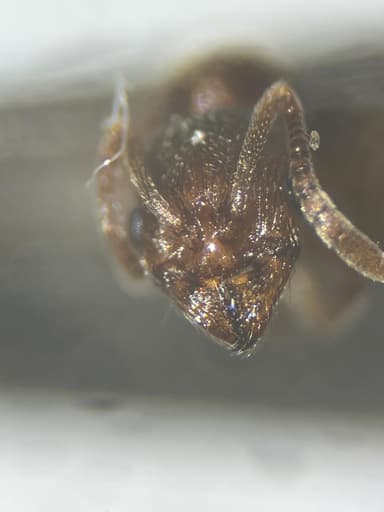
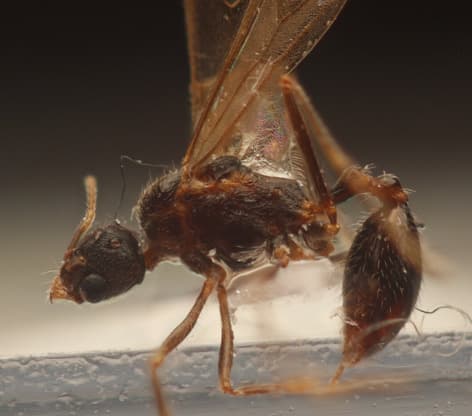
Stenamma westwoodii is a small, cryptobiotic ant distributed widely across Europe, from the Mediterranean region northward into southern Scandinavia, west to Ireland, and eastwards into the Balkans and beyond (Seifert, 2018). Queens measure a modest 4.5 to 5.5 mm, while the monomorphic workers range from 3 to 4 mm, both cloaked in a uniform dark brown to blackish hue that renders them nearly invisible against damp soil and leaf litter. Colonies are discreet, with a maximum size typically around 250 individuals, and new nests are founded claustraly by a single queen. For the devoted myrmecologist, the fascination of this species lies precisely in its obscurity: it spends almost its entire life underground, navigating narrow soil galleries and only rarely venturing onto the surface under cover of dusk or high humidity. Observing them is a study in subtlety—the way a worker cautiously tests the air with her antennae, the delicate transport of a springtail carcass—and this reclusive nature, well documented in Collingwood’s classic survey of Fennoscandian ants (Collingwood, 1979), makes a thriving Stenamma westwoodii colony a quiet triumph of husbandry.
This is unequivocally an expert-level species, reserved for keepers who have already mastered humidity control, diapause management, and the art of leaving a colony largely undisturbed. The ants are exquisitely sensitive to environmental fluctuations, with even brief drops in humidity causing brood dessication, while overfeeding or inadequate ventilation quickly invites fatal mould outbreaks in their perpetually moist confines. A beginner will almost certainly fail, but an experienced hobbyist who delights in the challenge of replicating a stable, cool woodland soil microclimate will find deep satisfaction here. Patience is the cardinal virtue: the colony will never offer the bustling spectacle of a Lasius or Formica, but instead rewards the keeper who can coax it through each cycle of growth, hibernation, and ephemeral foraging, much like tending a delicate, slow-moving bonsai ecosystem.
Housing must recreate the cool, saturated humidity of their native leaf-litter and upper soil horizons. Maintain the nest at 18 to 24°C, with relative humidity firmly between 70% and 90%—lower values stress the ants visibly, causing workers to cluster restlessly around water sources. The most successful setups employ a naturalistic substrate blend of fine sand, clay, and humus topped with decomposing leaf litter, or a plaster/ytong nest with generous water reservoirs that wick moisture evenly. Since workers are expert escape artists at their size, all ventilation must be screened with fine stainless steel mesh, and connections between modules sealed with PTFE oil or similarly secure barriers. Provide a small foraging arena with a shallow layer of dampened substrate and a few pieces of bark as cover; a test tube water feeder or a corner lightly misted every few days ensures drinking water without flooding the nest. In my own trials, colonies housed in too dry a plaster nest abandoned active chambers for the humid shelter of a connected tube within days, a telling sign that humidity had dipped below their tolerance.
Feeding Stenamma westwoodii is a study in minimalism. In the wild they are timid predators of tiny soil arthropods, and in captivity they readily accept freshly killed fruit flies, springtails, or minuscule fragments of cricket and mealworm, always presented in portions no larger than a worker’s head. Sugars should be delivered as a dilute honey solution or sugar water on a wax-paper slip, replaced every two days to prevent fermentation. Because of their tiny biomass, feeding twice a week with a single micro-drop of sugar and one equally small protein item suffices; any uneaten protein must be removed after 24 hours, as the high humidity that these ants require also accelerates decay and mould. Observing a worker delicately feeding from a droplet of honey water in the dim light of early morning is one of the quiet pleasures of keeping this species, a reward for the keeper who has mastered the rhythm of such restrained provisioning.
A true hibernation at 5°C is non-negotiable for long-term colony health. In nature, Stenamma westwoodii retreats deep into the soil to escape frost, and captive colonies require a minimum of three to four months of chill, typically from late October through February, mirroring the cool, stable temperatures of their native range. Begin by gradually lowering the temperature over two to three weeks, ceasing all protein feeding at the start of the cooling period. Place the nest in a dedicated refrigerator or wine cooler set to 5°C, checking monthly that the substrate or water reservoirs remain damp but not waterlogged, as even in dormancy the ants will perish from desiccation. Throughout this period the colony will appear motionless, the queen and workers huddled in a tight cluster; resist any urge to warm them prematurely, as a broken diapause can disrupt the reproductive cycle and weaken the colony for the coming season.
Receiving a Stenamma westwoodii queen or small colony is a delicate moment that sets the tone for months to come. If you are starting with a newly captured, mated queen—best obtained in August or September, timed with their crepuscular nuptial flights after warm, humid days—place her test tube setup in a completely dark, vibration-free spot at around 20°C and do not disturb her for at least two weeks. She is fully claustral, needing no food until her first nanitic workers emerge, and even the briefest exposure of light can cause her to consume her brood in panic. Once one to three tiny workers are active, offer the tip of a needle dipped in sugar water just outside their tube, followed the next day by a single newly killed fruit fly placed as near to the entrance as possible without blocking it. Watch their response: if a worker emerges timidly, then retreats to the queen before returning to feed, you are on the right track. Should they ignore food entirely, replace the item with a fresh offering and give them another day of quiet; a colony that has endured shipping stress may take several days to feel secure enough to forage. From this whispered beginning, the patient keeper will gradually witness the ants accept their new domain, a tiny hidden world unfurling only for those who know how to wait.