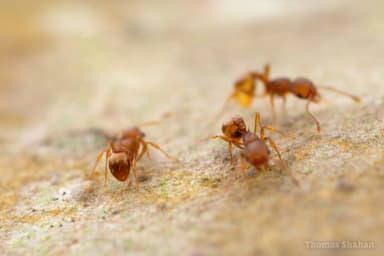
Wasmannia
Wasmannia auropunctata
Nuptial Flight Calendar
Flight months: Jan, Feb, Mar, Apr, May, Jun, Jul, Aug, Sep, Oct, Nov, Dec
Care Guide
The little fire ant, Wasmannia auropunctata, is a minute but formidable species that captures the attention of hobbyists and scientists alike. Workers measure a mere 1.2 to 1.5 millimeters, while the queens are notably larger at 4 to 4.5 millimeters. All workers belong to a single monomorphic caste of minor workers, and colonies can swell to a staggering one million individuals, housing hundreds of fertile queens. This polygynous, highly populous structure is powered by a reproductive strategy dominated by budding: new queens typically mate inside their natal nest, and nuptial flights are exceedingly rare, though they may occur throughout the year in the Neotropical native range (Wetterer & Porter 2003). The species’ potent sting, which feels like a concentrated spark, has earned it the name “electric ant.” What truly sets W. auropunctata apart is its remarkable genetic system—in many invasive populations, queens and males reproduce clonally, creating separate gene pools that bypass conventional sexual recombination and accelerate colonization (Foucaud et al. 2010). Originally native to the Neotropics, its occurrence now sprawls from 35°N to 35°S across the globe, making it one of the most notorious tramp ants. For a dedicated keeper, this ant offers an unparalleled glimpse into a superorganism shaped by invasion biology, but it also demands the highest level of responsibility.
Care difficulty for Wasmannia auropunctata is intermediate, not because the ants are fragile—they are exceptionally hardy—but because the entire husbandry challenge revolves around containment and ethical stewardship. This species is a globally recognized invader, and escape must never occur. Therefore, it is suited only to experienced ant keepers who are fully prepared to build or purchase an escape-proof setup and to maintain rigorous safety checks at all times. Beginners should never attempt this species, and anyone living in a climate where outdoor temperatures consistently stay above 22°C should reconsider, as accidental release could have serious ecological consequences. Even in cooler regions, a heated formicarium can sustain a colony that would quickly perish outside, but a single breach during warm weather could still become a local chronic problem. If you are willing to treat every interaction with the mindset of a biocontainment operator and you have the skill to fashion barriers that can thwart a 1.2‑millimeter ant, you will find these ants endlessly fascinating.
Housing must prioritize absolute security. I recommend a plaster or Ytong nest with a precisely fitted, weighted lid, connected to a foraging arena that utilizes a PTFE or mineral‑oil barrier along the entire rim. Every seam, ventilation hole, and cable entry must be flawless, because the workers can exploit gaps invisible to the naked eye. Maintain the nest temperature between 22 and 30°C by placing a heating cable under one portion of the nest, creating a gentle gradient that lets the ants self‑regulate. Humidity is equally critical; target 60 to 80 percent relative humidity by keeping the plaster or Ytong damp and by providing a constant water source, such as a test tube with a cotton plug. A substrate of coconut coir, fine sand, or modeling clay in the outworld helps retain ambient moisture and gives the ants a naturalistic surface to traverse. Monitor moisture daily, as these ants wilt quickly if the nest becomes too dry.
The dietary needs of W. auropunctata are straightforward but must be met with increasing frequency as the colony explodes in size. Offer protein from small insects such as fruit flies, pinhead crickets, or chopped mealworms two to three times per week, and supplement with flaked fish food or a dab of hard‑boiled egg yolk. Carbohydrates should be provided as dilute honey, maple syrup, or commercial ant nectar in a shallow, easy‑to‑clean feeder; replace these offerings every one to two days to prevent fermentation. A separate water source, ideally a fresh test tube with a cotton plug, should always be available. Because these ants are aggressive and lightning‑fast foragers, never open the outworld without first placing the entire setup inside a larger, smooth‑walled containment tray, and keep your pooter or aspirator handy for any stray individuals.
*Wasmannia auropunctata* does not hibernate and requires no winter dormancy period. In their native and introduced ranges they thrive in stable warmth all year, and captive colonies must be kept at their regular temperature range without any prolonged cooling. A slight nightly dip within the 22‑30°C bracket is harmless, but never allow the colony to remain below 20°C for more than a few hours. Because there is no seasonal slowdown, the colony will grow relentlessly; be prepared to upgrade nest capacity far sooner than you might expect, and never give the ants an opportunity to become overcrowded and seek egress.
The first days after your colony arrives are a critical settling‑in period. Place the sealed transport container inside the outworld and open it under a secondary containment tub, letting the ants migrate into the prepared nest at their own pace—a tiny drop of sugar water near the nest entrance can serve as a gentle invitation. Wait at least 24 hours before offering the first protein meal to allow the queen and workers to stabilize. During that first week, watch closely for escape behavior: if you see workers persistently probing the lid or barrier, refine your seals immediately. You can expect the queens to resume egg‑laying within a day or two, as the species is extremely fecund. Keep disturbance minimal and use a red‑light flashlight for brief inspections of brood and hydration. Above all, start planning your expansion modules now—a founding group that seems manageable can swell into the thousands in a matter of months, and once you witness their explosive potential, you will understand why eternal vigilance is the price of keeping this miniature marvel.