Odontomachus
Odontomachus rixosus
Nuptial Flight Calendar
Flight months: Apr, May, Jun, Sep, Oct
Care Guide
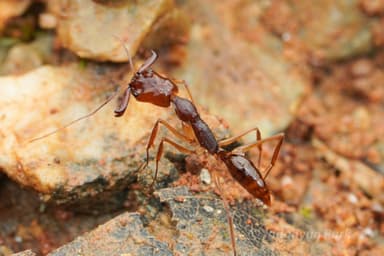
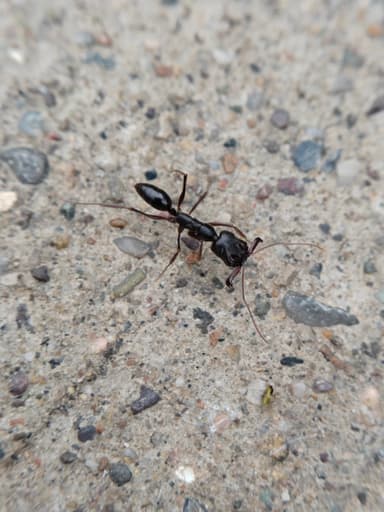
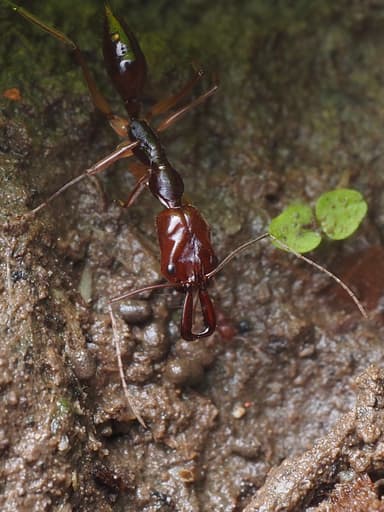
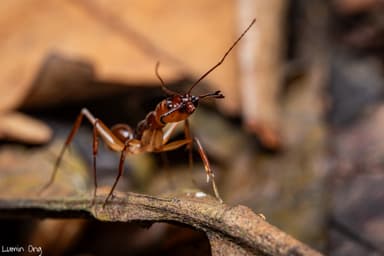
Odontomachus rixosus is one of the most visually arresting ants available to hobbyists, a trap-jaw predator with a glossy, reddish-brown body and long, slender mandibles that lock open at 180 degrees. Queens measure between 13 and 15 millimeters, while workers span 11 to 13.5 millimeters, with no polymorphism or major subcastes – all workers are fundamentally similar in form, a single caste of monomorphic foragers and nurses. Native to the warm, humid lowlands of Southeast Asia, from the eastern edges of India across the Malay Archipelago, this species forms modest colonies of up to around 200 individuals, and new colonies are founded claustrally by a single dealate queen. What truly sets O. rixosus apart is the biomechanics of its jaw apparatus; the trap-jaw mechanism can snap shut at extraordinary speed to impale soft-bodied prey or launch the ant backwards to safety – one of the fastest movements in the animal kingdom (Sorger 2015). This combination of stealthy predatory behavior and cryptic nesting habits makes observing a thriving colony deeply rewarding.
In terms of husbandry, O. rixosus falls squarely into the intermediate care level. It is not a beginner ant, because it demands consistently high humidity and stable temperatures that can be tricky for novice keepers to maintain, and the solitary hunting style means the queen and small founding colonies are sensitive to disturbance. This species is best suited to keepers who have already successfully raised a few easier claustral species and are comfortable fine-tuning microclimate conditions. You need patience during the founding period, which can be long and seemingly uneventful, and you must be willing to supply a steady stream of live or fresh-killed insect prey. For a hobbyist with some experience who is fascinated by ponerine behavior and wants a colony that will actively hunt in the outworld, O. rixosus offers a spectacular display of natural history in miniature.
Housing these ants requires a setup that replicates the humid, soil-rich environments of their native range. A plaster, gypsum, or ytong nest block with a generous hydration reservoir works very well, as these materials wick moisture evenly and help maintain relative humidity between 70% and 90%. A naturalistic soil-based nest, with a mixture of coconut coir, sand, and clay, can also be used successfully if you monitor moisture levels carefully. The temperature gradient should be kept within 22 to 28 degrees Celsius, with a very slight warm spot around 26–28°C at one end to encourage brood development, but never allow the nest to overheat or dry out. Provide a layer of substrate in the foraging arena – a few centimeters of coconut fiber or leaf litter mimics the forest floor, gives workers foothold, and buffers ambient humidity. A test tube or tiny water tower with fresh water must always be available, as these ants drink frequently. Good ventilation is essential to prevent mold, but it must be balanced against humidity loss; a partial lid on the arena can help.
Diet is where O. rixosus really shows its carnivorous nature. In the wild, these ants are solitary hunters that take down a wide range of small arthropods with their snapping jaws and a potent sting. In captivity, feed them primarily on protein in the form of small live insects – flightless fruit flies, newly hatched crickets, small roach nymphs, or chopped mealworms are all excellent. Offer prey items no larger than the workers’ own body size; a founding queen will happily accept a freshly killed fruit fly or a piece of mealworm placed near her. Carbohydrates are taken only sporadically, but a tiny droplet of dilute honey, sugar water, or an ant jelly can be offered once a week, especially when larvae are present. Do not leave sugary liquid pooling where ants can become trapped; use a small dish of absorbent cotton. Adjust feeding frequency according to colony size: a queen with first brood may need only one or two prey items every two to three days, while a colony with dozens of workers will consume several insects daily. Always remove uneaten remains to prevent mite outbreaks and fungal growth.
Odontomachus rixosus hails from the equatorial tropics and has no hibernation requirement whatsoever. There is no cool period in its native climate, and you should never attempt to force a diapause. The colony will remain fully active year‑round as long as temperature and humidity are held within the optimal ranges. In fact, any sustained drop below about 20°C can cause stress, refusal to feed, and brood die‑off. Simply maintain their warm, moist microclimate throughout the year, and they will continue to forage and develop brood without any seasonal adjustment.
The first days after you receive your queen or founding colony are critical. The queen will likely arrive in a standard test tube setup with a water reservoir. Place the tube in a dark, quiet, vibration‑free spot within the correct temperature range and resist the urge to check on her for at least 24 to 48 hours. After this initial settling period, you can offer an infinitesimal drop of honey water on a tiny piece of wax paper or foil and a single freshly killed fruit fly placed near the cotton plug. Watch from a distance: she may drag the prey into the tube quickly, or she may ignore it for another day. Do not disturb the tube by moving it around or exposing it to bright light for more than a few seconds at a time. The first workers (nanitics) will emerge six to eight weeks after the queen begins laying, and this is when you should attach the tube to a small outworld with substrate and a carefully installed escape‑proof barrier. Only then begin offering slightly more substantial prey and gradually increase observing time. Mites are an ever‑present risk with moist substrates, so keep the tube clean and discard any uneaten food promptly. With gentle, consistent care, your O. rixosus colony will slowly gain strength and eventually reward you with glimpses of their trap‑jaw hunting, turning a quiet little glass tube into a window on the forest floor.