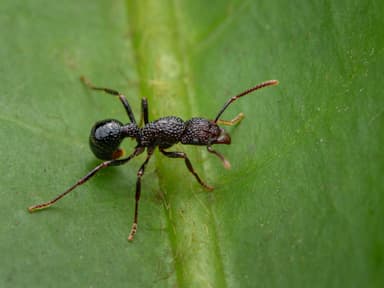
Gnamptogenys
Gnamptogenys menadensis
Nuptial Flight Calendar
Flight months: Apr, May, Jun, Sep, Oct
Care Guide
Gnamptogenys menadensis is a striking yet demanding predatory ant native to the tropical forests of Southeast Asia and northern Australasia, ranging from southern India to Indonesia and the Philippines, with occurrences recorded as far east as New Guinea and the Solomon Islands (Lattke 2004). A member of the poneromorph subfamily Ectatomminae, this species is characterized by its relatively robust, monomorphic workers, which measure between 5.5 and 6.5 mm, while the queen is noticeably larger, spanning 6.5 to 7.5 mm. Colonies are modest, peaking at around 200 individuals, and typically founded by a single queen through a semi-claustral strategy—meaning the new queen must leave the nest to forage for herself while tending her first brood. What makes G. menadensis particularly fascinating to specialist keepers is its active hunting behaviour, its powerful sting, and its position within a genus that is still poorly represented in captivity. Observing their cooperative prey retrieval and the subtle social dynamics of a small, tightly-knit ponerine colony offers a window into ant evolution that more common, mass-recruiting species cannot provide.
This species is unequivocally suited only for expert myrmecologists. The care difficulty rating is driven by their semi-claustral foundation, which demands that a founding queen be provided with live prey and checked regularly without excessive disturbance—a delicate balance that often proves fatal for beginners. Moreover, G. menadensis workers are capable of delivering a memorable sting, so escape-proof housing and cautious handling are mandatory. Colony growth is slow, and sensitivity to humidity fluctuations means that lapses in terrarium maintenance can rapidly lead to brood desiccation or worker death. Anyone drawn to the challenge of keeping a true ponerine hunter, who has experience maintaining stable tropical microclimates and is prepared for meticulous daily feeding routines, will find these ants rewarding. They are not suitable for children, classroom displays, or any low-intervention keepers; rather, they belong in the collections of dedicated enthusiasts who appreciate ants as predators first and foremost.
Creating a suitable artificial habitat requires mimicking the warm, saturated leaf litter of their native range. Nest temperatures should be maintained between 22°C and 28°C, ideally with a gentle gradient that allows the ants to self-regulate. Relative humidity is the most critical parameter and must stay within 70%–90%; even brief drops can cause brood to shrivel and adults to become lethargic. Suitable nest types include poured plaster or aerated concrete (Ytong) designs, as these materials wick moisture evenly and can be kept damp from an external reservoir. A deep layer of coconut coir, peat, or decomposed wood combined with live moss helps buffer humidity and provides a naturalistic substrate for foraging and nesting. The outworld, securely sealed with a tight-fitting lid and a fluon barrier, should offer plenty of hiding spots under bark or leaf litter, because G. menadensis is shy and relies on ambush strategies. Ventilation must be balanced: too little will cause stagnant air and mould, while too much will dry the enclosure. Small ventilation holes covered with fine stainless-steel mesh over a portion of the lid, paired with daily misting, generally maintain the required tropical conditions.
In the wild these ants are formidable predators, and their dietary needs in captivity reflect this. The primary food source is live or freshly killed invertebrates: fruit flies (Drosophila hydei or melanogaster) are ideal for small colonies and founding queens, while small crickets, roach nymphs, and chopped mealworms can be added as the colony grows. Protein is essential for larval development, and workers will hunt cooperatively to subdue prey. A semi-claustral queen must be fed immediately upon arrival, typically accepting a pre-killed fruit fly or a cricket leg placed near her nest entrance every two to three days. Although ponerines are not known to require carbohydrates, a tiny dab of diluted honey or sugar water offered infrequently may be taken by workers as an energy boost, but it should never replace protein. Hydration is equally critical; a water-filled test tube plugged with cotton or a small, escape-proof water feeder must be provided in the outworld, while substrate moisture supplies drinking water within the nest. Remove uneaten prey after 24 hours to prevent mould and mite outbreaks, which can quickly overwhelm a damp tropical setup.
Happily, G. menadensis does not require any form of hibernation or winter diapause. Their tropical origins mean they remain active year-round as long as temperatures stay within the optimal 22–28°C range. There is no need for a cooling period, and attempting to chill them can be lethal. Keepers should therefore plan to maintain stable heating and humidity through all seasons, which may require a thermostat‑controlled heat mat or cable attached to one side of the nest, and a reliable hygrometer to alert you to any drying trends. As colonies mature, they may produce winged reproductives in response to seasonal humidity shifts; nuptial flights in their native Southeast Asia have been noted most frequently during April, May, June, September, and October, often after warm, humid rains, though the precise timing remains poorly documented (AntWiki). In captivity, these alates rarely mate, but their appearance signals a healthy, well-adapted colony.
The first days after acquiring a founding queen or a small incipient colony are the most delicate. If you receive a semi-claustral queen, immediately place her in a small, high-humidity founding chamber—a standard test tube setup with a water reservoir and a few grains of sand for grip works well, but the tube should be inserted into a small outworld where you can offer prey without opening the nest itself. Allow her a few hours of darkness and quiet to settle, then introduce a freshly killed fruit fly or a tiny, disabled cricket leg. Watch closely: she should eagerly accept protein; if she ignores it, remove the food and try again the next day. Once the first workers eclose, they will take over foraging and brood care, and you can gradually increase prey size and frequency. During these early weeks, disturbance is the enemy—keep the colony in a dark, vibration-free spot and resist the urge to check on them more than once a day. Signs of trouble include the queen wandering restlessly, refusing food repeatedly, or workers dragging brood out of the nest, which often indicates insufficient humidity. With precise environmental control and patient, protein-rich feeding, G. menadensis can develop into a wonderfully active small colony, offering a rare glimpse into the life of a truly subtropical hunter.